The founder's playbook for building content that generates inbound leads. A 4-step framework to turn your expertise into a compounding pipeline.
Most founders think content strategy means "post more on LinkedIn." It doesn't.
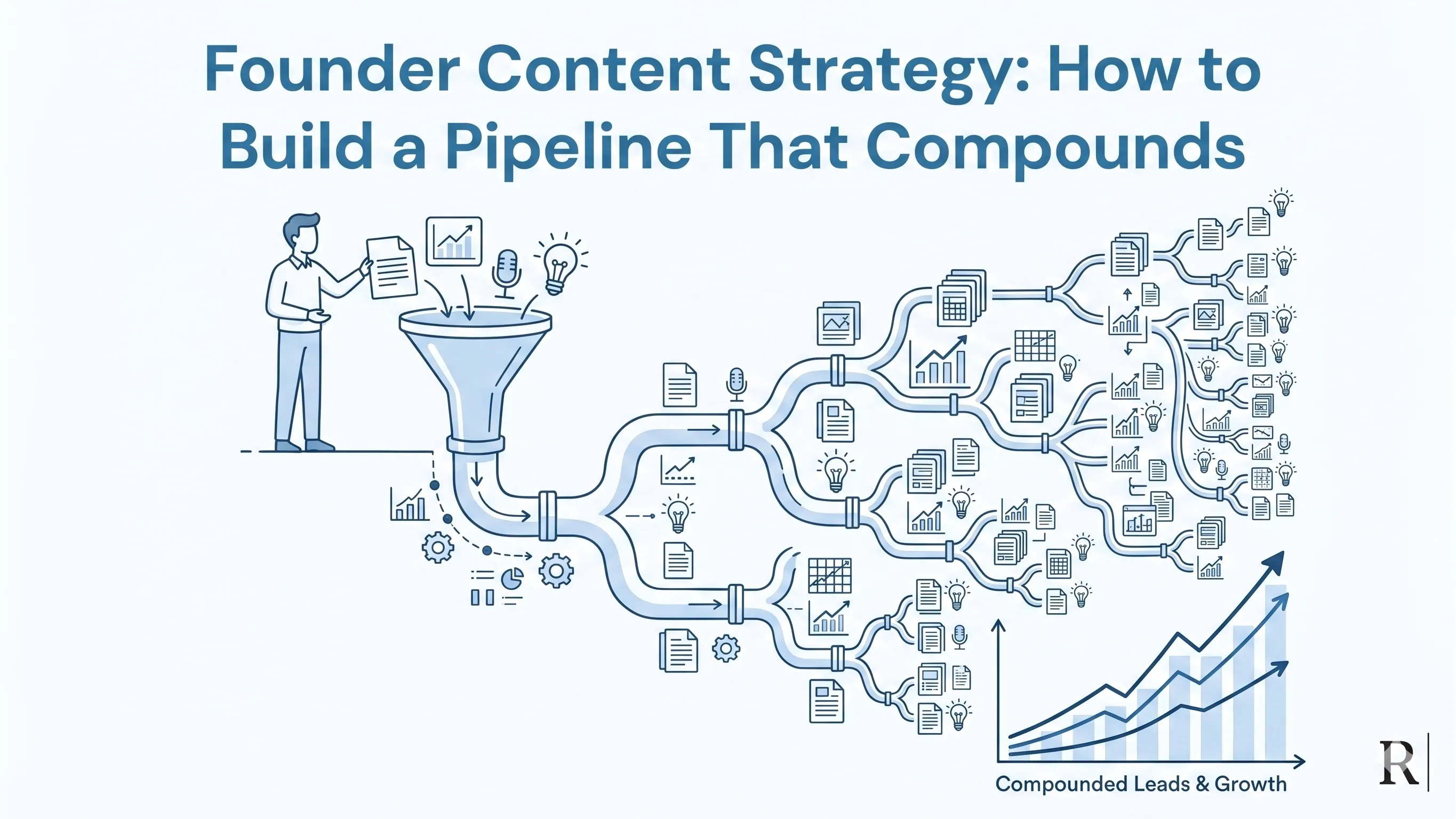
A founder content strategy is a system that turns your expertise into inbound leads on repeat. Not a content calendar. Not a posting schedule. A pipeline that compounds over time, where every piece of content you publish works harder the longer it exists.
The difference between founders who generate consistent inbound leads and those who stay stuck in outbound is simple: they built a content system, not a content habit. And the founders who do this well rarely write everything themselves. They work with a content partner like Rethoric to turn their ideas into assets that rank, resonate, and convert.
Here's how to build one.
Before building a system, it helps to understand why most founder content efforts stall within 90 days.
The first failure mode is inconsistency. Founders start strong, post for two or three weeks, then a fundraise or product sprint takes priority. Content disappears. The audience forgets. You start over from zero.
The second is chasing vanity metrics. Impressions and likes feel good, but they don't close deals. A post that gets 50,000 views but zero qualified leads is a distraction, not a strategy. Founders who optimize for engagement instead of pipeline end up with an audience that watches but never buys.
The third is delegation without direction. Hiring a freelance writer and handing them vague topics produces generic content that sounds like everyone else. Your content strategy needs your perspective baked in, even if someone else does the writing. That's exactly why Rethoric's model starts with capturing your thinking before a single word gets drafted.
A founder content strategy is a repeatable system for turning founder expertise into content that attracts, educates, and converts ideal buyers. It is the difference between posting randomly and building a predictable pipeline of inbound opportunities. Unlike generic content marketing, a founder content strategy leverages the one asset no competitor can replicate: your firsthand experience building the company. When done right, it compounds over time because every piece of content strengthens your authority, improves your search rankings, and gives your audience more reasons to trust you. It works in four stages.
At Rethoric, we call this the Capture, Create, Distribute, Convert framework.
Capture is where you extract the insights that already live in your head. Every conversation with a customer, every investor meeting, every product decision contains content. Most founders let these insights evaporate.
Create is where raw insights become polished content. Blog posts, LinkedIn posts, email sequences, case studies. This is the stage where working with a content partner pays off. You bring the expertise; they handle the craft.
Distribute is where you put that content in front of the right people on the right channels. Not everywhere. Just the two or three platforms where your buyers actually spend time.
Convert is where content drives action. A reader becomes a subscriber. A subscriber becomes a booked call. A booked call becomes a client.
Most founder content efforts only focus on Create and Distribute. They skip Capture (so the content sounds generic) and ignore Convert (so the content never drives revenue). Hit all four, and your content strategy becomes a compounding asset.
Every effective founder content strategy starts with a simple question: what are you uniquely qualified to talk about?
This isn't about picking trending topics or chasing what's popular on LinkedIn this week. Content positioning is the intersection of three things: what your buyers need to understand, what you've learned through firsthand experience, and what your competitors aren't saying.
For most founders, this comes from a specific lens on their industry. Maybe you've built three companies in the same vertical and see patterns others miss. Maybe your product was born from a pain point no one else was solving. That origin story and the thinking behind it is your content positioning.
Write down three to five themes you could talk about for the next 12 months without running out of material. These become your content pillars. Everything you publish should ladder up to one of these pillars, which builds topical authority over time instead of scattering your effort across random topics.
If you're unsure where to start, look at the last 20 questions your prospects asked during sales calls. Those questions are your content roadmap.
The biggest lie in founder-led content is that you need to write for hours every week. You don't. You need a system that captures your thinking efficiently and a partner who turns it into content.
First, build a voice capture habit. Before a single piece gets drafted, the raw material has to exist. Record a five-minute voice memo after every customer call. Save the best Slack messages you send to your team. Screenshot the frameworks you sketch on whiteboards. This takes less than 10 minutes a day and creates months of content fuel.
Second, establish a weekly rhythm. Pick one day per week where you review captured notes and flag the two or three strongest ideas. This is a 20-minute exercise, not a half-day commitment.
Third, work with a content partner who knows how to turn raw thinking into polished, SEO-optimized content. This is what Rethoric does for founders: we take your voice memos, meeting notes, and rough ideas and turn them into LinkedIn posts, blog articles, and thought leadership content that sounds like you wrote it yourself.
The key is that the founder stays in the "thinking" seat, not the "writing" seat. Your time is better spent having insights than formatting blog posts.
Not all content channels deliver the same returns. For founders building pipeline, two channels matter most: LinkedIn and your blog (powered by SEO).
LinkedIn is your awareness engine. It puts your thinking in front of your network and their networks. A strong LinkedIn presence builds trust quickly because people see your face, your name, and your perspective in their feed every day. If you're starting from scratch, our guide on how to grow LinkedIn followers as a founder breaks down the exact steps. The challenge is that LinkedIn content has a short shelf life. A post that performs well today is invisible in 48 hours.
Understanding how LinkedIn distributes content matters too. LinkedIn replaced its algorithm with 360Brew in Q4 2025, a model that reads your profile before deciding who sees your posts. Our guide on the LinkedIn 360Brew algorithm breaks down exactly what changed and how to adapt.
That's why you pair LinkedIn with SEO-driven blog content. Blog posts and articles that rank on Google keep working for months and years. While your LinkedIn post from last Tuesday is buried, your blog post on LinkedIn growth strategy is still generating traffic and leads six months later.
The compounding effect happens when these two channels reinforce each other. Publish a blog post, then break it into three or four LinkedIn posts throughout the month. Each LinkedIn post drives traffic back to the blog. The blog captures search traffic that never saw your LinkedIn. Together, they build a flywheel that gets stronger over time. For a deeper look at making LinkedIn work as a distribution channel, read our guide on how to grow your network on LinkedIn.
Rethoric clients typically see this compounding effect kick in around month four, when organic search traffic starts supplementing their LinkedIn-driven pipeline.
Content that doesn't convert is just journalism. Here's how to make your content strategy drive actual revenue.
Every piece of content should have a next step for the reader. Not a hard sell. A natural progression from "that was helpful" to "I want more." This means including relevant calls to action in every article and post.
For awareness-stage content (broad industry topics, trend analysis), the next step is a newsletter signup or free resource. You're asking for a small commitment: an email address in exchange for ongoing value.
For consideration-stage content (how-to guides, comparison posts, strategy breakdowns), offer something more specific. A template, a checklist, or a free audit. This is where you qualify interest. Someone who downloads your content strategy template is a warmer lead than someone who just read a blog post.
For decision-stage content (case studies, ROI breakdowns, service comparisons), link directly to a consultation or demo. If someone is reading about ghostwriting services for founders, they're already evaluating options. Make it easy to take the next step.
The content-to-pipeline path at Rethoric follows this exact sequence: a founder discovers a blog post through Google, subscribes to the newsletter, reads two or three more articles, then books a free content strategy call. No cold outreach. No paid ads. Just content doing the work.
Founder-led content isn't a "nice to have" anymore. The data makes a clear case for why every founder should treat content as a core growth channel.
B2B companies with a documented content strategy are three times more likely to report success than those without one, according to the Content Marketing Institute. Despite this, 40% of B2B marketers still don't have a documented strategy, which means the bar to stand out is lower than you'd think.
The economics are compelling. Content marketing generates roughly three times the leads per dollar spent compared to paid search for B2B companies with established programs. And 78% of CMOs plan to increase content marketing investment in 2026, signaling that this isn't a trend. It's the new baseline.
On the consumption side, 64% of target buyers spend more than one hour per week consuming thought leadership content, according to LinkedIn's research. Your buyers are actively looking for the kind of expertise you have. The question is whether they're finding it from you or from your competitors.
Companies that publish 16 or more blog posts per month generate 3.5 times more traffic than those publishing fewer than four. You don't need to hit 16, but consistency matters. Even four to six well-crafted posts per month can move the needle significantly when paired with active LinkedIn distribution.
The 90-10 rule applies here: 90% educational value, 10% promotional. Founders who lead with genuine insight and save the pitch for the right moment build audiences that actually convert.
At some point, every founder asks: should I just hire a marketer?
The honest answer is that it depends on your stage and budget. A full-time content marketing hire costs $70,000 to $120,000 per year in salary alone, plus tools, management time, and a three-to-six-month ramp before they're producing at full speed. For a seed-stage or Series A founder, that's a significant commitment with a delayed payoff.
The alternative is working with a content partner who specializes in founder-led content. This is the model Rethoric was built around. Instead of hiring a generalist marketer who needs to learn your industry, you work with a team that already understands how to capture founder expertise and turn it into content that ranks and converts.
The cost is typically a fraction of a full-time hire, the ramp time is measured in weeks instead of months, and you maintain full control over your content voice and strategy.
If you eventually scale to the point where a full-time hire makes sense, the content library and SEO foundation you built with a partner like Rethoric becomes the playbook your new hire inherits. One Rethoric client went from zero organic traffic to 15 qualified inbound calls per month within six months of launching their founder content system. Either way, the content compounds.
For a deeper look at the delegation model, read our guide on ghostwriting for founders.
Here's a practical roadmap to go from zero to a functioning founder content strategy in 90 days.
During weeks one through four, focus on foundation. Define your three to five content pillars. Set up your voice capture system. Audit your existing content (if any) and identify gaps. Choose your primary channels (LinkedIn plus blog is the recommended starting point). If you're working with Rethoric, this is where we run your content positioning workshop.
During weeks five through eight, focus on publishing. Start your weekly content rhythm: one blog post and three to four LinkedIn posts per week. Prioritize topics your buyers are actively searching for. Add calls to action to every piece. Build your email list from day one.
During weeks nine through twelve, focus on optimization. Review what's working. Double down on topics and formats that drive engagement and leads. Update and improve your best-performing content. Start building internal links between your articles to strengthen your SEO foundation. Measure pipeline metrics, not just traffic.
By the end of 90 days, you'll have a content library of 8 to 12 blog posts, 30 or more LinkedIn posts, and a system that produces content consistently without eating your entire week.
A founder content strategy isn't about becoming a full-time creator. It's about building a system that turns your expertise into a compounding pipeline of inbound leads.
The founders who start now will have a 12-month head start on everyone else still relying on cold outreach and paid ads. The ones who pair their expertise with a content partner like Rethoric will get there faster.
Book a free content strategy call with Rethoric and we'll map out your content positioning, channel strategy, and 90-day plan in 30 minutes.
Use customer questions, product decisions and lessons from building the company as source material. Choose what is useful to your buyer and safe to share, then connect each topic to a clear next step. For interview-led writing and ongoing publishing support, explore LinkedIn ghostwriting for SaaS founders.
