Founder-led marketing works when founder expertise becomes a repeatable content and distribution system, not random posts or delegated AI slop.
Founder-led marketing is not a founder posting whenever they have a launch, a thought, or a spare 20 minutes.
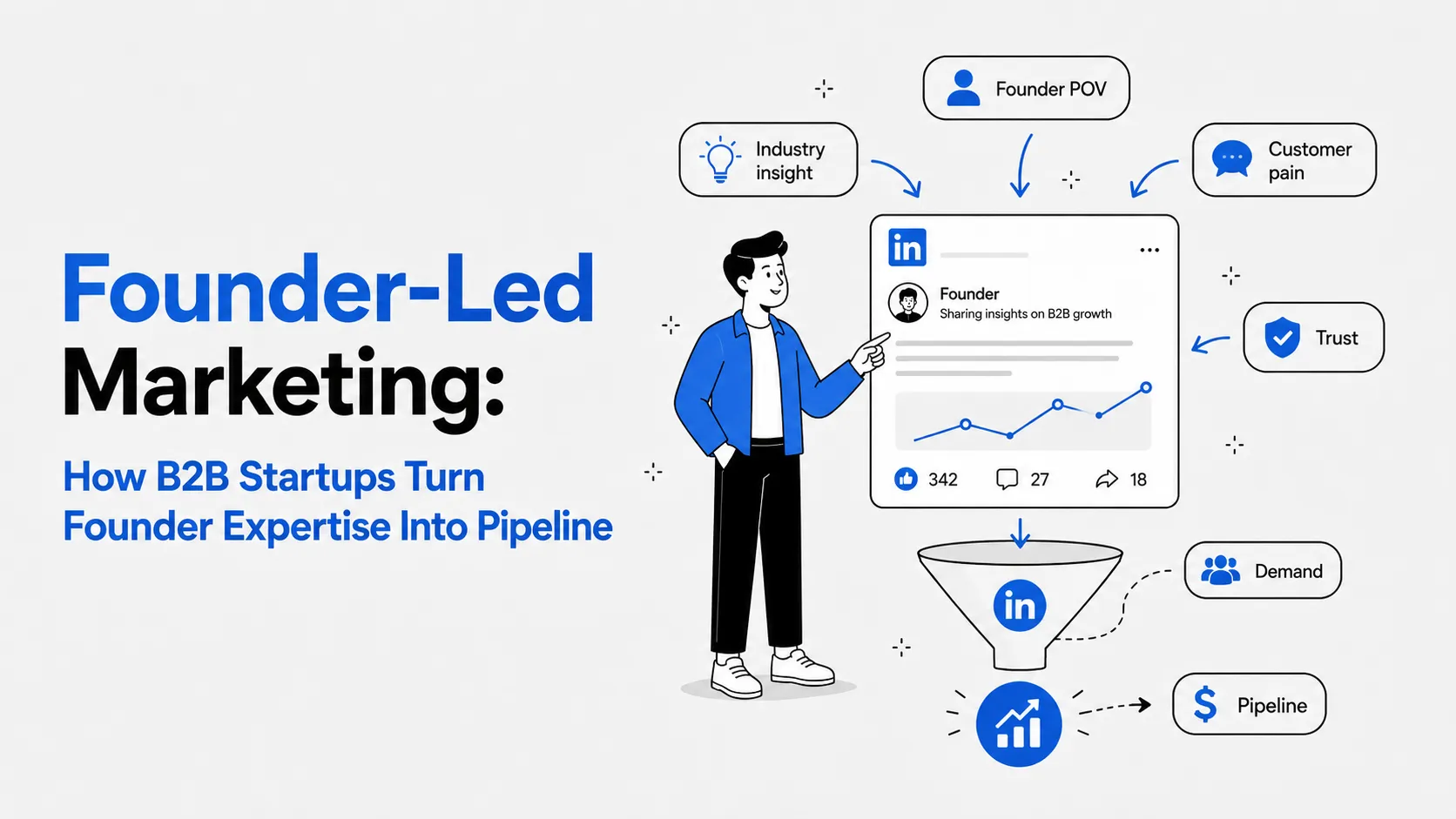
It is a system for turning the founder's expertise, customer insight, category point of view, and hard-won lessons into distribution that builds trust before the first sales call.
That distinction matters. Most B2B startups do founder-led marketing badly because they treat it like a content task. Write a post. Approve a caption. Share a funding announcement. Move on.
The founders who make it work treat it like a growth channel. They capture the thinking that already happens inside the business, turn it into sharp content, distribute it through the founder profile, and connect it back to pipeline.
That is the difference between sounding visible and becoming trusted.
Founder-led marketing is the practice of using the founder's expertise and public point of view to create demand, build trust, and move buyers closer to action.
It is not the same thing as personal branding. Personal branding is often about recognition. Founder-led marketing is about commercial trust.
The founder is not posting to become internet famous. The founder is posting because buyers, investors, partners, and future hires want to understand how the company thinks before they commit attention, budget, or reputation.
In a B2B market where every company can publish generic content, the founder's lived experience is the part competitors cannot clone. The sales calls. The product tradeoffs. The customer objections. The market lessons. The unpopular beliefs. The moments where the company chose one path and rejected another.
That is the raw material.
A strong founder-led marketing system turns that raw material into:
If you already have a founder content strategy, founder-led marketing is the go-to-market layer around it. It connects the content system to distribution, trust, and pipeline.
Early and growth-stage B2B companies do not win because the market fully understands them. They win because a small group of high-intent people starts to trust their judgment before everyone else catches up.
That trust rarely starts with a company page.
It starts with a person.
Buyers want to know what the founder sees that others miss. Investors want to know whether the founder has a sharp read on the category. Future employees want to know whether the company has conviction or just a roadmap. Partners want to know whether the team is credible enough to bet on.
Founder-led marketing gives all of those audiences a clearer signal.
It also solves a practical distribution problem. Company content often feels sanitized. Founder content can be specific, opinionated, and context-rich. That does not mean reckless. It means the content carries a real point of view instead of sounding like it was approved by five departments.
For Series A and later B2B startups, this becomes especially important. Paid ads get more expensive. Cold outbound gets noisier. PR is sporadic. The founder's LinkedIn presence becomes one of the few channels where credibility and distribution can compound together.
That is why the question is not whether the founder should be visible. The question is how to make that visibility operational without turning the founder into a full-time creator.
The fastest way to ruin founder-led marketing is to outsource the voice before anyone has captured the thinking.
This is where generic AI slop and cheap ghostwriting usually fail.
A writer cannot invent a founder's judgment. A tool cannot guess the nuance behind a product decision. A content calendar cannot create conviction where the input is a vague topic like "share thoughts on the market."
The founder does not need to write every word. But the founder does need to supply the substance.
That substance usually already exists. It is hiding in places like:
The system should capture those moments, not ask the founder to stare at a blank page every week.
This is why the best founder-led marketing process starts with extraction. Voice memos. Interview calls. Meeting notes. Draft approvals. Short comments from the founder that sharpen the argument.
Once the thinking is captured, a strong content team can turn it into publishable work. Without that capture layer, the output may be polished, but it will not sound earned.
A founder-led marketing system needs four parts: capture, shape, distribute, and convert.
Miss one, and the channel becomes inconsistent. Hit all four, and the founder's expertise starts working even when the founder is not actively posting.
The capture layer is where ideas enter the system.
Do not start with a list of post topics. Start with the places where the founder is already useful. Sales calls, customer interviews, investor conversations, product reviews, board prep, and internal debates are all better inputs than trend lists.
A simple weekly capture process is enough for most founders:
The goal is not to create more work. The goal is to stop letting valuable thinking disappear.
Raw expertise needs structure before it becomes useful content.
For founder-led marketing, the strongest formats usually include:
These formats prevent the founder from sounding random. They also make approval easier because everyone knows what kind of argument the piece is trying to make.
If the content is mostly for LinkedIn, pair these formats with a clear LinkedIn content strategy for founders. The point is not just to post more. The point is to build repeated market memory around a few ideas the founder wants to own.
Distribution is where most B2B teams underuse the founder.
They publish a company blog post, share it once from the company page, and wonder why nothing happens.
The founder profile should be the first distribution layer because people follow people before they follow companies. A single founder post can create conversation, reach second-degree networks, and surface the company's point of view in a way a brand post usually cannot.
But distribution is not only posting. It also includes strategic commenting, replying to thoughtful comments, sending useful follow-ups, and turning strong posts into longer assets.
A practical weekly rhythm looks like this:
This is where a platform and workflow matter. Without calendars, approvals, reminders, scheduling, and analytics, founder-led marketing becomes a recurring fire drill.
Founder-led marketing should create trust, but trust still needs a path.
Every content system needs conversion points. Not aggressive pitches in every post. Clear next steps for readers who are already leaning in.
Those next steps can include:
The best conversion path depends on the reader's stage. Someone reading a broad founder-led marketing guide may need education. Someone reading a LinkedIn ROI breakdown may be closer to evaluating whether the channel is worth operationalizing.
The job of the system is to meet both without forcing every reader into the same CTA.
At some point, the founder asks a reasonable question: should we just hire someone in-house?
Sometimes, yes. But hiring a content marketer does not automatically solve founder-led marketing.
A marketer can manage calendars, briefs, analytics, publishing, and repurposing. Those are important. But the hard part is still extracting the founder's specific judgment and translating it into content that buyers trust.
If the founder is unavailable, the marketer becomes a guesser. If the marketer is too junior, the content becomes generic. If the process lacks approvals, the founder becomes a bottleneck. If the company hires before the strategy is clear, the new hire inherits chaos.
For many Series A+ founders, the better move is to build the system first:
Then decide whether to run it with an in-house hire, an agency partner, or a hybrid model.
This is the gap a ghostwriting system for founders can close when it is done correctly. The point is not to fake the founder's voice. The point is to make the founder's thinking easier to ship.
LinkedIn is usually the best starting point because the audience is already professional, searchable, and commercially relevant.
For B2B founders, LinkedIn does three jobs at once.
First, it builds familiarity with buyers before they enter an active evaluation. Second, it gives investors and partners a public record of how the founder thinks. Third, it creates a distribution surface for blog posts, product narratives, hiring stories, and category opinions.
But LinkedIn should not be isolated from the rest of the content engine.
The best founder-led marketing systems connect LinkedIn to SEO, sales, and employee distribution. A founder post can become a blog section. A blog post can become five LinkedIn posts. A strong comment thread can become a sales objection asset. A company-wide amplification system can turn one founder point of view into broader market reach.
That is why LinkedIn employee advocacy works best when it starts with a founder-led point of view. The team should not be forced to amplify generic company updates. They should be given sharp ideas worth sharing.
Founder-led marketing is easy to undervalue if you only measure the final click.
The channel often creates demand before the buyer is ready to be tracked. Someone sees the founder's post, recognizes the name later, reads a blog post, asks a peer about the company, and eventually comes inbound through search or direct traffic.
That does not mean measurement is impossible. It means the scoreboard needs to match the channel.
Track these signals:
The last metric matters more than most teams think. A founder-led content engine that cannot get approvals will not compound. The operational layer is part of the strategy.
You do not need a huge campaign to start. You need a repeatable operating rhythm.
Define the three to five ideas the founder wants to own. Audit the founder's LinkedIn profile, existing content, sales calls, and strongest customer proof. Set up a weekly interview or voice-note workflow. Decide which content requires founder review and which content can be approved by the team.
By the end of the first month, the team should have a backlog of founder-sourced ideas and a clear point of view.
Start publishing consistently. For most founders, that means two to three LinkedIn posts per week, one longer asset every one to two weeks, and a daily comment habit focused on buyers, investors, partners, or category peers.
Use a content calendar, not a spreadsheet graveyard. Every piece should have a theme, owner, status, approval step, and scheduled date.
Review what is creating the right conversations. Look at comments, DMs, profile views, sales-call mentions, and traffic to linked assets. Turn strong posts into longer articles. Turn common objections into new content. Add internal links between related pieces so the content library starts to compound.
This is where founder-led marketing becomes more than posting. It becomes a learning loop between the market and the company.
Founder-led marketing works because the founder is often the clearest signal a B2B startup has.
Not the logo. Not the tagline. Not the company page. The founder's judgment.
The mistake is assuming that judgment has to be manually written from scratch every week. It does not. It needs to be captured, shaped, distributed, approved, and measured through a system that respects the founder's time.
That is what Rethoric is built for: founder-led LinkedIn content with the strategy, workflows, approvals, scheduling, engagement, and analytics needed to keep the engine running without turning the founder into the content team.
If you want your expertise to become a growth channel instead of another unfinished task, book an intro call with Rethoric. We will map the first 90 days of your founder-led marketing system and show where LinkedIn can start creating pipeline.
