Founder thought leadership is not a branding exercise. It is the pipeline asset that shortens sales cycles by 23%, reaches buyers cold outbound cannot, and makes the first sales call a confirmation rather than a pitch.
73% of B2B decision-makers say thought leadership from a named individual is more trustworthy than any marketing material their company produces. That number comes from the Edelman-LinkedIn B2B Thought Leadership Impact Report, and most founders have not acted on it.
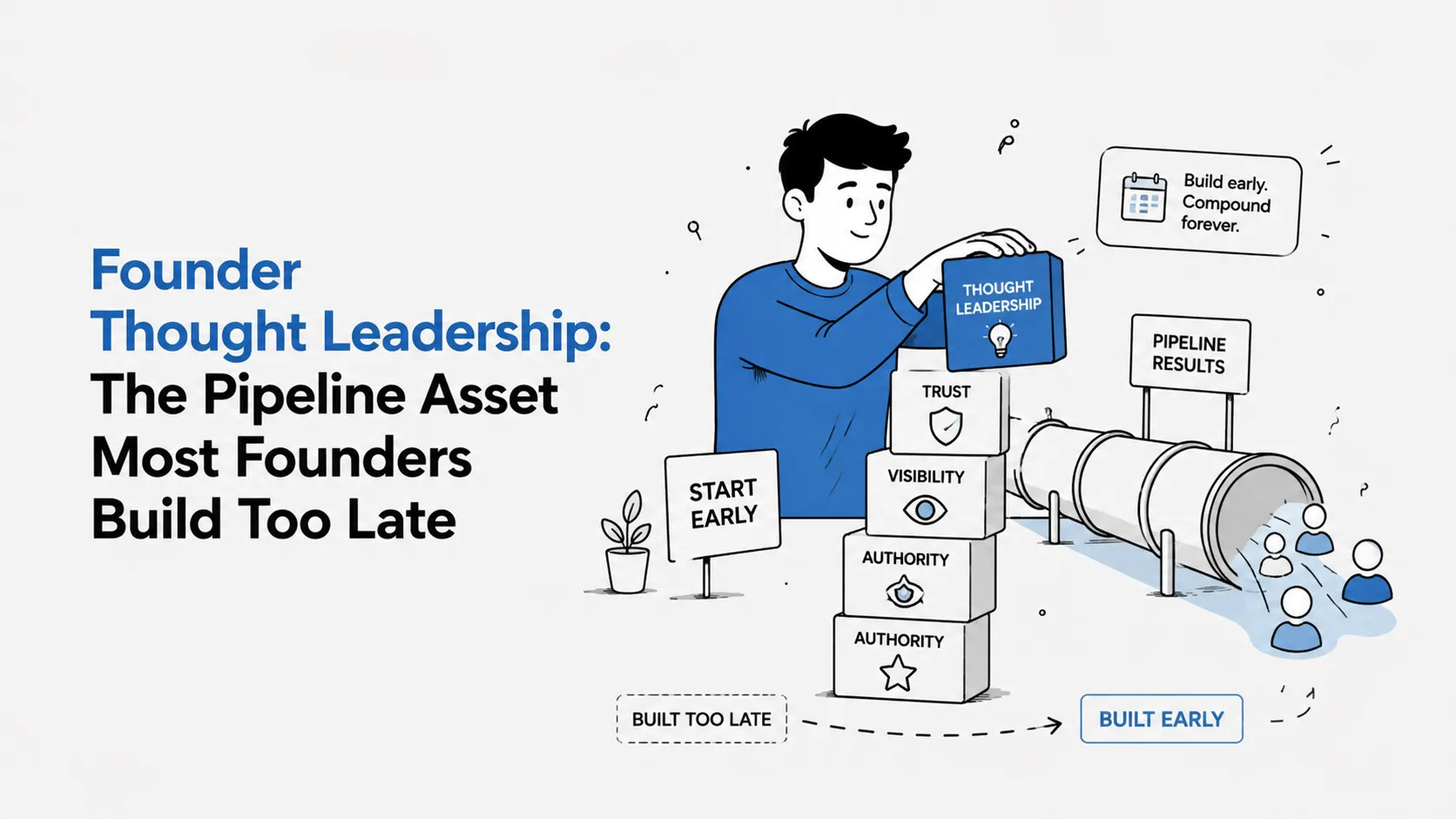
Founder thought leadership gets treated as a long-term brand play. Something to work on after the product is stable, the team is built, the pipeline is full. The data says that is backwards. Thought leadership is not the output of a successful company. It is one of the inputs. It is what makes buyers arrive at your sales call already warm, already trusting, already sold on your perspective.
This post covers what the research actually shows about founder thought leadership, why most founders get the definition wrong, and how to build a system that generates pipeline over time.
Founder thought leadership is the consistent public development of a specific perspective on a defined set of problems, published under the founder's name, with the goal of building credibility with buyers, investors, and peers before any sales conversation starts. It is not frequent posting, credential display, or resharing industry news. The test is simple: if a buyer reads six months of your LinkedIn content, they should know exactly how you think about two or three specific problems, not just that you are experienced. Thought leadership differs from personal branding in scope: personal branding is the broader system of how you present expertise across channels, while thought leadership is the content itself, the specific opinions and frameworks that give buyers a reason to trust your judgment. When built correctly, founder thought leadership functions as pre-sales infrastructure. It answers objections before they are raised, establishes context before the first call, and builds the trust that shortens the buying cycle.
For a closer look at how personal branding and thought leadership interact, see personal branding for founders: the stats that should change your strategy.
The ROI of founder thought leadership is measurable and well-documented. Executives whose companies have strong thought leadership programs report 23% shorter sales cycles due to pre-established trust and credibility, according to Gartner research via Phantom IQ. Published executives generate three times more inbound opportunities than non-published peers. 95% of hidden buyers, the finance, legal, and procurement stakeholders who influence decisions without being visible in the sales process, say strong thought leadership makes them more receptive to sales and marketing outreach. The mechanism is trust acceleration: a buyer who has read a founder's thinking for six months arrives at a sales conversation with objections already answered and context already established. That is why inbound leads generated through thought leadership content close at 14.6%, compared to 1.7% for cold outbound, an 8.6x difference documented in Linkboost's 2026 State of LinkedIn. The ROI is not hypothetical. It is documented across deal size, sales cycle length, and pipeline volume.
More data points worth knowing:
For a deeper breakdown of how these numbers translate into LinkedIn revenue, see LinkedIn ROI for founders.
The most common mistake founders make is equating thought leadership with output volume. Post three times a week, the advice goes, and you will become a thought leader. That is not how it works.
Thought leadership is earned through specificity and repetition of a perspective, not repetition of publishing. A founder who posts daily about a rotating mix of productivity tips, company updates, industry news, and motivational takes is not building thought leadership. They are building noise. The buyer reading their feed cannot tell what the founder actually believes about the problems that matter.
The founders who build genuine thought leadership do something different. They pick one or two specific problems their buyers face. They develop a perspective on those problems that is not consensus. They publish that perspective consistently, in different formats and with different examples, until their name becomes associated with a specific way of thinking about those problems.
That is the asset. Not the follower count. Not the impressions. The association in the buyer's mind between a problem they have and your perspective on how to solve it.
Step 1: Define a one-sentence positioning. Before publishing a single post, answer this: what specific problem do I help a specific person solve? That answer should appear in your LinkedIn headline, your About section, and the themes you return to every week. Without it, your content has no gravitational center.
Step 2: Choose three to five content pillars. Thought leadership is not random. Pick three to five recurring themes that align with your positioning and rotate through them. For a B2B SaaS founder, those might be: product decisions, sales cycle patterns, hiring lessons, go-to-market failures, and category positioning. Every post should connect to one of those pillars.
Step 3: Use the earned opinion format. The most effective thought leadership posts follow a simple arc: here is what most people believe, here is what I discovered through direct experience, here is the implication for you. This structure signals that the founder has done the thinking, not just the reading.
Step 4: Publish at minimum effective volume. The TopRank Marketing 2026 State of B2B Thought Leadership report identifies consistency as the primary driver of thought leadership credibility. Two to three posts per week is the minimum for compounding effects to activate on LinkedIn. Below that threshold, the algorithm does not accumulate enough signal to distribute content to target audiences reliably.
Step 5: Build the conversation loop. Thought leadership builds through conversation, not broadcast. Ten or more targeted comments per day on posts from your ICP drives 30 to 40% of total profile visibility, according to Windmill Growth's 2026 LinkedIn research. Founders who combine consistent posting with active engagement see two times more inbound messages than those who only post.
For a full breakdown of how to structure this system week over week, see founder content strategy: how to build a pipeline that compounds.
Founder thought leadership generates pipeline through a mechanism called trust acceleration: buyers who have consumed a founder's content before any sales interaction arrive already familiar with the founder's perspective, already confident in their expertise, and already primed to buy. The Edelman-LinkedIn data shows that 75% of B2B decision-makers say a specific piece of thought leadership led them to research a product or service they had not previously considered. 55% use thought leadership content to vet organizations they are actively considering hiring. 86% say they would invite organizations with strong thought leadership into RFP processes those organizations would not otherwise be invited to join. For founders, the practical implication is straightforward: a consistent thought leadership presence means that by the time a buyer reaches your sales call, the hardest part of the sale is already done. The content has already answered the objections, established the credibility, and built the trust. The call is a confirmation, not a pitch.
The compounding effect works on two timelines. In the short term, each post expands your reach within a specific audience segment. In the long term, the body of work becomes searchable, linkable, and citable. Buyers who find you through a Google search six months from now will read posts you wrote last quarter. Every piece of content adds to the archive that makes you discoverable and trustworthy to buyers who have never met you.
For the LinkedIn growth system that makes this sustainable over six months and beyond, see LinkedIn growth strategy for founders.
Does thought leadership work for early-stage founders? Yes, and earlier is better for one reason: compounding. A founder who builds a recognized perspective in their domain over two years before a fundraise has a fundamentally different conversation with investors than one who starts cold. The same applies to sales. Buyers who have been reading your thinking for six months arrive at a demo already trusting you. Starting late means the asset is not built by the time you need it most.
How is thought leadership different from content marketing? Content marketing is typically company-owned, product-adjacent, and written to drive organic search traffic. Founder thought leadership is personal, perspective-driven, and written for a specific professional audience on platforms where they spend time. Content marketing builds site traffic. Thought leadership builds individual trust. The two are complementary but not interchangeable, and thought leadership is what enables the trust transfer that content marketing alone cannot produce.
Can a ghostwriter produce genuine thought leadership? Yes, when the process is right. The founder's expertise, perspective, and specific experiences need to be the source material. What a ghostwriter provides is structure, editorial polish, and the consistency most founders cannot sustain while running a company. When done correctly, the output reflects the founder's actual thinking in a more refined form. See how ghostwriting for founders works when the process is built around capturing the founder's voice, or see our guide to finding a ghostwriter for executives.
How long before founder thought leadership produces pipeline? Most founders see the first leading indicators at 60 to 90 days: profile views from target buyers increase and inbound message quality improves. Tangible pipeline impact typically appears between months four and six. The mechanism is trust accumulation, not viral distribution. Most founders give up before month three, which is precisely when the compounding is about to begin.
The research on founder thought leadership is not subtle. Buyers trust it more than marketing. It shortens sales cycles. It reaches buyers that cold outbound cannot. And it keeps working after you stop creating it.
The cost of ignoring it is real: 23% longer sales cycles, missed RFP invitations, and buyers who never connect your name to the problem they are trying to solve.
If you want help building a thought leadership system that compounds over time, see how Rethoric works with founders.
