A practical guide to hiring a ghostwriter for executives: what to look for, what separates voice-matched pipeline content from generic posts, the seven questions to ask before signing, and what to expect in the first 90 days.
52% of C-suite executives and senior decision-makers spend at least one hour per week reading thought leadership content on LinkedIn. The buyers you are trying to reach are already on the platform, already consuming content, already forming opinions about who is worth a conversation.
The challenge is producing that content consistently while running a company. Most executives have the expertise. They do not have the hours. That is the case for hiring a ghostwriter for executives: not to put words in your mouth, but to get your actual thinking in front of the right people on a schedule that does not require you to write every week.
This guide covers what executive ghostwriting is, what it costs, what separates good providers from generic ones, and what to expect in the first 90 days.
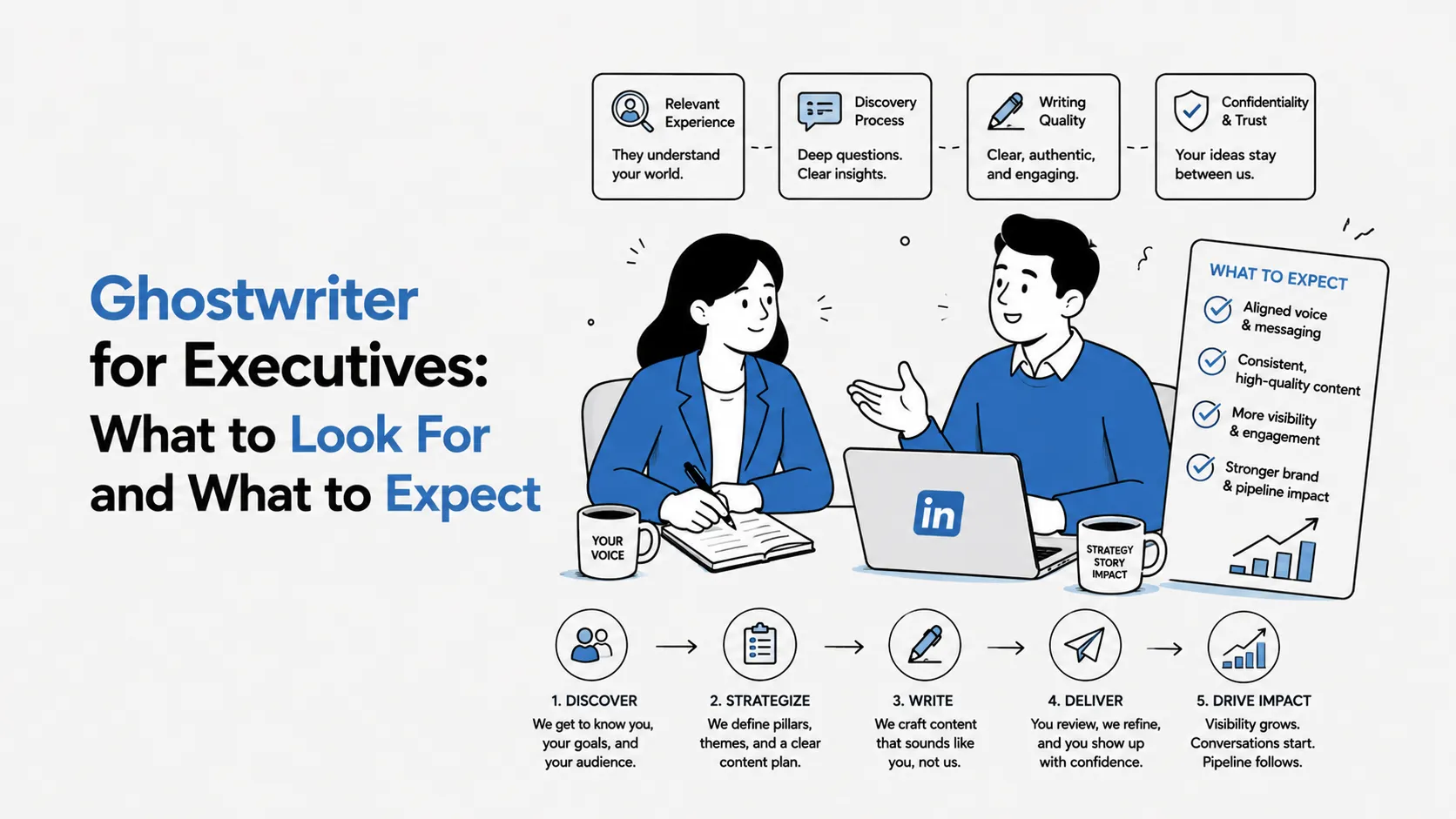
A ghostwriter for executives is a professional content writer who creates LinkedIn posts, articles, and other thought leadership content published under the executive's name, using the executive's expertise, perspective, and experience as source material. The ghostwriter's contribution is structure, voice matching, consistency, and platform strategy: deciding what to say, when to say it, and how to format it for the LinkedIn algorithm. What distinguishes executive ghostwriting from general content writing is the emphasis on voice accuracy: the content must read as the executive, not as a generic professional or a marketing department. The source material comes from interviews, voice memos, call recordings, and documented frameworks. Rates for LinkedIn-specific executive ghostwriting typically range from $1,500 to $5,000 per month depending on output volume, writer seniority, and whether content strategy is included. Full-service packages covering LinkedIn, blog, and email start at $4,000 per month. The investment is justified when the executive's visibility directly supports pipeline, enterprise deals, or fundraising.
For a fuller picture of how ghostwriting works from end to end, see ghostwriting for founders: how to build a content engine without writing a word.
The executive case for ghostwriting is different from the founder case. Founders hire ghostwriters primarily because writing is not their highest-leverage activity. Executives hire ghostwriters for that reason, plus one more: their visibility has a direct multiplier effect on enterprise deals, board relationships, and recruiting.
The research is specific about how this works. Edelman-LinkedIn data shows that 52% of C-suite buyers spend over an hour per week reading thought leadership on LinkedIn. 73% of B2B decision-makers trust content from named executives more than any marketing material the company produces. 67% of B2B buyers research executives before meetings. A visible, credible executive presence on LinkedIn means buyers arrive at sales conversations already familiar, already trusting, already warm.
The gap between what that presence is worth and how much time it costs to build is exactly where a ghostwriter for executives creates value.
Executive ghostwriting's pipeline impact follows a documented pattern. Inbound leads generated through consistent LinkedIn content close at 14.6% compared to 1.7% for cold outbound, an 8.6x difference according to Linkboost's 2026 State of LinkedIn. Executives using professional ghostwriting services report an average of 12 to 18 qualified inbound inquiries per month after 90 days of consistent posting at 3 to 5 times per week. The mechanism is the same as for founder-led content: buyers who have consumed an executive's thinking before any sales interaction arrive already familiar with their perspective, already trusting their judgment. ConnectSafely's 2026 analysis puts the average ROI for LinkedIn ghostwriting at 340 to 540%, calculated against a monthly investment of $1,500 to $2,500. The critical variable is content quality: generic ghostwritten content produces minimal pipeline. Content that is genuinely expertise-driven, built from the executive's actual experience and specific point of view, is what creates the trust transfer that converts.
For a detailed breakdown of how LinkedIn content translates into revenue, see LinkedIn ROI for founders.
Four criteria separate ghostwriters who produce pipeline from those who produce content.
Voice matching process. The best ghostwriters have a documented system for capturing how you speak and think: intake interviews, analysis of existing writing and communication samples, early drafts you refine together, and ongoing calibration over the first four to six weeks. If a writer claims they can produce content in your voice from a single onboarding call, that is a red flag.
ICP alignment. Good ghostwriting for executives starts from the same place your sales team starts: who are you trying to reach, what problems do they have, and what do they need to believe before they will buy from you? A ghostwriter who cannot explain how your content connects to your target buyer is writing for engagement, not pipeline.
Pipeline evidence over engagement metrics. Follower counts and impression numbers are easy to inflate. Ask for case studies that include conversion data: inbound lead volume, deal influence, or sales cycle changes attributable to LinkedIn content. If the only metrics a ghostwriter can point to are likes and views, they are optimizing for the wrong outcomes.
Industry familiarity. A ghostwriter working with a fintech executive needs to understand the difference between compliance requirements and product limitations. One working with a healthcare executive needs to know how procurement cycles differ from commercial sales. Deep practitioner knowledge is not required, but enough to ask the right questions and write with authority is not optional.
The seven questions worth asking any ghostwriter for executives before signing are: How do you learn my voice beyond a kickoff call? What inputs do you need from sales calls or customer conversations? How do you decide what topics are worth posting about? How do you handle comments and inbound DMs after posts go live? What happens if I disagree with the tone or angle? Who owns the content system if your writer leaves? And: Can you show me samples from three different clients that sound like three clearly different people? That last question is the most diagnostic. If all portfolio samples use the same structure, the same sentence rhythm, or the same motivational tone, the writer is not doing voice matching. They are applying a template. Good ghostwriting for executives produces content that sounds like the executive, not like a ghostwriter's default voice. If they answer in abstractions on any of these questions, keep looking.
For a comparison of ghostwriting approaches and how to decide between a full-service agency and a hybrid model, see LinkedIn ghostwriting vs. DIY: what actually drives pipeline.
The first 30 days of working with a ghostwriter for executives produce almost no visible signal. This is normal. The algorithm needs consistent posting to learn your topic area, and the audience needs time to associate your name with a specific problem domain. Executives who evaluate the strategy at four weeks and conclude it is not working are quitting before the compounding has started.
At 60 to 90 days, most executives see the first leading indicators: profile views from target buyers increase, inbound message quality improves, and content begins reaching people outside the immediate network. Posts start getting shared into relevant professional communities without any seeding from the executive.
Tangible pipeline impact, meaning inbound leads traceable to LinkedIn content, typically appears between months four and six. Among professionals actively running a personal brand content program, 80% report receiving inbound leads within six months (Gitnux). The executives who reach that outcome are almost always the ones who stayed consistent through the first three months when nothing appeared to be happening.
Is executive ghostwriting ethical? Yes. Ghostwriting is a centuries-old professional practice used across books, speeches, columns, and content at every level. On LinkedIn, it is widely practiced and accepted. The only requirement is that the content reflects the executive's actual expertise and perspective, not fabricated opinions or positions they do not hold. When done correctly, ghostwriting for executives produces content that is more refined and consistent than the executive would produce alone, while remaining authentically theirs in terms of the ideas and point of view.
How much time does an executive need to invest? The hybrid model most executives use requires 15 to 20 minutes per week for idea capture, 30 minutes per week for post review and approval, and 10 to 15 minutes per day for direct engagement on LinkedIn. The ghostwriter handles everything else. Total executive time: under two hours per week.
How is a ghostwriter for executives different from a marketing team? A marketing team produces company-branded content for the company's channels. A ghostwriter for executives produces content attributed to a specific individual, building personal credibility that the company cannot build for itself. Personal profiles generate 8 to 10 times more engagement than company pages on LinkedIn. The two are complementary, not interchangeable.
A ghostwriter for executives is not a shortcut to thought leadership. It is a production system that makes consistent thought leadership possible without requiring the executive to write every word themselves.
The expertise, the perspective, and the experience still have to come from you. What the ghostwriter provides is the structure, the consistency, and the editorial layer that turns what is in your head into content that compounds in front of the right audience.
For more on how thought leadership connects to personal brand and pipeline, see founder thought leadership: the pipeline asset most founders build too late.
To see how Rethoric approaches executive ghostwriting, get in touch.
