LinkedIn ghostwriting vs. DIY: a data-driven breakdown of which approach actually produces pipeline, where each one wins, and how to decide based on your time, budget, and stage.
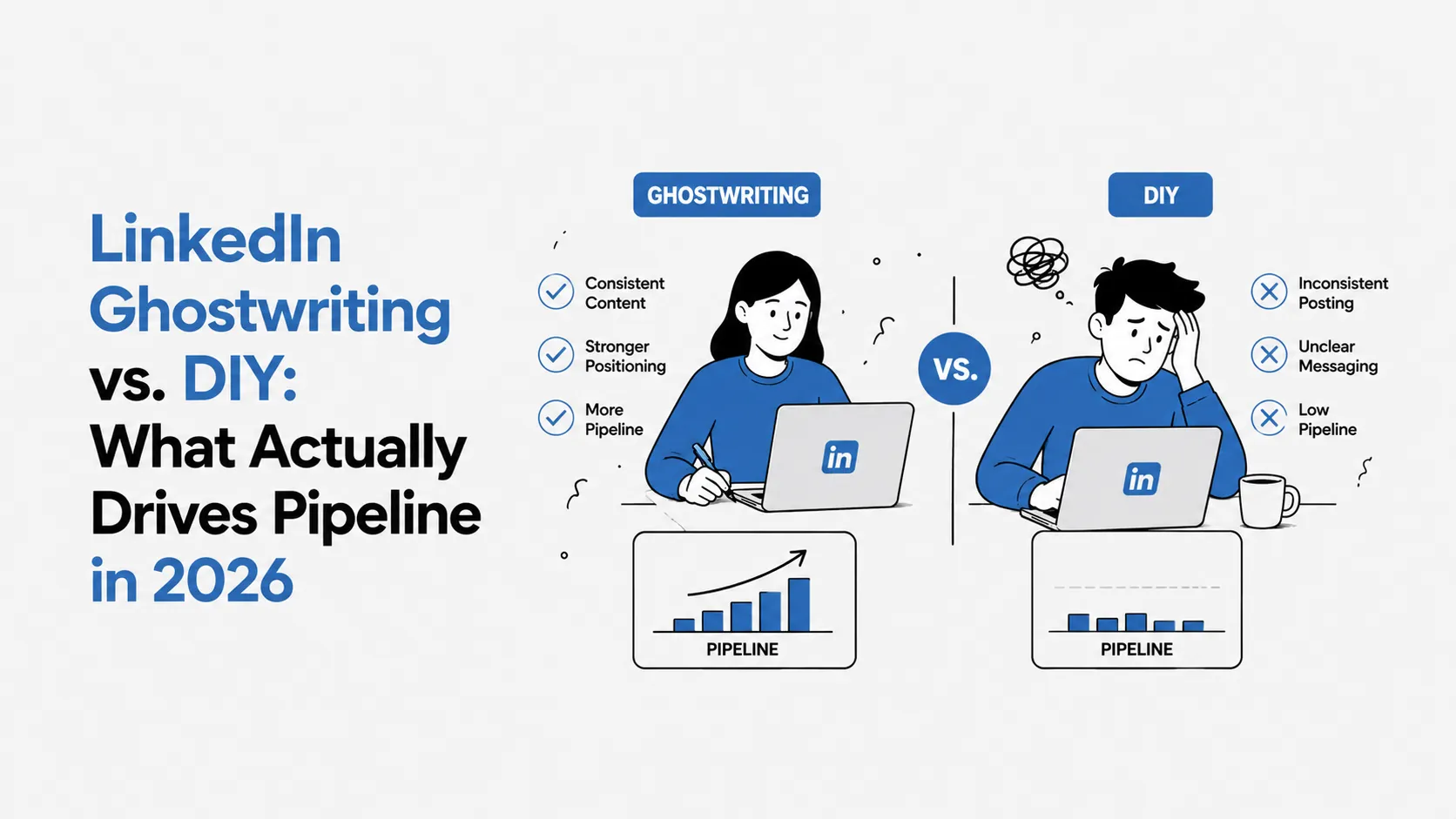
Most founders approach LinkedIn content as a binary choice: hire someone to write it, or do it yourself. The real question is not which is easier. It is which one actually produces pipeline.
The answer depends less on who writes the content and more on whether the system behind it is built to compound. This post breaks down what the data says, where each approach wins, and how to decide which one is right for your situation.
LinkedIn ghostwriting is the practice of hiring a professional writer to create LinkedIn content published under the client's name, with the goal of building the client's personal brand and generating pipeline. It is not content fabrication: the source material is the client's expertise, perspective, and experience, extracted through interviews, briefs, or documented conversations. The ghostwriter's contribution is structure, voice refinement, consistency, and strategic thinking about which content will perform with a specific audience. LinkedIn ghostwriting is one of the fastest-growing segments of the professional services market, with demand growing roughly 3x since 2024 as founders shifted budget from paid advertising to organic content (Windmill Growth, 2026). Most LinkedIn ghostwriting services include content strategy, post writing, and engagement support. The founder provides the substance. The ghostwriter provides everything else.
What it is not:
For a deeper look at how professional ghostwriting works end to end, see ghostwriting for founders: how to build a content engine without writing a word.
Before comparing the two approaches, it is worth being precise about what doing it yourself actually involves, because most founders underestimate the real workload.
Effective DIY LinkedIn content for founders requires 3 to 5 hours per week to execute consistently. That includes 1 to 2 hours for content strategy and post planning, 1 to 2 hours for writing and editing, and 30 to 45 minutes for daily engagement. Research on LinkedIn's 2026 algorithm shows that engagement activity drives 30 to 40% of total profile visibility, making it a required component of any distribution strategy, not optional (Windmill Growth, 2026). Founders who find writing difficult or who lack a reliable idea-capture system should budget closer to 5 hours. Time is the primary cost of DIY LinkedIn content, not money. The question is whether that time is reliably available most weeks for six months or more, because that is the minimum timeline for compounding effects to appear in pipeline.
Most founders can do this in theory. The question is whether they will do it consistently for six months or more, which is the minimum timeline for compounding effects to show up in their pipeline.
For more on what makes writing on LinkedIn hard specifically for founders, see why LinkedIn writing is hard and how to fix it.
DIY LinkedIn content has specific advantages that ghostwriting cannot fully replicate.
Real-time authenticity. Founders who write their own content can react to what is happening in their business right now. A founder who just closed a difficult deal, had an insight in a customer call, or changed their mind about something can publish that thought today. That kind of immediacy reads differently from planned content, and the algorithm rewards it.
Voice ownership. The most compelling LinkedIn posts often come from a founder's specific way of seeing a problem. Some of that is transferable to a ghostwriter. Some of it is not, particularly early in the relationship before voice matching has had time to develop.
Cost. Good ghostwriting is not cheap. Rates for experienced LinkedIn ghostwriters range from $1,500 to $5,000 per month depending on output volume and seniority. For bootstrapped founders with tight budgets, DIY is the rational choice.
Speed of iteration. A founder writing their own content can test a new angle today and adjust tomorrow, without waiting for a brief cycle or editorial review.
Where DIY typically breaks down is consistency. The research on LinkedIn growth is unambiguous: founders who post fewer than two times per week cannot build momentum. Most DIY founders post consistently for four to eight weeks, then miss a week, then miss two, then effectively stop. The algorithm does not forgive that pattern.
LinkedIn ghostwriting solves for the three problems that kill most DIY strategies.
Consistency. A ghostwriter operates on a production schedule. Content goes out regardless of whether the founder is traveling, deep in a fundraise, or burned out from a difficult quarter. Consistency is the compound interest of LinkedIn. Losing it resets the algorithm's understanding of who you are and which professional cohort to route your content to.
Strategy. Most founders writing their own content focus on what to say, not on how to build a coherent body of work that positions them for a specific outcome over 12 months. Good ghostwriters think in content arcs: building topical authority across dozens of posts, not just writing good individual pieces.
Volume without dilution. The 2026 LinkedIn algorithm rewards founders who post 3 to 5 times per week in a consistent topic area. Writing that volume of content while running a company is where most founders hit a ceiling. LinkedIn ghostwriting removes that ceiling without removing the founder's voice.
LinkedIn ghostwriting's pipeline impact is documented in the data. Inbound leads generated through consistent, high-quality LinkedIn content close at 14.6% versus 1.7% for cold outbound, an 8.6x difference (Linkboost 2026 State of LinkedIn). Founders using professional ghostwriting services report an average of 12 to 18 inbound leads per month after 90 days of consistent posting at 3 to 5 times per week. Average deal sizes for those leads have been reported at $4,200, producing an estimated $7,300 to $11,000 in monthly revenue from LinkedIn-attributed pipeline, against a ghostwriting investment of $1,500 to $2,500 per month, an average ROI of 340 to 540% (ConnectSafely, 2026). The critical variable is whether the ghostwriting produces content that is genuinely expertise-driven. Generic ghostwritten content performs worse than authentic DIY content, which is why the intake process and ongoing founder involvement matter significantly.
Neither approach is universally correct. The right choice depends on four variables.
Time availability. If you can reliably protect 3 to 5 hours per week for content, DIY is viable. If your schedule makes that impossible most weeks, ghostwriting is not a luxury. It is a consistency mechanism.
Stage of brand. If you are just starting to build on LinkedIn and are still figuring out your content pillars and voice, spending time writing your own content first is valuable. Even if you later hire a ghostwriter, having done it yourself makes the collaboration substantially more effective.
Budget. For founders with under $2,000 per month available for LinkedIn content, the DIY model with lightweight strategy support is typically the better investment. Above that threshold, professional LinkedIn ghostwriting starts to produce a better return on the combined time-and-money investment.
Pipeline urgency. If you need inbound pipeline in the next 90 days, ghostwriting's consistency advantage matters more. If you have runway to build slowly, DIY compound effects are real and do not require ongoing spend. For a breakdown of what that pipeline actually looks like in numbers, see LinkedIn ROI for founders.
The most effective approach many founders use is neither fully DIY nor fully outsourced. It divides the work by what each party does best.
The founder:
The ghostwriter:
This model keeps the founder's authentic voice and real-time thinking in the content while removing the production bottleneck that kills DIY consistency.
For a closer look at how this plays out in practice, see our guide to LinkedIn content strategy for founders.
Is LinkedIn ghostwriting ethical? Yes. Ghostwriting is a centuries-old professional practice used in books, speeches, and published content across industries. On LinkedIn, it is widely practiced and accepted. The key requirement is that the content reflects the client's actual expertise and perspective, not fabricated opinions or false claims. When done correctly, LinkedIn ghostwriting produces content that is more polished than the founder would write alone, but remains authentically theirs in terms of ideas and point of view.
How do you maintain your authentic voice with a ghostwriter? Voice matching in LinkedIn ghostwriting happens through intake interviews that capture how the founder speaks and thinks, analysis of existing writing and communication samples, iterative editing where the founder refines early drafts, and ongoing calibration as the relationship develops. Most founders report that after 4 to 6 weeks, the content feels like them without requiring heavy editing. The quality of the intake process is the primary determinant of how authentic the output feels.
What should you look for in a LinkedIn ghostwriter? Look for three things: domain familiarity with your industry or audience, a documented process for voice matching and content strategy, and evidence of pipeline results for other clients, not just engagement metrics. Engagement is easy to inflate. Pipeline impact is not. Ask for case studies that include conversion data, not just follower growth numbers.
How long before LinkedIn ghostwriting produces results? The timeline is the same as for DIY: most founders see leading indicators at 60 to 90 days and meaningful pipeline signals at the four to six-month mark. The advantage ghostwriting provides is not a faster timeline. It is a higher probability of actually reaching the six-month mark with consistent content, because the production is not dependent on the founder's availability on any given week.
The question is not whether to outsource your LinkedIn content or do it yourself. The question is whether you will actually publish consistently for six months or more, because that is the minimum investment the compounding effect requires.
DIY works, if you protect the time. LinkedIn ghostwriting works, if the content is genuinely expertise-driven. The hybrid model works for most founders because it removes the production bottleneck without removing the founder's voice.
What does not work is sporadic. What does not work is generic. What does not work is evaluating the strategy at 60 days and concluding it is not working, when the compounding has not started yet.
For founders who want to build the system without building it alone, see how Rethoric works.
For the six-month compounding framework that makes consistent posting sustainable, see LinkedIn growth strategy for founders.
