The founder's playbook for LinkedIn growth in 2026. Build a system that generates inbound leads, not just followers. With a realistic 6-month timeline.
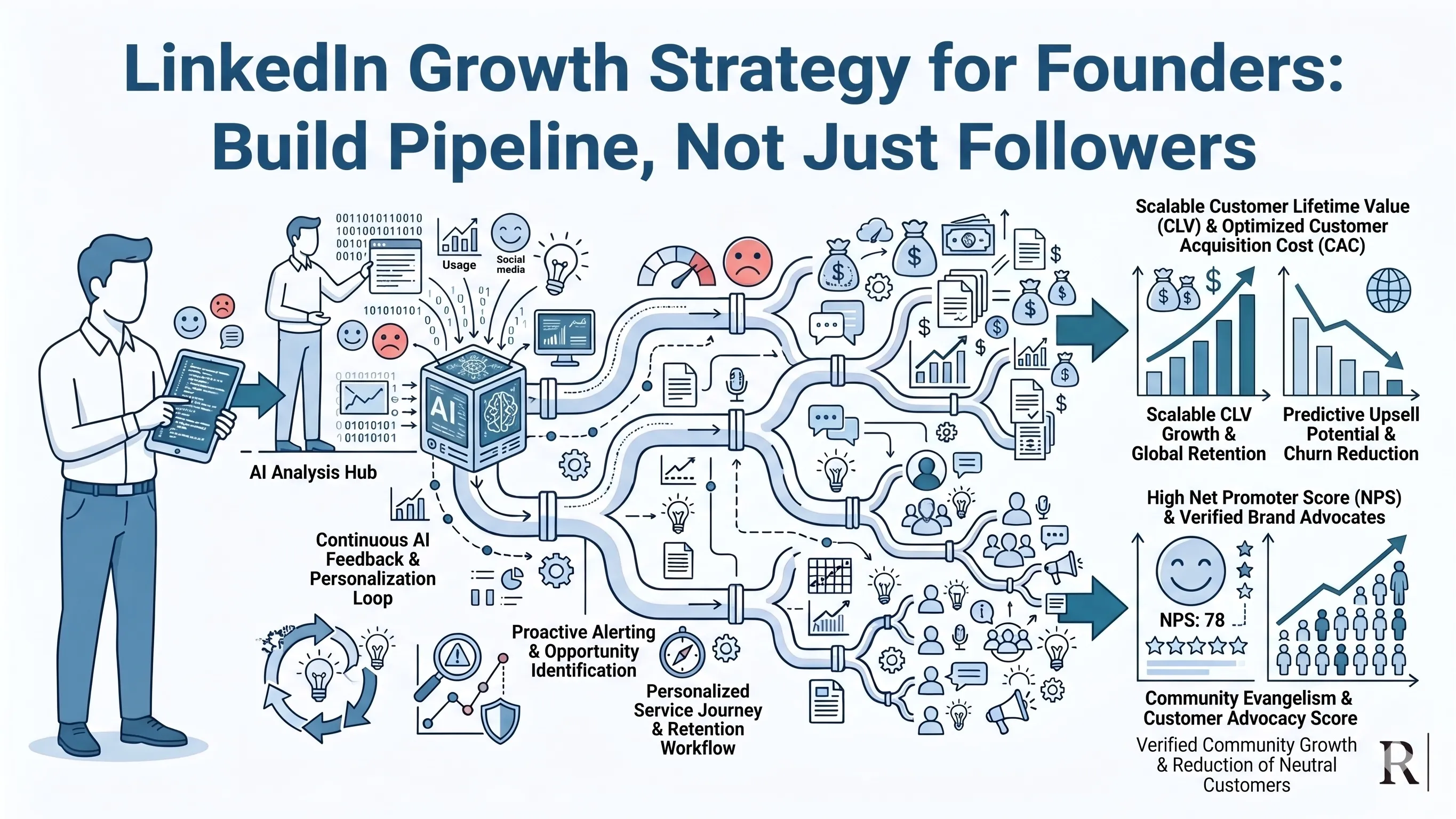
A LinkedIn growth strategy for founders is a systematic approach to building visibility with the exact people who buy from you, invest in you, or hire for you, then converting that visibility into inbound pipeline over time. It is not about going viral, and it is not the same as a personal brand. It is a repeatable system with four parts: a profile that converts, a content engine built on your own expertise, an understanding of how the algorithm distributes your posts, and a daily engagement habit.
Only 3% of LinkedIn users post more than once per week. That means if you show up consistently with a clear point of view, you are already ahead of 97% of the platform before you even optimize a single post.
But showing up is only the start. Most founders who try LinkedIn end up frustrated, posting into the void, chasing follower counts that don't translate to leads, or copying tactics designed for influencers and agencies that simply do not apply to someone building a company.
This guide covers the four-step system that works in 2026: profile as a landing page, a content system built around your expertise, how the algorithm actually distributes content today, and a daily engagement habit that turns attention into conversations. Plus a realistic timeline for what to expect month by month.
A LinkedIn growth strategy for founders is the practice of systematically building visibility and authority on LinkedIn to generate qualified inbound leads, attract investors, and recruit top talent, using personal content, strategic engagement, and profile optimization rather than paid advertising. Unlike social channels that reward reach for its own sake, LinkedIn connects founders directly with decision-makers who have buying authority.
The numbers make the case clearly:
The opportunity is even larger right now because of a specific shift in the content landscape. As of 2026, an estimated 53.7% of long-form LinkedIn posts are likely AI-generated. AI comments have surged 340%. The feed is flooded with generic, templated content that sounds the same.
This creates a real advantage for founders willing to post with a genuine voice, specific data, and real experience. The bar for good content has dropped because most content is mediocre. Your authentic perspective is a moat most agencies cannot replicate.
LinkedIn and SEO are the two channels that compound over time. Everything else resets when you stop. At Rethoric, we work with founders who want both, LinkedIn for fast visibility and SEO for long-term pipeline. The founders who build both early stop chasing leads entirely.
Most founders lose potential leads before their content even matters. A visitor lands on your profile, sees a job-title headline and a generic about section, and leaves without taking any action.
Your LinkedIn profile is not a resume. It is the first page of your sales funnel. Before you think about what to post, get this right.
Replace your job title with the outcome you create. Instead of CEO at your company, write something like Helping B2B SaaS founders build organic demand that compounds. The headline appears in search results, in comments, and every time someone sees your name. Make it immediately clear who you help and how.
Founders who optimize their headline as a value proposition, not a title, see meaningfully more profile-to-DM conversion. The headline is the one piece of LinkedIn personal brand building most people get wrong.
Three things belong here: the story of why you built what you are building, specific proof that it works (numbers, client outcomes, milestones), and a clear call to action. Two to three short paragraphs maximum. Most founders write an essay. Nobody reads an essay.
Pin one thing that captures leads, a lead magnet, a case study, a free audit, or your best-performing post. This section is prime real estate and most profiles leave it empty. If you have a free LinkedIn tool or resource, this is where it lives.
The goal is that someone who has never heard of you can land on your profile, understand exactly what you do and who it is for, and have a reason to reach out or click through, all within 30 seconds.
The difference between founders who grow on LinkedIn and those who plateau is not talent or follower count. It is whether they have a system or are winging it post by post.
Content pillars give your account a clear identity. A useful breakdown for founders building a LinkedIn content strategy:
This mix builds trust in a specific way: customer stories prove results, industry insights prove expertise, founder lessons prove authenticity, process posts prove depth. Together they position you as someone worth following for business reasons, not just personal ones.
For every 10 posts: five that share curated insights or useful perspectives, three that are original content you created, and two that are personal or human, sharing something real about your experience. This prevents the trap most founders fall into, which is over-indexing on self-promotion.
Three posts per week is the minimum for meaningful growth. Accounts with 1,000–5,000 followers that post consistently achieve 40%+ annual follower growth. Posting once per week increases your profile views by 4x and doubles follower growth, according to LinkedIn's own data.
Text posts, short-form video, carousels, and newsletters each reach different segments of your audience and signal different things algorithmically. Rotating formats prevents your account from going stale with any single distribution segment.
The key metric to watch is not likes. It is dwell time, how long someone pauses on your post. Posts that hold attention for 7+ seconds get pushed to a second pass of distribution. That means your first line, not your fifth paragraph, does the most important work. Write hooks that create a reason to stop scrolling, not a reason to keep going.
LinkedIn's algorithm has shifted significantly since 2023. Organic reach is down 63–66% from its peak, but per-post engagement is up 12–39% for creators who have adapted. The platform is not punishing creators, it is rewarding a specific type of content differently.
The 2025 rollout of LinkedIn's 360Brew AI model changed how the algorithm reads and distributes content, it now evaluates your profile credibility before deciding how far your posts travel. For the full breakdown, read our guide on how the LinkedIn 360Brew algorithm works.
The algorithm measures how long people pause on your post before scrolling. Reaching the 4.5-second threshold gets you basic distribution. Reaching 7+ seconds triggers second-pass expansion to a broader audience. This means your hook, the first line, is not optional. It is the entire game.
Thoughtful comments carry 3x more algorithmic weight than likes. Shares carry 5x. A post with 10 substantive comments will outperform a post with 100 likes in terms of actual distribution. This changes what you should optimize for: posts that invite a real response, not posts that are easy to double-tap.
LinkedIn evaluates how your content performs in the first hour and uses that to decide whether to push it further. Posting when your ICP is active, typically Tuesday through Thursday, 8–10am in your target timezone, gives your content the best shot at triggering expanded distribution.
When one post performs well, your next two posts get a temporary algorithmic lift. Consistency is literally rewarded mechanically. One strong post sets up the next one.
The final shift worth knowing: AI content is everywhere. Posts with a genuine voice, real experience, and specific data stand out precisely because 53.7% of long-form content sounds templated. Being specific, naming actual numbers, real client situations, honest failures, is now a competitive advantage.
Struggling to post 3x per week while running a company? That is the most common reason LinkedIn growth stalls for founders. Rethoric builds the content system for you, so the posts that go out sound like you, reach your ICP, and drive inbound pipeline.
Posting is half the equation. The other half is showing up in conversations that are already happening with your target audience.
Strategic commenting means spending 15–30 minutes per day leaving substantive comments on posts from people in your ICP, not peers or other founders, but actual potential customers, investors, or partners. A thoughtful comment puts your name and expertise in front of their entire network. It is the most efficient free distribution available on the platform.
The distinction between strategic and random commenting matters. Random commenting on trending posts gets you visibility with people who will never buy from you. Strategic commenting on posts from your ICP gets you visibility with their audience, which is likely full of people who look just like them.
Building a strong LinkedIn network is a compounding asset. When someone engages with your content (likes, comments, or follows), visit their profile. If they fit your ICP, send a short message acknowledging the connection without a pitch. Relationships before revenue.
This habit, done consistently for 90 days, is what separates founders who say LinkedIn does not work from those generating qualified inbound pipeline. It is not glamorous. It compounds.
LinkedIn growth for founders follows a predictable curve. Here is what the data shows for founders posting 3x per week with consistent daily engagement:
Expect 100–200 new followers and 0–2 qualified leads. The algorithm is learning who you are. Growth is slow. Profile visits increase. Most founders quit here. The ones who do not are the ones who see results in month 4.
The algorithm recognizes consistency and expands distribution. Expect 3–5 qualified leads per month. Prospects start mentioning your content in sales calls. Inbound DMs become a regular occurrence.
Expect 8–15 qualified leads per month and 400–600 new followers per month. LinkedIn functions as a primary inbound channel. The compound effect becomes visible in your pipeline data.
One data point: a B2B analytics SaaS founder posted 3x per week for 6 months and grew from 800 to 4,200 followers, generated 23 qualified leads, closed 8 deals, and added $400K ARR, with 45 minutes per day. That is what systematic LinkedIn authority building looks like when you commit to the process.
Short, reactive posts that chase trending topics do not build authority. LinkedIn rewards depth, consistency, and professional expertise, not hot takes.
A founder with 2,000 highly engaged followers in their exact ICP will generate more pipeline than one with 20,000 followers who are mostly other founders. Follower count is a vanity metric. Inbound lead volume is the real one.
Posting without engaging in the comments section of your own posts kills distribution. If you are not responding to comments, you are leaving distribution on the table and signaling to your audience that you are broadcasting, not having a conversation.
Company pages get 2.75x fewer impressions than personal profiles. This is why ghostwriting for founders has become a legitimate growth lever, founders understand the value of the personal brand but do not have the bandwidth to execute consistently.
Most founders jump straight to content without fixing their profile. If your headline does not communicate your value and your featured section does not capture leads, every post you write is driving traffic to a leaky funnel. Fix the profile first.
A LinkedIn growth strategy for founders is a 6-month investment with a long tail. The founders who win build the system before they need the results, so that when they do need pipeline, it is already there.
The compounding effect is real. A post you publish today can generate leads 18 months from now. That is the difference between a LinkedIn growth strategy and a marketing campaign.
If you want to build this system without spending 45 minutes a day on content creation, Rethoric works with founders to build the strategy layer, so the content that goes out sounds like you, ranks in search, and drives inbound pipeline rather than just impressions.
Ready to see which LinkedIn content pillars would generate the most pipeline for your business? Start with a free content audit, we will show you exactly which topics your ICP is searching for and where your biggest growth gaps are.
Explore more founder growth strategies on the Rethoric blog.
