LinkedIn ROI for founders doesn't show up in attribution dashboards. Here's why that happens, what to measure instead, and how to know if your content is working.
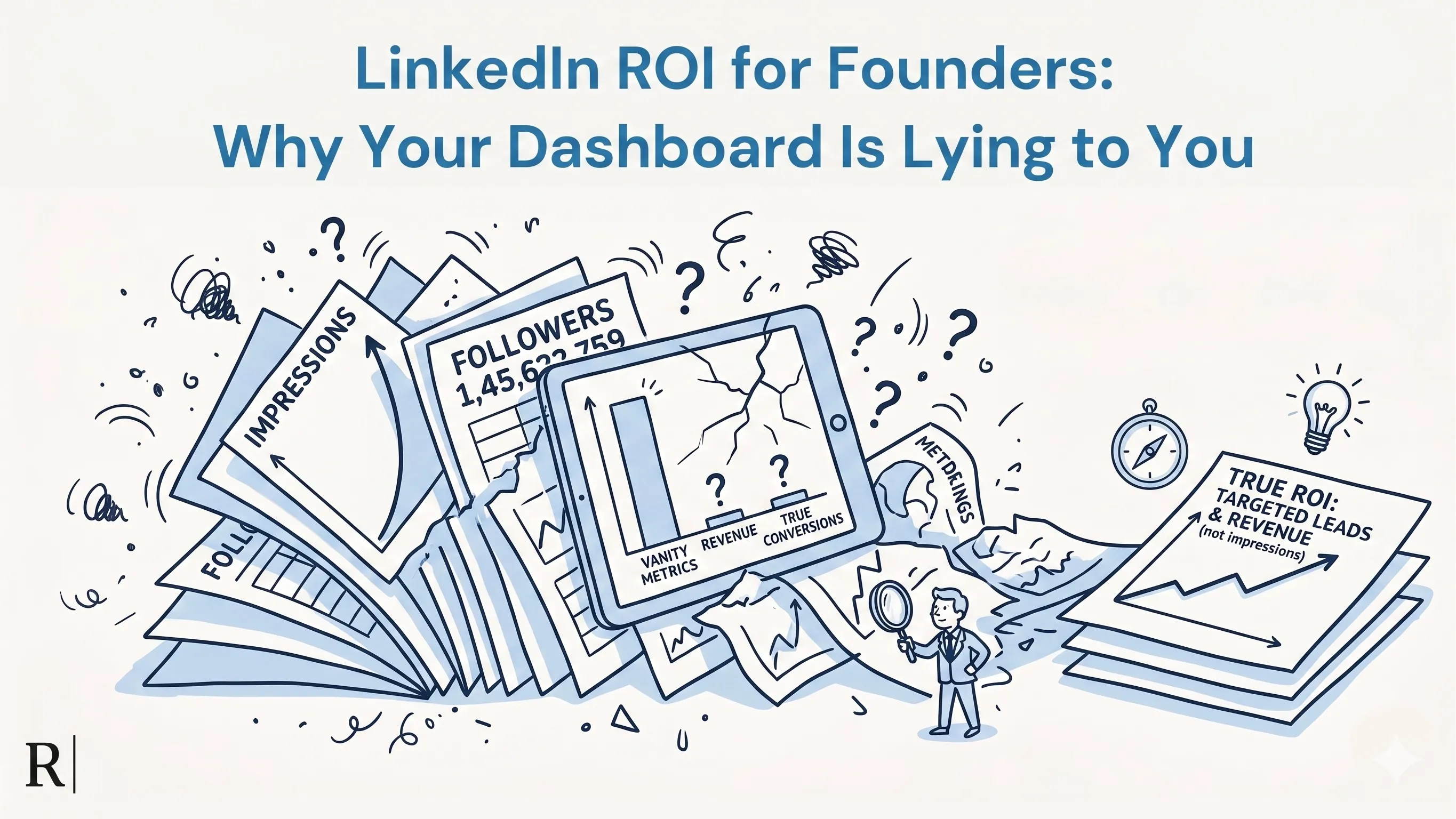
LinkedIn ROI for founders is one of the most misunderstood metrics in B2B go-to-market. Most founders measure it wrong, conclude it is not working, and quit. The ones who stick with it long enough to see it compound tend to realize the same thing: the value was always there. Their dashboard just had no way to show it.
If you have been posting on LinkedIn and wondering why your analytics do not reflect the effort, this post explains why that happens, what LinkedIn is actually doing for your business, and how to measure results in a way that reflects reality.
The problem is structural, not strategic.
A buyer sees your post on a Tuesday. They do not click anything. Three weeks later, your name comes up in a podcast they listen to on their commute. Someone in their Slack group mentions your company. Eventually they Google you, land on your website, and book a demo.
Your attribution dashboard gives all the credit to organic search. LinkedIn gets zero.
This is the dark social problem. Dark social refers to all the sharing and discovery that happens in private or untracked channels: direct messages, Slack groups, email threads, AI search results, and private communities. When someone copies your LinkedIn post URL into a Slack DM, there is no referrer data. When your name comes up in a private conversation and someone Googles you afterward, Google search gets the click. LinkedIn gets nothing.
The data on this is stark. 65% of all social sharing happens in dark social channels, according to ATTN Agency attribution research. These shares generate traffic that shows up as "direct" or "unassigned" in GA4. The channel that actually put you on the map is invisible to your tools.
Here is what that looks like in practice:
| What your dashboard shows | What actually happened |
|---|---|
| Organic search closed the deal | Buyer Googled you after seeing your LinkedIn post |
| Direct traffic, source unknown | Your LinkedIn URL was shared in a private Slack channel |
| LinkedIn gets 0 attribution credit | LinkedIn was the first touchpoint three weeks earlier |
| Paid search drove the conversion | Buyer recognized your name from LinkedIn, then clicked the ad to confirm |
LinkedIn replaced its entire ranking algorithm with 360Brew, a 150-billion-parameter model that distributes content specifically to the professional network most likely to care about your expertise. Your posts are reaching the right people. Those people just research you through channels that leave no attribution trail.
Most founders treat LinkedIn like a bottom-of-funnel channel. They want to trace a specific post to a specific deal, within 30 to 60 days.
That is a reasonable expectation for paid search, where someone is actively looking to buy. It is not how LinkedIn works.
LinkedIn is where buyers build familiarity. It is where they decide whether you are credible, whether your perspective is worth following, and whether your name is one they would bring up in a meeting. That decision gets made weeks or months before they ever search for a solution.
B2B buyers consume an average of 10 pieces of content before making a purchase decision, according to LinkedIn's own B2B marketing research. The first several of those touchpoints produce no trackable signal in your CRM. By the time a buyer fills out your demo form, they have already made a provisional judgment about you based on content they consumed without clicking anything.
If you are waiting for your LinkedIn analytics to justify the effort, you are measuring the last mile of a much longer race.
The value of LinkedIn content for founders is not lead generation in the traditional sense. It is name recognition before evaluation begins.
When a potential buyer starts evaluating solutions in your category, there are two types of companies they encounter: ones they already have a sense of, and ones they are discovering cold. The first group gets the benefit of the doubt. The second group has to earn trust from scratch in a sales process.
LinkedIn is the mechanism that puts you in the first group.
Buyers who engage with founder content before a sales conversation convert at 2 to 3 times the rate of cold outbound prospects, according to B2B content attribution research. 80% of B2B social media leads come from LinkedIn. And 15 to 30% of closed-won revenue at companies with active founder LinkedIn presences traces back to LinkedIn touchpoints, once you start asking the right questions.
The challenge is that this value only becomes visible when you look for it directly. Your current dashboard cannot find it. You have to build a different measurement system. If you want to understand what the operational side of that content engine looks like, read our breakdown of how LinkedIn ghostwriting for founders actually works and what results to expect by month.
LinkedIn ROI for founders becomes measurable once you replace last-touch attribution with a multi-signal approach. The core of this approach is self-reported attribution: asking people directly how they first became aware of you.
Add one open-text field to every conversion point on your site. The exact wording matters. Do not ask "How did you find us?" That invites answers like "Google." Ask instead: "What first made you aware of us? Be specific if you can."
The responses will tell you things your dashboard never will. Founders who implement this consistently find that LinkedIn content, podcast mentions, peer referrals, and community recommendations show up at much higher rates than software attribution suggests. One B2B company that published its attribution data found that podcasts received 0% of multi-touch attribution credit but 23% of self-reported credit. LinkedIn organic content showed similar gaps between what software tracked and what buyers actually remembered.
Beyond self-reported attribution, four signals give you a real picture of whether LinkedIn is working.
Branded search volume in Google Search Console is the first. When your LinkedIn presence is working, people Google your name after seeing your content. Branded search volume rising in parallel with LinkedIn activity is a strong signal that awareness is compounding.
Profile views from ICP-matching titles is the second. LinkedIn analytics shows who viewed your profile. Filter by job title and industry. If your ideal customers are looking you up, your content is reaching the right people.
Content mentions in sales calls is the third. Ask every new prospect whether they have seen your LinkedIn content before the call. Track the yes rate over time. As your content builds, this number climbs steadily.
Inbound DM rate from qualified contacts is the fourth. The benchmark for founders posting 3 to 5 times per week is 3 to 8 inbound DMs per month from ICP-relevant contacts. Below that, your content is reaching the wrong audience or not reaching enough of it.
Inbound leads sourced from LinkedIn close at 14.6% compared to 1.7% for cold outreach, according to HubSpot data. The measurement system above is how you capture that difference in your own pipeline.
For a structured approach to building the underlying content system, the LinkedIn growth strategy framework walks through how to align content to business outcomes from the start.
Once you have self-reported attribution set up and are tracking the signals above, you can replace the vanity metrics most founders watch with leading indicators that actually connect to revenue.
ICP impression share is the most important one. LinkedIn analytics lets you filter impressions by follower demographics, including title, industry, and company size. The benchmark for a well-targeted content strategy is 40 to 60% of total impressions coming from ICP-matching titles. If your content is reaching the right people, this number will be in range even if raw impression volume is not.
Outbound reply rate lift is another signal most founders overlook. Compare the reply rates on outbound sequences for contacts who have LinkedIn engagement history versus those who do not. The data consistently shows a 2 to 3x lift for contacts who have seen your content. Your outreach is having easier conversations with people who already know your name.
Trust-influenced pipeline is the ultimate metric. Track the percentage of closed-won deals where the buyer mentioned LinkedIn, your content, or your name recognition as a factor in their evaluation. As your presence builds, this number should sit between 15 and 30% of total pipeline for B2B founders selling above $25K ACV.
A clear founder content strategy ties each of these metrics back to a specific content goal, so you know which posts are building pipeline signals and which ones are purely brand-building.
The honest answer is 6 to 8 months before the compound effect becomes clearly visible in your pipeline.
Months 1 and 2 are largely invisible. The algorithm is learning your expertise. Your content is reaching a small, targeted audience. Self-reported attribution mentions are rare. Most founders quit here because nothing in their dashboard tells them it is working.
Months 3 and 4 are where the signal starts to emerge. Profile views from ICP contacts increase. Prospects start mentioning your content in early sales conversations. Branded search creeps up. You are not yet generating consistent inbound leads, but the awareness layer is forming.
Months 5 through 8 are when LinkedIn becomes a real pipeline channel. Consistent posting at 3 to 5 times per week, combined with daily engagement management, produces 8 to 15 qualified inbound conversations per month for founders in B2B categories. The close rate on these conversations is meaningfully higher than cold outbound because buyers arrive already familiar with your thinking.
The founders who generate the best LinkedIn ROI are not the ones who post the best content. They are the ones who do not quit at month 2.
If you understand the attribution problem but the hard part is showing up consistently, that is the gap a LinkedIn ghostwriting service for founders is designed to close. The content engine keeps running, the brand signal keeps building, and the measurement system above gives you the data to see it working, even when your dashboard cannot.
LinkedIn ROI for founders is real. It just requires measuring the right things at the right time. Start with self-reported attribution today. It costs nothing and will immediately reveal channels you have been undervaluing.
If you want to talk through what a content system built around your business goals looks like, book an intro call with Rethoric. We will map it out in 20 minutes.
