The data on personal branding for founders is clear: 44% of company market value is tied to CEO reputation, and inbound leads from founder content close at 8.6x the rate of cold outreach. Here is what the research actually says.
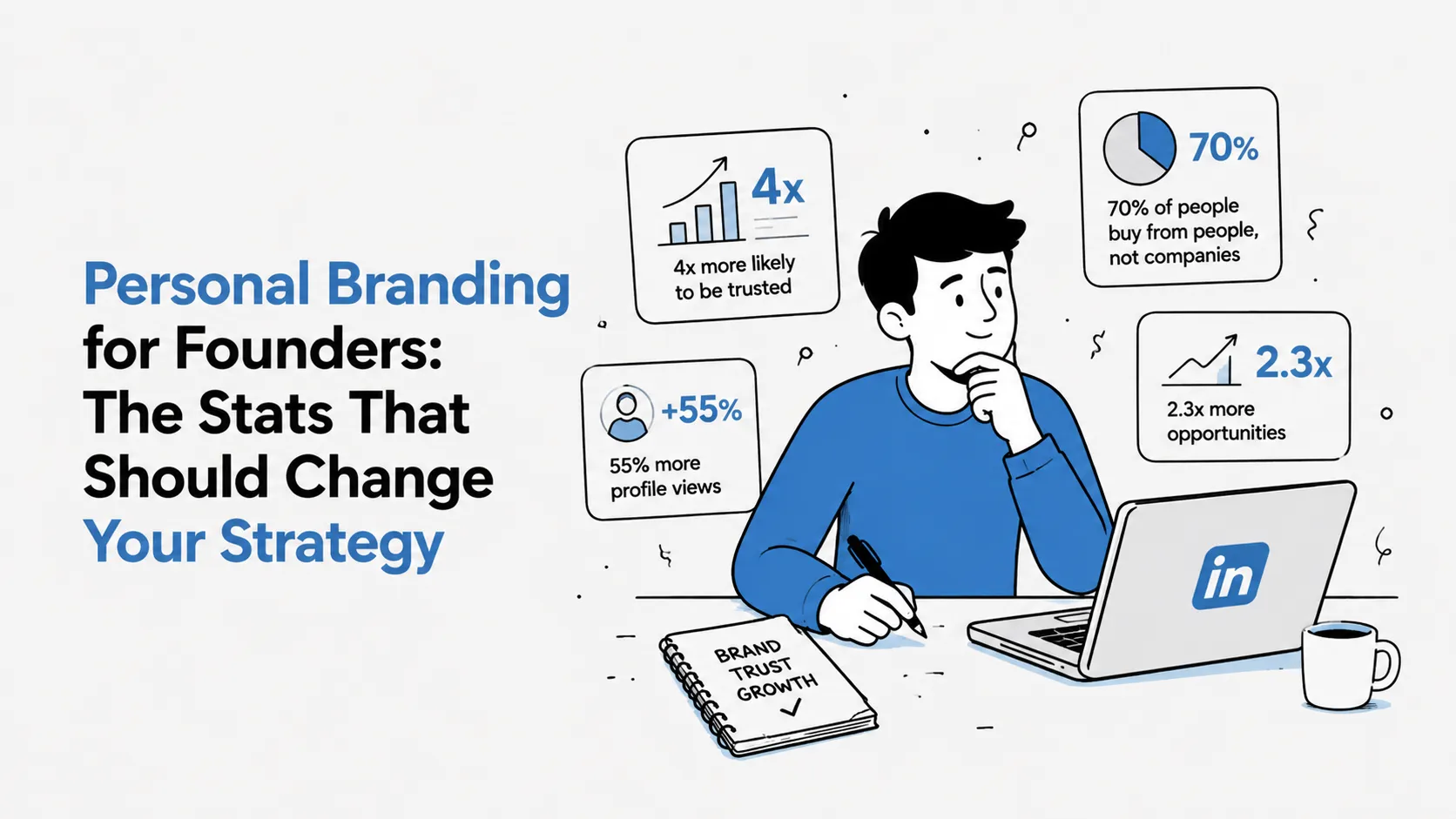
44% of a company’s market value is directly tied to the CEO’s reputation. That number comes from Weber Shandwick, and most founders have never heard it.
Personal branding for founders gets treated as a vanity project. Something you work on when things slow down. A LinkedIn presence is a nice-to-have, not a business priority.
The data says otherwise. This guide compiles the research on personal branding for founders and explains what it actually means for how you spend your time and where you direct your attention.
The research on personal branding consistently points to one conclusion: buyers and investors do not separate the founder from the company. They evaluate both simultaneously, and the founder’s credibility transfers directly to company trust.
Personal branding for founders is the strategic and consistent expression of a founder’s expertise, perspective, and values across public channels, with the goal of building credibility and trust with buyers, investors, talent, and media. It is not self-promotion or follower accumulation. It is a measurable business asset: founders with active personal brands see higher conversion rates, shorter sales cycles, and lower customer acquisition costs than those without one. The channels that matter most are LinkedIn, long-form content, and earned media. The mechanism is trust transfer: when a buyer trusts the founder, they trust the company. When they trust the company, they buy. This is not a soft claim. It is documented in purchase behavior research across multiple industries and buyer types.
The data on what this trust transfer looks like in practice:
These are not engagement metrics. They are purchase signals.
Most founders frame the personal branding question as: is this worth my time? The data reframes it as: what is the cost of not doing this?
The ROI of founder personal branding is measurable across multiple dimensions: sales conversion, talent acquisition, fundraising, and market valuation. Founders and creators with strong niche authority see 3 to 7 times higher conversion rates than traditional corporate marketing (Gitnux). Inbound leads generated through LinkedIn content close at 14.6%, compared to 1.7% for cold outbound, an 8.6x difference (Linkboost 2026). Executives estimate that 44% of their company’s market value is directly attributable to the CEO’s reputation (Weber Shandwick). Personal branding also affects hiring: 44% of employers have hired a candidate specifically because of their personal brand, and 70% of employers say a personal brand is more important than a resume (WiserNotify). The ROI compounds over time because the content you create keeps working after you stop creating it.
Specific numbers worth knowing:
For a deeper look at how LinkedIn content translates into revenue, see our guide to LinkedIn ROI for founders.
There is a specific mechanism behind why personal branding works. People trust people more than they trust organizations.
Buyers trust founders more than company brands because human credibility transfers to organizational credibility in ways that logo-driven marketing cannot replicate. Nielsen research shows that 92% of people trust recommendations from individuals over brand messaging, regardless of whether they know the individual personally. The Edelman Trust Barometer (2026) confirms that among people who trust thought leaders, 62% would trust or consider trusting a company they currently distrust if it were vouched for by someone they already trust. This trust transfer is why founder-led content consistently outperforms company page content: personal profiles generate 8 to 10x more engagement than company pages on LinkedIn. The practical implication is that a founder’s personal brand is not a supplement to company marketing. It is the trust infrastructure that makes company marketing more effective.
More data from the research:
Most founders who know the research still do not act on it. Not because they disbelieve the numbers, but because personal branding for founders lacks a clear starting point. “Build your personal brand” is not an actionable instruction.
What it actually requires, broken into concrete steps:
Step 1: Pick one specific problem you understand deeply. Not a broad industry. A specific problem with a specific audience. The more precisely you can name it, the faster the algorithm and the audience associate you with it. Founders who bounce between topics see reach decline consistently. Founders who stay in one lane see distribution grow over time.
Step 2: Publish consistently about that problem. On LinkedIn, two to three times per week is the research-backed minimum for compounding effects to activate. The algorithm needs consistent signals to associate you with a topic. So does your audience.
Step 3: Document real experience, not generic advice. Personal stories with specific numbers outperform generic advice by 3 to 4x in engagement (Windmill Growth, 2026). Specificity is the differentiator, especially in a feed flooded with AI-generated content.
Step 4: Engage where your audience is. ICP-targeted commenting drives 30 to 40% of total profile visibility on LinkedIn (Windmill Growth, 2026). Founders who combine consistent posting with 10 or more thoughtful daily comments see 2x more inbound messages than those who only post.
What it does not require:
For a practical framework on how to build this system, see founder content strategy: how to build a pipeline that compounds.
Personal branding results for founders typically follow a 90-day to 6-month timeline. The first 30 days produce almost no visible signal as the algorithm learns your topic area. At 60 to 90 days, most founders see the first leading indicators: profile views from target buyers increase, inbound message quality improves, and content begins reaching people outside the immediate network. Tangible pipeline impact, meaning inbound leads traceable to content, typically appears between months four and six. The mechanism is trust accumulation, not viral distribution. Among professionals actively working on authentic personal branding, 80% report receiving inbound leads (Gitnux). The data on consistency is unambiguous: 91% of LinkedIn creators who maintained strong personal brands in 2025 posted at least once every three days.
Most founders give up before month three. That is precisely when the compounding is about to start.
For the six-month system that makes this sustainable, see LinkedIn growth strategy for founders.
Is personal branding worth it for B2B founders? Yes, especially for B2B founders. 73% of B2B buyers say they trust thought leadership from named individuals more than any marketing material a company produces (Edelman-LinkedIn). The higher the deal size, the more the buyer’s confidence in the founder influences the decision. For founders selling to enterprise buyers, a personal brand is often the primary credibility signal evaluated before a deal conversation starts.
How is personal branding different from thought leadership? Personal branding is the broader system: the consistent expression of expertise across channels over time. Thought leadership is one output of that system, specifically content that demonstrates a well-reasoned point of view on a specific problem. Thought leadership without distribution is academic. Personal branding without substance is hollow. The combination, substantive expertise published consistently under your name, is what builds the pre-trust that shortens sales cycles.
Does personal brand matter more for early-stage or late-stage founders? Earlier is better, for one reason: compounding. A founder who builds a known presence in their domain over three years before a fundraise has a fundamentally different conversation with investors than one who starts cold. The same applies to sales: buyers who have been reading your content for six months arrive at a demo already trusting you. Starting early means the asset is built by the time you need it most.
Can a ghostwriter build an authentic personal brand? Yes, with the right process. The founder’s expertise, perspective, and voice need to be the source material. What a ghostwriter provides is structure, editing, and the consistency most founders cannot sustain on their own. When done correctly, the output reads and feels like the founder because it is based on the founder’s actual thinking. See how LinkedIn ghostwriting for founders works at Rethoric.
The research on personal branding for founders is not subtle. A founder with an active, specific personal brand closes more deals, raises capital more easily, hires better, and builds a company that buyers and investors trust more.
The cost of ignoring this is real and measurable: 44% of company market value tied to CEO reputation, an 8.6x difference in inbound versus outbound close rates, and a trust gap that no company branding budget can close.
Personal branding for founders is not a project you start when things slow down. It is the infrastructure that makes the other things easier.
If you want help building yours, see how Rethoric works with founders.
