Most founders who try a LinkedIn content strategy quit within 90 days. Here's exactly why it's hard, how to fix it, and when to delegate to a ghostwriter.
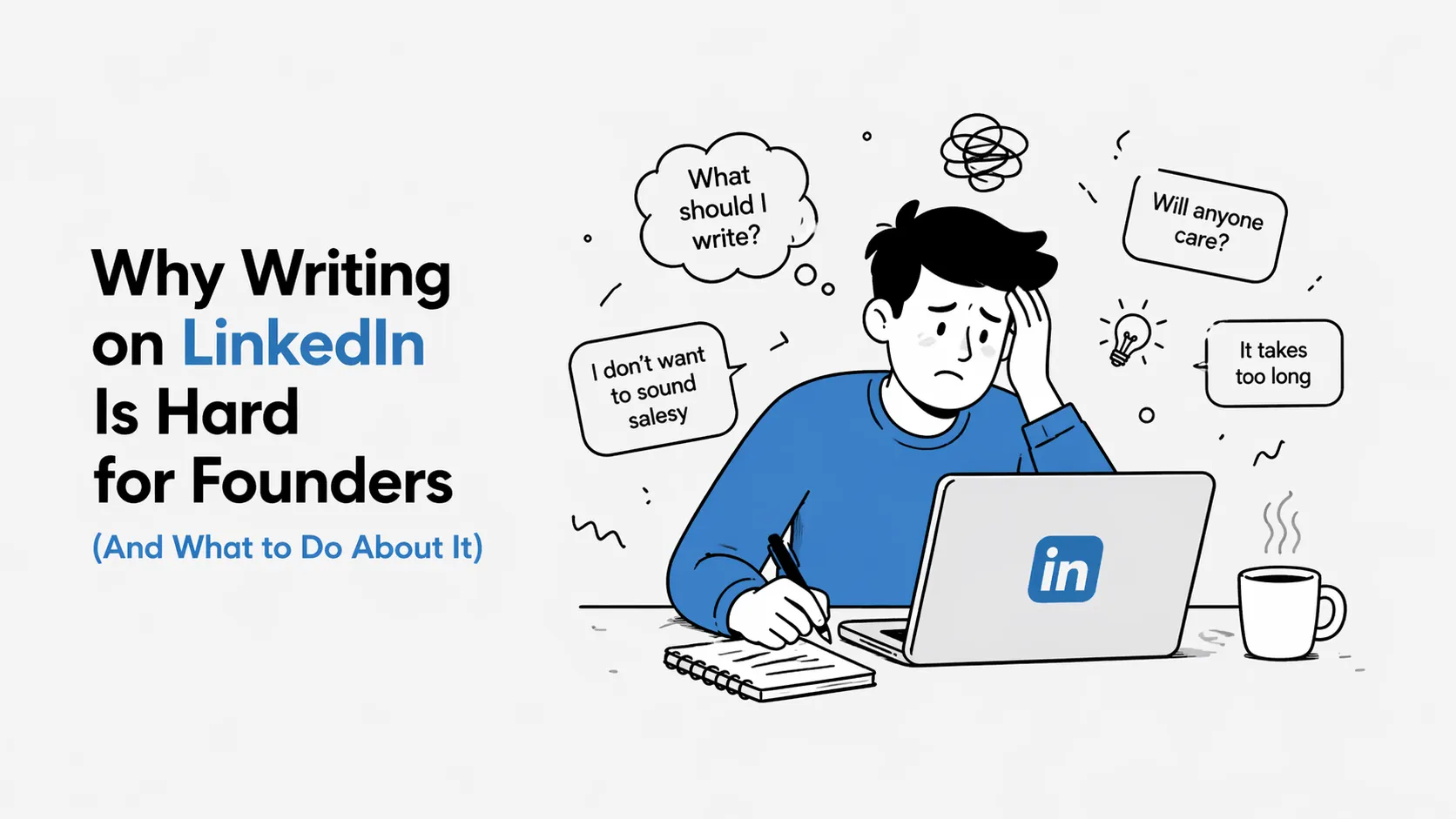
A founder content strategy on LinkedIn is one of the highest-ROI moves available to early-stage companies right now. Inbound leads from founder content close at 14.6% compared to 1.7% for cold outbound (Linkboost, 2026). Personal profiles generate 8x more engagement than company pages. And 73% of B2B decision-makers say they trust thought leadership from a named individual more than any marketing material a company produces (Edelman, 2026).
The numbers are not ambiguous. But most founders who try LinkedIn quietly stop within 90 days. Not because the channel does not work, but because the actual experience of sustaining a founder content strategy is harder than anyone explains before you start.
This post covers exactly why. Then it covers what actually fixes it, whether you want to build the system yourself or hand the execution to someone else.
LinkedIn writing is hard for founders because it competes directly with the highest-value activities in their week, demands a level of creative consistency that is difficult to sustain under operational pressure, and punishes inconsistency faster than most founders expect. Unlike paid ads, which you can pause and restart without losing ground, LinkedIn momentum is fragile. A founder content strategy requires continuous output to maintain algorithmic reach, regular engagement with other creators to build audience trust, and enough mental bandwidth to stay inspired over months, not weeks. Most founders underestimate all three demands before they start, and that mismatch is what causes the 90-day drop-off pattern that repeats across industries and company stages.
Here is what nobody warns you about before you commit.
Writing the post is not the hard part. The hard part is everything around it.
Every time you publish, you make final edits, respond to comments, and check what is performing. That alone adds 60 to 90 minutes of context switching to your day, typically mid-workday, when your focus is worth the most. Add that to 6 to 9 hours of actual writing per week and you are committing real founder time before you see a single lead.
Research on cognitive task-switching puts the recovery cost of a single context shift at 20 to 30 minutes. Founders posting 3 to 5 times per week pay that tax multiple times over, often without realizing the cumulative drag it puts on deeper work.
The mental load of a founder content strategy does not clock out when you close your laptop.
Every walk, every client call, every meeting becomes potential content material. That creative vigilance is useful, but it is also exhausting. You cannot simply live your life. Part of your brain is always in observer mode, scanning for the next post angle.
And when inspiration dries up, which it does for everyone, you are left staring at a blank editor with a consistency streak on the line. That blank page feeling does not get lighter the longer you have been posting. It gets heavier.
This is the part that surprises founders most.
LinkedIn momentum builds slowly and collapses fast. One founder generating more than 50 million annual views reported that when posting dropped by 50% in a single quarter, leads from the channel dropped by nearly 50% as well. Not gradually. Sharply.
Missing two or three weeks feels manageable in the moment. The algorithm treats it as a signal that you are no longer relevant to your network. Rebuilding after a gap takes longer than building from scratch because you are recovering lost ground, not starting fresh.
For a sustainable LinkedIn growth strategy, consistency is not a nice-to-have. It is the mechanism itself.
Most founders focus entirely on publishing and skip what actually builds the audience.
Replies, DMs, and showing up in other people's comment sections are not optional extras. They are the mechanism by which LinkedIn decides whether your content deserves more reach. Founders who post without engaging see their reach flatline within months. Their audience feels the absence, even if they cannot name it, and they stop returning.
According to LinkedIn's own 2026 data, the algorithm tracks comment activity as a measure of genuine community participation. Founders who spend 15 minutes per day on substantive comments get routed to larger audiences as a direct reward. Skip that habit and even your strongest posts underperform.
A consistent founder content strategy is built on four habits: capturing ideas in the moment rather than reconstructing them later, batching writing sessions to reduce context switching, engineering the first 100 words of every post to earn the scroll-stop, and treating daily commenting as a non-negotiable distribution lever. Founders who try to write every post from scratch in real time almost always burn out. Those who separate idea capture from writing, and writing from publishing, find the process far more sustainable. None of these habits require more total time. They require reorganizing the time you are already spending.
The biggest mistake founders make is trying to write content from memory at the end of a busy week.
The energy is gone. The specific detail that made the story worth telling has blurred. What you get is generic content that sounds like every other LinkedIn post, because it is reconstructed from a faded impression rather than from the real moment.
The fix is simple: capture ideas when they happen, not when you plan to write. A 30-second voice note after a client call. A single sentence in your notes app when a meeting produces something unexpected. You are not writing. You are preserving the raw material before it disappears.
When you sit down to write, you are not starting from nothing. You are working from real moments.
Set aside one or two focused blocks per week for writing, and produce multiple posts in each session.
Batching cuts the context switching tax dramatically. Instead of interrupting deep work three times a week, you interrupt it once and come out with a week of content. Some founders batch three weeks of posts in a single sitting.
The quality is better too. You build momentum within the session. Each post makes the next one easier. You are not forcing creativity on demand, you are riding a flow state that compounds as you go.
LinkedIn truncates posts after two to three lines in the feed. That is all most people see before deciding whether to stop scrolling.
Your first 100 words are your headline, your hook, and your argument compressed into a single opening move. If they do not create enough tension or curiosity to earn the tap, the rest of your post never gets read, regardless of how strong it is.
One sharp post three times per week consistently outperforms daily mediocre content. Fewer posts with better openings will always win on both reach and pipeline conversion.
Fifteen minutes of genuine commenting per day is worth more than an extra post per week.
Leave comments that add a real perspective, challenge an assumption, or contribute a relevant experience. Not "great post." Not a restatement of what the author said. Something that makes the original poster want to respond and other readers want to find out who you are.
This habit compounds in a way most founders do not appreciate until they have done it consistently for 60 days. It builds the kind of algorithmic trust that makes your own posts perform better before anyone even reads them.
A founder should consider delegating their LinkedIn content strategy when the time cost of self-management exceeds the opportunity cost of doing so, when inconsistency has become a recurring pattern rather than an occasional exception, or when the creative drain from content production is competing with the founder's ability to lead the business. At ten or more hours per week, a conservative founder opportunity cost of $200 per hour puts the real cost of self-managed LinkedIn content at over $100,000 per year in attention. For founders where LinkedIn is the primary pipeline driver, that calculation may still favor DIY. For founders where the output has become inconsistent or dreaded, delegation is a leverage decision, not an admission of failure.
The signs are usually obvious well before founders act on them.
Posting becomes inconsistent. The blank page shows up more often than the ideas. Publishing starts to feel like a chore competing with higher-priority decisions. Engagement drops and the instinct is to post more rather than to rethink the system.
The LinkedIn ghostwriting market has grown 3x since 2024, and an estimated 15 to 20% of funded startup founders now use some form of content delegation (Windmill Growth, 2026). It is not a shortcut. It is the same leverage decision founders make when they hire a CFO instead of doing their own bookkeeping: you keep the strategy and the judgment, you hand off the execution.
Delegation does not mean surrendering your voice. It means keeping the thinking and perspective that are irreplaceable, and offloading the production that is not. Understanding LinkedIn ROI for founders is still your job. Drafting every post from scratch does not have to be.
Rethoric helps founders build a consistent LinkedIn presence without the time tax of self-managing a full content strategy. The process starts with a structured interview, not a questionnaire, where we learn how you think, what you care about, the stories from your company that are worth telling, and the language you naturally use. From that, we write posts that sound like you because they are built from you. You review and approve. We handle the rest. Founders who work with Rethoric maintain a consistent publishing cadence without the context switching, the blank pages, or the momentum crashes that follow an overloaded quarter. The leads keep coming in because the content keeps going out, even when your calendar does not have room for it.
If you are serious about building a LinkedIn presence that generates pipeline but honest that you cannot sustain it alone, that is the exact problem we solve.
Book a free call with Rethoric and we will map out what a consistent, voice-accurate founder content strategy looks like for your specific situation. No template. No generic playbook. A clear picture of what it takes to show up on LinkedIn the way you actually want to.
A self-managed founder content strategy typically requires 8 to 12 hours per week when you account for writing, editing, publishing, and daily engagement. That breaks down as 6 to 9 hours of writing, plus 60 to 90 minutes of context switching and comment management per post. Founders who batch their writing and maintain a structured idea capture habit can reduce that to 5 to 7 hours per week without sacrificing quality or consistency.
Most founders see meaningful results from a consistent LinkedIn content strategy within 3 to 6 months. The first 60 to 90 days typically produce audience growth and increased profile visibility. Pipeline impact, measured through self-reported attribution from inbound leads, usually becomes visible between months 3 and 6. Founders who stop before month 3 almost always conclude that LinkedIn does not work, when in reality they stopped before the compounding effect had time to build.
When a founder manages their own LinkedIn content strategy, they retain full creative control and spend 8 to 12 hours per week on production. When they work with a ghostwriter or content partner like Rethoric, they contribute their perspective, stories, and strategic judgment in a structured session, then review and approve finished posts. The voice and ideas remain the founder's. The production time drops to one to two hours per week. The primary tradeoff is cost versus time, not authenticity.
Most founders quit their LinkedIn content strategy within 90 days because the real time and mental cost is higher than expected, early results are invisible in standard analytics dashboards, and there is no immediate feedback loop to signal whether the effort is working. The channel requires 3 to 6 months of consistent output before pipeline impact becomes measurable, which means most founders stop right before the strategy begins to compound.
Yes. LinkedIn is the primary social channel for B2B pipeline generation. According to Martal (2026), 75 to 85% of all social-media-sourced B2B leads come from LinkedIn. Founder-led content consistently outperforms company page content, with personal profiles generating 8x more engagement (Refine Labs). For B2B founders, a consistent LinkedIn content strategy is one of the most direct paths to inbound pipeline that does not require paid media spend.
