Turn engineering decisions into useful content for B2B buyers. Explain the tradeoffs, evidence, and limits without jargon or unsupported claims.
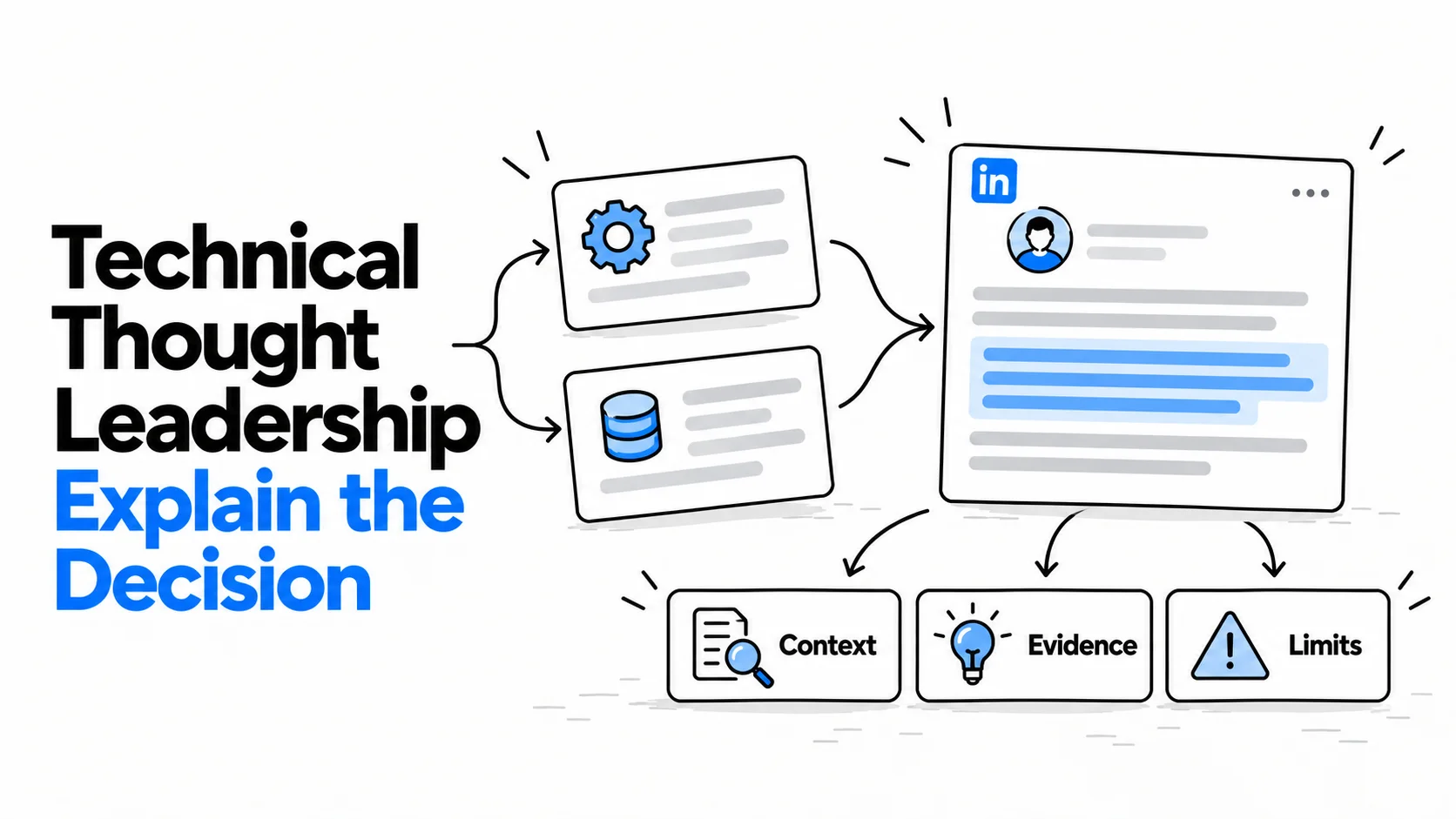
Technical thought leadership explains the judgment behind a technical decision in terms a buyer can use. It connects the problem, the alternatives, the tradeoff, and the evidence without turning an engineering detail into an unsupported business promise.
For a B2B founder, the goal is not to prove that the product is complicated. It is to help a prospective customer understand why a decision matters to their work, what it changes, and where its limits are. A list of features describes what you built. An explanation of a difficult choice shows how you think.
This guide focuses on turning one engineering decision into a useful piece of buyer-facing content. For the wider editorial program, see our guide to B2B thought leadership strategy.
Before writing, finish this sentence: “This matters to someone deciding whether to ___.” The answer should name a decision or task, not a vague outcome such as “innovate faster.”
A technical evaluator might want to understand how a system behaves when a request fails. An operations lead might care about how their team recovers from an uncertain transaction. A finance stakeholder might ask what evidence supports a claim about reduced manual work. These are possible reader perspectives, not assumptions that every buying group has the same roles.
The 2025 Edelman–LinkedIn B2B Thought Leadership Impact Report examines both visible decision-makers and less visible participants in purchasing decisions. Its findings support considering readers beyond the direct product user. They do not establish that any particular post will generate pipeline.
Choose one reader and one question for the piece. If you try to explain the architecture, the purchasing case, and the implementation plan in a single LinkedIn post, each can become too thin to be useful.
“We launched a new processing layer” is an announcement. The source material becomes more useful when you can explain what the team chose and what that choice required.
Ask the founder or engineer who made the decision:
Keep the source notes separate from the proposed message. “The system returned the recorded result in this test” and “customers will spend less time resolving problems” are different claims. The second needs its own evidence.
This invented example is not a customer story or measured result. The general retry problem is explained in Amazon's Builders' Library. The product choices and copy below are hypothetical.
Repeat order submissions carrying the same request identifier return a recorded result. This adds state-management work. We tested defined cases; we have not measured support impact.
Enterprise-grade architecture eliminates duplicate orders and transforms efficiency.
This invents an outcome and drops the conditions.
The order request timed out. Did it fail, or did confirmation fail to arrive?
For repeat submissions with the same identifier, our endpoint returns the recorded result. We accepted more state to manage.
Our defined tests passed; support impact is still unmeasured.
This preserves the mechanism, the tradeoff, and the measurement gap. A technical owner must confirm the actual identifier rules and supported cases before approving real product copy.
A useful editing check is to identify which level each sentence describes:
A product decision can be worth discussing before its commercial effect is measured. Explain the problem and the reasoning honestly. Do not fill the measurement gap with an invented percentage, a customer quotation, or a claim that the change increased retention.
The same rule applies to benchmarks. If a performance number is relevant, identify what was measured and under which conditions. A result from one test does not automatically describe every workload or customer environment.
You do not have to remove every technical term. Explain the terms the reader needs and link to deeper material where appropriate. What you should remove is language that hides the point: “next-generation,” “enterprise-grade,” or “seamless” does not explain a decision by itself.
A good simplification preserves three things: who is affected, what happens, and under which conditions. In another illustrative example, “Every team gets a real-time view” hides limitations. “The dashboard shows when its source data was last refreshed” gives a buyer a concrete behavior to verify.
Then connect the mechanism to a buyer's concern without claiming an unmeasured outcome. Explaining what information an export contains is more defensible than promising that nobody will need to check it.
Before sharing a source document or screenshot, check whether it exposes customer information, internal access details, or a security-sensitive design. Use approved material. A public explanation should not require disclosing everything that helped the team make the decision.
Ask the technical owner whether the piece describes the behavior accurately, retains the important qualifications, and avoids implying a guarantee the product does not make.
Ask someone who understands the intended buyer's work what decision the piece helps them make. Can they explain why the tradeoff matters? Do they know what evidence or documentation to ask for next? If they remember only that the company uses sophisticated technology, the business context is still missing.
These are editorial checks. They are not a substitute for testing the product, conducting a security review, or substantiating a performance claim.
For the next piece, use the same five-part outline: the buyer's problem, the decision, the rejected alternative, the evidence, and the limit. It works best when the source contains an actual choice rather than a feature name in search of a story.
Across several posts, recurring choices can become useful LinkedIn content pillars: reliability versus operational complexity, flexibility versus setup effort, or automation versus human review. Those are examples of tensions to investigate, not claims about how a particular product behaves.
Judge the content first by whether the right reader can understand and discuss the decision. Relevant questions from buyers or feedback from sales can inform the next piece. They should not be presented as proof that a single post caused revenue.
Rethoric helps B2B founders turn real experience into LinkedIn content through interviews, human writing, review, and distribution. If your strongest ideas are buried in engineering conversations, explore LinkedIn ghostwriting for founders or book an intro call. Bring one decision you can discuss openly; the starting point is the reasoning behind it.
