How founders can use LinkedIn content pillars to turn expertise, customer pain, market beliefs, and proof into a repeatable point of view.
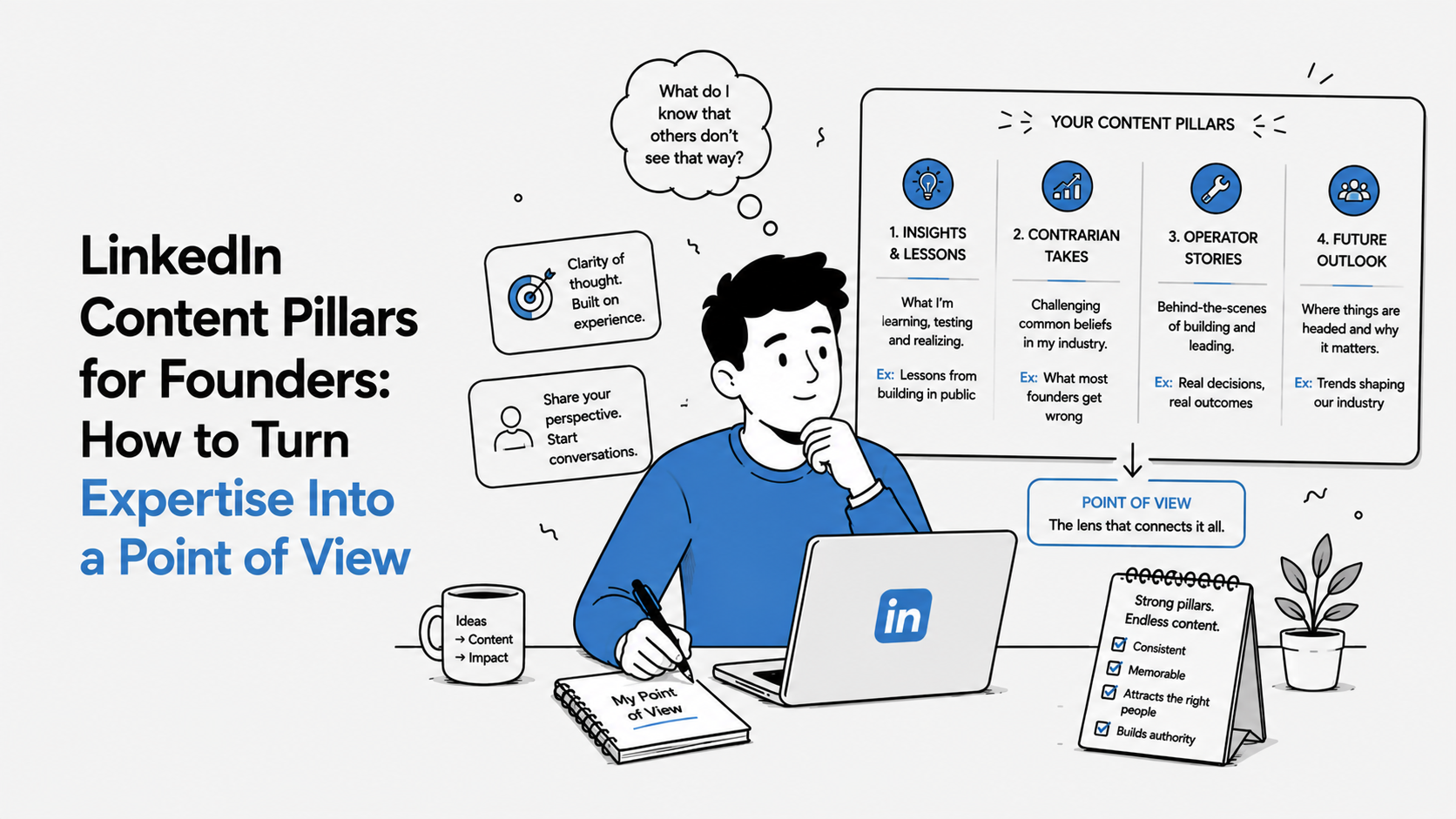
Most founders do not run out of ideas.
They run out of structure.
One week they post a customer lesson. The next week they share a company update. Then a hiring note. Then a reaction to a market trend. Then silence, because every post feels like starting from zero again.
That is the problem LinkedIn content pillars are supposed to solve.
But most advice about content pillars is too generic for founders. It tells you to pick themes like leadership, culture, product, and growth. Those are labels, not strategy. They do not tell the market what you believe. They do not help your team capture better raw material. They do not create a consistent point of view buyers, investors, candidates, and category peers can recognize.
For a B2B founder, LinkedIn content pillars should do something sharper. They should turn the founder's expertise into repeatable market signal.
The goal is not to make posting easier by filling a calendar with buckets. The goal is to make your judgment easier to find, trust, remember, and act on.
This guide breaks down how founders should build LinkedIn content pillars, what good pillars look like, what weak pillars get wrong, and how to use them without turning your voice into a template.
LinkedIn content pillars are the recurring strategic themes that organize what a founder talks about on LinkedIn.
They define the ideas, problems, beliefs, proof points, and stories the founder returns to over time. A strong pillar gives the content program a spine. It tells the team what to capture, what to ignore, and how each post should help the market understand the company more clearly.
That matters because founder-led LinkedIn content can drift quickly.
Without pillars, every post is judged in isolation. Is this interesting? Is this timely? Will this perform? Those questions are not useless, but they are incomplete. A post can perform well and still teach the wrong audience nothing important about your company.
With pillars, the better question becomes: does this post strengthen the point of view we need the market to associate with us?
If you already have the broader strategy layer in place, Rethoric's guide to LinkedIn content strategy for founders explains why founder-led content has to connect to pipeline, authority, and distribution, not just posting consistency.
Creator content pillars are usually built around audience growth. Founder content pillars should be built around market trust.
That difference changes everything.
A creator can choose pillars based on what gets attention. A founder has to choose pillars based on what creates commercial belief. The founder is not just trying to be seen. They are trying to make a market more familiar with the problem they solve, the category they are building, the taste behind the product, and the judgment behind the company.
For a Series A or later B2B founder, the audience is not one clean persona. It includes buyers, investors, candidates, partners, analysts, existing customers, and employees. The same post can influence several of those groups if the pillar is strong enough.
That is why generic pillars like "leadership" or "company culture" usually fail. They are too broad to create strategic memory. Nobody walks away thinking, "That founder understands our exact problem better than the alternatives."
Good founder pillars are narrower. They are rooted in what the founder knows from building the company: buyer pain, market timing, category beliefs, product lessons, operating principles, customer outcomes, and the founder's contrarian read on where the industry is going.
That is also what separates founder-led marketing from ordinary social media management. The founder's real thinking is the asset. The pillars are the operating system that keeps that thinking from getting lost.
Rethoric's founder-led marketing playbook goes deeper on why the founder's expertise can become a growth channel when it is captured and distributed with intent.
There is no universal pillar set. A cybersecurity founder, vertical SaaS founder, and AI infrastructure founder should not sound the same.
Still, most B2B founders can start with five pillar types and then make them specific to their market.
This pillar explains what you believe about the market that your audience needs to understand before they can fully value your company.
Market belief posts are not generic trend commentary. They make the founder's view of change visible. What is breaking? What old assumption no longer works? What are buyers realizing too late? What will the best companies do differently in the next two years?
For example, a founder selling to revenue teams might repeatedly explain why outbound volume is becoming less defensible and why buyer trust has to be built before the pitch. A founder selling infrastructure might explain why teams are paying hidden tax for architectural decisions made three years ago.
This pillar helps the market understand why now matters.
This pillar turns customer pain into public clarity.
Founders hear better raw material than almost anyone else in the company. They hear objections on sales calls, frustrations in customer conversations, confusion during onboarding, and hard tradeoffs during renewals. Those patterns should become content.
The point is not to turn customers into case studies every week. The point is to show that the founder understands the problem at a level deeper than the landing page.
A strong customer-problem pillar makes buyers feel seen before they ever book a call.
This pillar shows how the founder makes decisions.
It can cover product tradeoffs, hiring lessons, pricing calls, market focus, fundraising discipline, sales learnings, or painful mistakes. The strongest posts usually come from a real decision with consequences.
This is where founder voice matters most. A generic lesson sounds like content. A specific decision sounds like an operator.
Founder judgment posts build trust because they let the market watch how the founder thinks under constraint.
This pillar shows evidence that the company is moving.
Proof does not have to mean vanity announcements. It can include customer outcomes, adoption signals, product progress, team lessons, implementation stories, investor milestones, community feedback, or a useful before-and-after from the market.
The mistake is posting progress like a press release. Strong proof content connects the milestone back to a larger market point.
Instead of saying "we launched a feature," the founder explains what customer behavior made the feature necessary and what it reveals about the category.
This pillar teaches the market how to think or act better.
It can include frameworks, checklists, teardown-style posts, mistakes to avoid, buying criteria, operating models, and explanations of complex concepts. Practical education works because it gives the audience something useful while reinforcing the founder's authority.
The key is specificity. "Five ways to improve your team" is forgettable. "Three signs your RevOps workflow is hiding pipeline leakage" is much more useful because it names a real problem for a real audience.
If you need tactical inputs for this pillar, Rethoric's guide to LinkedIn post ideas for founders can help turn founder expertise into posts without drifting into filler.
The best pillars are not brainstormed in a blank document.
They are extracted from the business.
Start with sales calls. Which objections keep appearing? Which buyer beliefs need to change before deals move? Which problems create urgency? Which stories make prospects lean in?
Then look at customer conversations. What language do customers use before they understand the category? What outcome do they care about but struggle to describe? What mistakes did they make before they found you?
Next, review investor updates, board decks, product strategy, and internal memos. Founders often write the sharpest content material for private audiences. The work is not to leak private details. The work is to turn the underlying judgment into public market education.
Finally, look at what the founder already says repeatedly. Strong pillars often hide inside phrases the founder repeats on calls. If the founder keeps saying, "The real issue is not X, it is Y," that is probably a pillar trying to get out.
A practical test is simple. If a pillar cannot produce ten strong posts without repeating itself, it is probably too narrow or too shallow. If it can produce a hundred posts that all sound unrelated, it is probably too broad.
Weak pillars usually fail for one of four reasons.
First, they are too generic. "Leadership," "innovation," and "growth" are not founder content pillars. They are content folders. They do not create a memorable point of view.
Second, they are too internal. A pillar like "company culture" can work, but only if it teaches the market something about how the company builds, hires, serves customers, or makes decisions. Otherwise it becomes employer-brand content with limited buyer relevance.
Third, they are too product-heavy. Founders should talk about product, but a content program that only explains features trains the audience to wait for announcements. The better move is to connect product choices to customer problems and market change.
Fourth, they are too dependent on trends. Trend commentary can create reach, but it rarely compounds unless it connects back to a durable belief. If every pillar depends on the news cycle, the founder never becomes known for a clear thesis.
Strong pillars do not make every post sound the same. They make every post feel like it belongs to the same mind.
Once the pillars are clear, the calendar becomes easier to operate.
Instead of asking, "What should we post this week?" the team asks which pillar needs more signal this week. That changes the workflow from idea hunting to strategic coverage.
A simple weekly mix might include one market belief post, one customer-problem post, one founder-judgment post, and one practical education post. Proof and progress can appear when there is real evidence worth sharing.
That mix is only a starting point. A company entering a new category may need more market belief content. A company with a complex buying process may need more practical education. A company raising or hiring may need more founder judgment and proof.
The point is not to rotate pillars mechanically. The point is to keep the content program balanced so the founder is not only posting lessons, only sharing announcements, or only reacting to trends.
If the calendar is already in place, Rethoric's LinkedIn content calendar for founders guide explains how to turn that structure into a shipping rhythm.
There is a risk with pillars.
If the team treats them too rigidly, the founder's content starts to feel manufactured. Every post fits a bucket, but none of it feels alive.
The fix is to treat pillars as editorial direction, not fill-in-the-blank templates.
A pillar should tell the team what kind of thinking to capture. It should not force every post into the same structure. The same market-belief pillar can produce a short opinion, a customer story, a teardown, a list of mistakes, a prediction, or a response to an objection.
Variation matters because LinkedIn is not a white paper library. People follow founders because they want judgment in motion. They want to see how the founder responds to the market, not just read approved messaging in different formats.
This is where a strong approval workflow helps. The team can use pillars to organize content, then use founder review to protect voice, specificity, and edge before anything ships.
For more on the workflow layer, see Rethoric's guide to content approval workflows for founder-led LinkedIn.
Content pillars are working when the right people start associating the founder with the right ideas.
That does not always show up as the highest-impression post. Sometimes the best pillar is the one that creates better sales conversations, warmer investor introductions, stronger candidate replies, or more precise inbound questions.
Track reach and engagement, but do not stop there. Look at profile visits from relevant people, comments from buyers and operators, saves from target accounts, replies from investors, content referenced in sales calls, and posts that your team keeps reusing in follow-up.
Also watch for language adoption. If prospects start repeating the founder's phrasing, the pillar is doing its job. If candidates mention a founder's operating philosophy in interviews, the pillar is creating hiring signal. If investors already understand the category narrative before the first meeting, the pillar is lowering the cost of explanation.
Rethoric's guide to LinkedIn analytics for founders covers the metrics that matter when the goal is pipeline and authority, not vanity reach.
LinkedIn content pillars are not a branding exercise for founders.
They are how founder expertise becomes a repeatable point of view.
The right pillars help a founder show up consistently without sounding generic. They give the team a way to capture better ideas, build a smarter calendar, protect voice, and create market memory around the problems the company is built to solve.
The wrong pillars create tidy buckets full of forgettable content.
If you are building founder-led LinkedIn as a growth channel, start with the business. Pull the pillars from sales calls, customer pain, product judgment, market beliefs, and proof. Then turn those pillars into posts the market can actually use.
That is how founders stop posting random thoughts and start building a public body of work that compounds.
