LinkedIn analytics only matter when they show whether founder-led content is creating the right visibility, relationships, and pipeline signals.
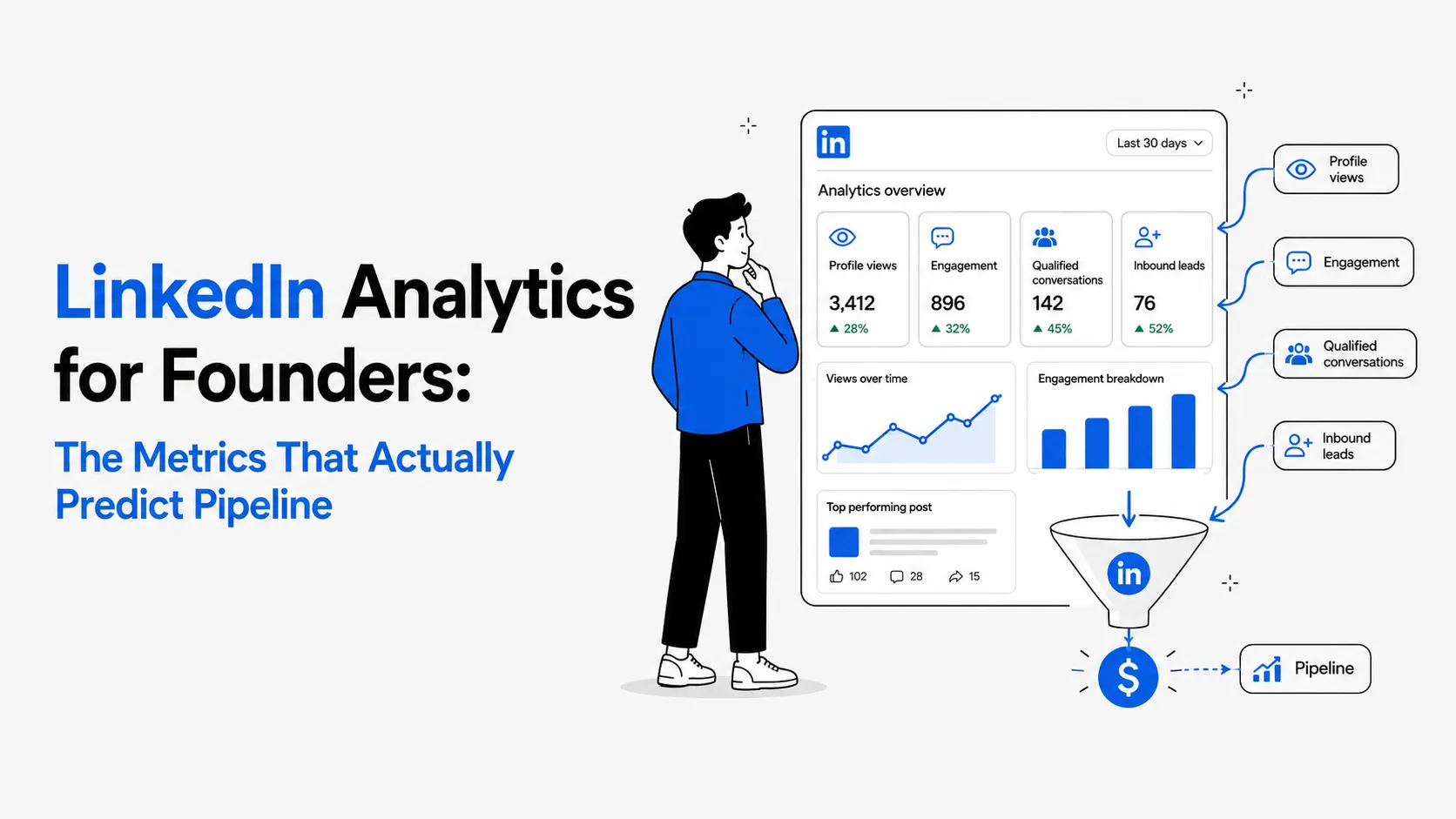
Most founders look at LinkedIn analytics the wrong way.
They open the dashboard, see impressions, reactions, profile views, and follower growth, then try to decide whether the work is paying off. If the numbers are up, they feel good. If the numbers are flat, they assume LinkedIn is not working.
That is too shallow for B2B.
LinkedIn analytics can be useful, but only if you know what each number is actually telling you. A founder does not need creator metrics. A founder needs market signal. Are the right people seeing the point of view? Are buyers starting conversations earlier? Are investors, candidates, partners, and category peers becoming familiar with the company before they need something?
That is what this guide covers: how founders should read LinkedIn analytics, which metrics matter, which ones mislead, and how to connect content performance to pipeline without pretending every deal will show up cleanly in attribution software.
LinkedIn analytics were not built around founder-led B2B growth. They were built to show account activity: impressions, engagement, followers, clicks, profile views, and audience traits.
Those numbers are not useless. They are just incomplete.
A post can create a sales conversation without earning many likes. A founder can influence an investor months before a fundraising process starts. A buyer can read five posts, never engage publicly, and still mention the founder's content on a discovery call. None of that is captured cleanly by a basic engagement chart.
This is why founders get frustrated. The channel is working in the market, but the dashboard is showing a narrow slice of the value.
The fix is not to ignore analytics. The fix is to separate diagnostics from business outcomes.
Diagnostics tell you whether the content is reaching people and creating response. Business outcomes tell you whether that attention is becoming trust, conversation, and pipeline. You need both, but you should not confuse one for the other.
A founder-led LinkedIn program should track five layers of signal.
Each layer answers a different question. Together, they show whether your content engine is moving from visibility to demand.
Impressions show how often your content was displayed. They do not prove trust. They do not prove demand. They prove distribution.
For founders, impressions matter because B2B buying is built on repetition. Buyers rarely convert from one post. They become familiar with the founder's judgment over time. They see the same point of view from different angles. They start associating the company with a specific problem, market shift, or category position.
That repetition has value.
But impressions only matter if they are attached to the right narrative. A high-impression post about a broad career lesson may build awareness, but it may not build demand. A lower-impression post about a painful customer problem may be more valuable if it reaches the people who feel that problem every day.
Track impressions by topic, not just by post. Which themes consistently travel? Which buyer problems create reach? Which opinions bring the right people into the comments or DMs? That is where impressions become useful.
Engagement rate shows how many people reacted, commented, shared, or clicked compared with the number of people who saw the post.
It is a useful diagnostic, but it is easy to overrate.
Some high-engagement posts are empty calories. They are relatable, broad, and easy to like. Some low-engagement posts are commercially valuable because they speak to a narrow buyer problem that only a small group understands.
Founders should look at engagement quality before engagement volume. A comment from a target-account VP, investor, category operator, or potential hire is worth more than a pile of generic reactions from people who will never buy, invest, refer, or join.
When you review LinkedIn post analytics, ask:
That lens keeps you from optimizing for easy applause instead of useful attention.
Profile views and follower growth are intent-adjacent signals. They show that someone saw enough to click deeper or subscribe to more of the founder's thinking.
For a founder, this matters because the profile is often the bridge between content and credibility. A strong post creates curiosity. The profile has to convert that curiosity into trust: what the company does, who it helps, what the founder knows, and why the market should care.
If posts are earning impressions but profile views are weak, the content may be too generic. If profile views are strong but followers or inbound conversations are weak, the profile may not be positioned clearly enough.
This connects directly to LinkedIn profile optimization for founders. Analytics will show you where people drop off, but the profile has to do the credibility work after the click.
Clicks can be useful when the post has a clear next step: a case study, landing page, newsletter, event, founder memo, or product page.
But clicks are not always the best measure for founder-led LinkedIn.
Many of the strongest founder posts are designed to build belief, not drive immediate traffic. They make a market argument. They explain a customer problem. They show the founder's operating judgment. The conversion may happen later through a DM, referral, search, direct traffic, or sales conversation.
Use clicks when the post is designed for clicks. Do not punish narrative posts because they did not behave like ads.
The better question is whether the post moved the audience one step closer. Sometimes that means a click. Sometimes it means a comment from the right buyer. Sometimes it means a prospect mentioning the post two weeks later on a call.
This is the layer most founders skip, and it is the layer that matters most.
Track the downstream signals that LinkedIn's native analytics will not show cleanly:
This is where LinkedIn ROI for founders becomes visible. The attribution will rarely be perfect, but the pattern will be obvious if you track it.
Founders should keep a lightweight content-influence log. When a prospect, investor, candidate, or partner references LinkedIn, capture the date, person, company, post or theme mentioned, and business context. Over time, this becomes more useful than a vanity dashboard.
You do not need a complicated reporting system. You need a dashboard that forces the right questions.
Build it around four sections.
Content performance. Track impressions, engagement rate, comments, shares, clicks, and profile views by post. This shows which formats and themes are getting distribution.
Audience quality. Track the titles, companies, industries, and relationship types showing up in engagement, profile views, comments, DMs, and connection requests. This shows whether the content is reaching the market you care about.
Topic signal. Group posts by theme: customer pain, founder lessons, category POV, product insight, hiring, fundraising, customer stories, or market shifts. This shows which narratives are compounding.
Business outcomes. Track inbound leads, self-reported attribution, sales-call mentions, investor familiarity, recruiting conversations, partnerships, and warm intros. This shows whether content is creating commercial movement.
The dashboard should be reviewed weekly for operating decisions and monthly for strategic direction. Weekly, you are asking what to adjust. Monthly, you are asking what the market is teaching you.
One post is not enough data.
Founders often make the mistake of treating every post like a referendum on the strategy. A post underperforms, so they change the topic. A post overperforms, so they chase the format. That creates a scattered content engine.
Look for patterns across 10 to 20 posts instead.
If customer-problem posts consistently earn lower impressions but stronger buyer comments, keep them. If broad founder lessons create reach but no commercial signal, use them carefully. If contrarian category takes drive DMs from the right people, build a series around them. If product posts only work when tied to a market problem, stop posting feature updates in isolation.
Analytics should sharpen the strategy, not whipsaw it.
A strong LinkedIn content calendar gives you enough consistency to learn. Without a calendar, analytics become noise because every post is testing a different idea, format, and audience.
A 90-day founder-led LinkedIn program should not be judged only by follower count.
After 90 days, you want to see evidence that the market is starting to understand the founder's point of view.
Look for these signals:
If those signals are showing up, the system is working even if attribution is messy.
If impressions are rising but none of the right people are appearing, the content is too broad. If the right people are engaging but volume is low, distribution may need work. If posts perform but no one converts, the profile, offer, or follow-up path may be weak.
Analytics are useful because they point to the constraint. They do not replace judgment.
Some LinkedIn metrics create more confusion than clarity.
Total followers. Follower growth is useful, but only if the right people are joining. A small audience of buyers, investors, operators, and category insiders can outperform a large audience of irrelevant accounts.
Likes. Likes are easy to earn and easy to misunderstand. They can validate resonance, but they rarely prove pipeline.
Viral reach. Viral posts are not automatically good. If the post travels outside the market you sell to, it may inflate the dashboard while weakening the signal.
Post-by-post winners. A single breakout post can teach you something, but it should not hijack the entire strategy. Founder-led content compounds through repeated ideas, not random hits.
The better standard is simple: did this content make the right people more familiar with how we think?
Rethoric treats analytics as an operating system, not a scoreboard.
The goal is not to tell a founder that a post got 8,000 impressions and move on. The goal is to understand what those impressions mean, which audience they reached, which topics are creating relationship signal, and what should happen next in the content calendar.
That matters because founder-led content is not just writing. It is capture, positioning, editing, approvals, scheduling, engagement, tagging, review, and measurement. Analytics only become useful when they are connected to that workflow.
If a post creates investor engagement, that should influence future fundraising visibility. If a customer pain point drives strong buyer comments, that should become a content series. If a topic creates reach but no business signal, it should be adjusted or deprioritized.
The founder should not have to become the analyst. The system should surface what matters and keep the content engine moving.
LinkedIn analytics are not the strategy. They are the feedback loop.
For founders, the point is not to win the dashboard. The point is to build repeated visibility with the people who can buy, invest, hire, refer, partner, or open doors.
Measure impressions, engagement, clicks, profile views, and followers. But do not stop there. Track audience quality, topic signal, relationship creation, and pipeline influence. That is where LinkedIn turns from content activity into a growth channel.
If you want founder-led LinkedIn content with the strategy, approvals, scheduling, engagement, and analytics needed to keep the engine running without adding another job to your week, see how Rethoric works with founders.
