LinkedIn profile optimization for founders covers every section that drives buyer discovery, from the headline formula to the About section structure and how the 2026 algorithm update changed what gets indexed.
67% of B2B buyers research executives before meetings, according to Edelman-LinkedIn's B2B Thought Leadership Impact Report. That research happens before the calendar invite, before the first email, before any member of your team has said a word. The page they land on most often is your LinkedIn profile.
Most founder profiles fail this moment. Not because the founder lacks credibility, but because the profile was built as a resume rather than as a buyer-facing asset. It lists what the founder has done. It does not signal who they help, what problem they solve, or why a specific buyer should care.
LinkedIn profile optimization for founders is the process of making that profile do the job it is actually there to do: get the right buyers to recognize you, trust you, and reach out. This guide covers every section that matters, the algorithm mechanics behind each one, and the specific changes that produce the most movement in the shortest time.
LinkedIn profile optimization for founders is the process of structuring each section of a LinkedIn profile to maximize discoverability by target buyers, signal credibility on the problems that matter to those buyers, and convert profile views into inbound conversations. It is not purely cosmetic. Every section of a LinkedIn profile contributes to two distinct outcomes: algorithmic visibility, which determines whether your profile appears when buyers search for solutions in your category, and human trust, which determines whether a buyer who lands on your profile concludes you are worth a conversation. The founders who get the most out of LinkedIn profile optimization treat the profile as the static foundation that amplifies everything the dynamic content does. A well-optimized profile turns content engagement into profile visits, and profile visits into inbound messages from the right buyers.
The importance of this has increased in 2026 for one specific reason: LinkedIn is now the second most cited source in AI-generated search results for B2B queries, according to Linkboost's 2026 State of LinkedIn. When a buyer asks ChatGPT or Perplexity who solves a specific problem, LinkedIn profiles and posts are part of the answer. A founder whose profile is keyword-indexed against their category is discoverable through AI search in a way that a founder with a generic profile is not.
For a breakdown of how the pipeline from LinkedIn content and profile visibility compounds over time, see LinkedIn ROI for founders.
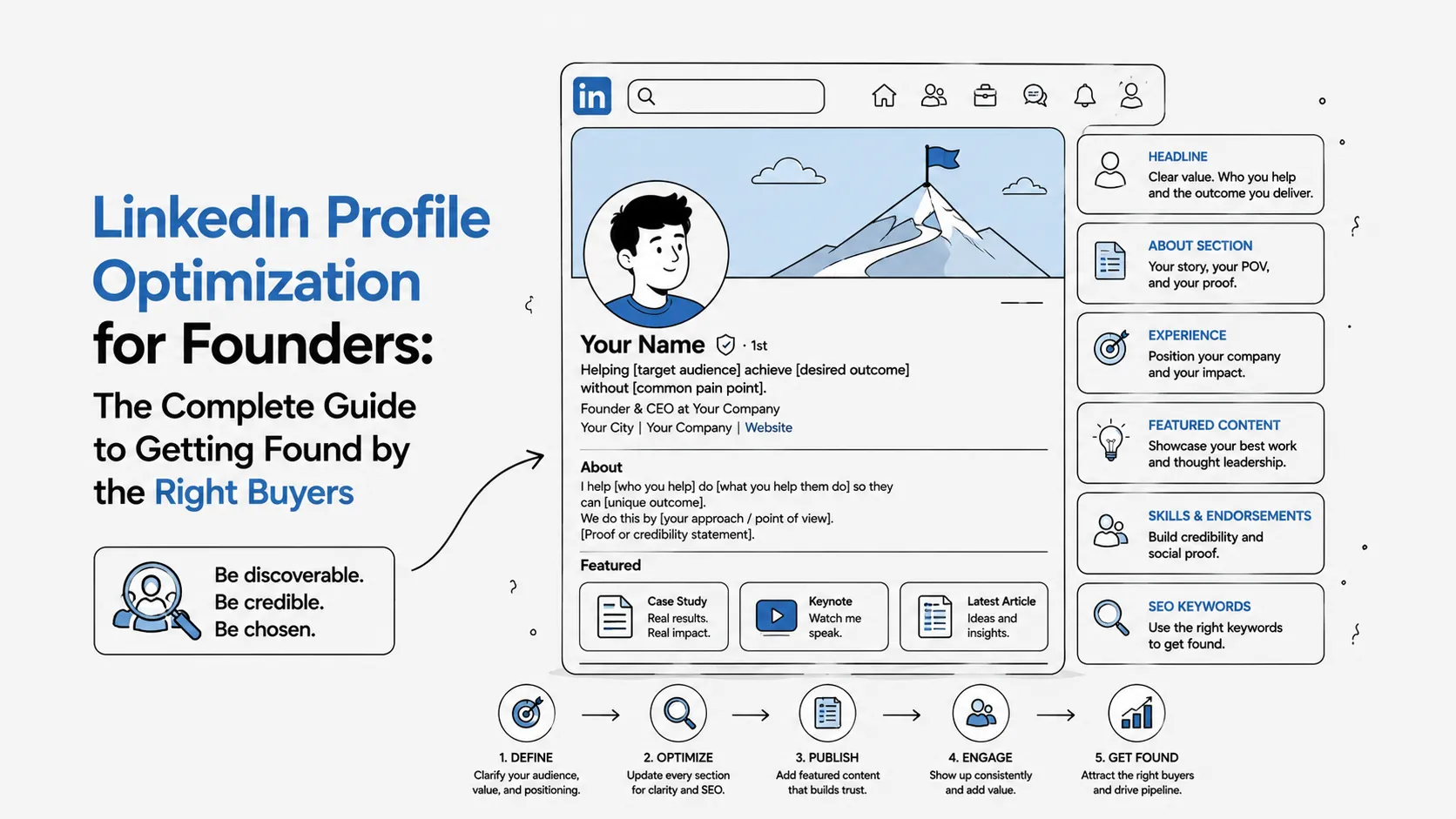
LinkedIn's search algorithm assigns different weights to different sections of your profile. The sections with the highest keyword weight, in order, are the headline, the first 300 characters of the About section, the skills section, and the experience titles. Optimizing these four sections produces most of the search visibility gain. The featured section does not carry significant keyword weight but is the highest-converting element for human buyers who land on your profile: it is what they click first after reading the headline.
The headline is the single highest-leverage change most founders can make. It is indexed heavily for search, it is the first thing any buyer reads, and it is the text that appears next to your name in every comment, every post, and every search result. Most founder headlines read "Co-founder and CEO at [Company]." This communicates nothing to a buyer who does not already know the company. A headline optimized for discovery reads differently: it names the problem, the audience, and ideally a proof point or outcome. The formula is: [Role] | [Specific Outcome] for [Specific Audience] | [Social Proof or Differentiator].
The About section's first 300 characters function as the preview text visible before a buyer clicks "see more." These 300 characters are displayed in search results and connection request previews. They carry high keyword weight and are the first narrative text a buyer reads. The most effective opening follows a four-part arc: a hook that names the problem the buyer recognizes, a statement of who you help and what outcome you deliver, a proof point with a specific number, and a call to action. The mistake most founders make is opening with their own story rather than the buyer's problem.
The featured section is where profile optimization converts attention into action. The maximum effective number of items is three: a best-performing post that demonstrates your perspective on the core buyer problem, a link to the company website or a landing page, and a useful asset like a case study, a guide, or a research piece that the buyer can take away. More than three items reduces click-through on each. Fewer than two leaves credibility evidence on the table.
The skills section is the least visited but still contributes to keyword indexing. Founders should include the two to three skills that exactly match the language their ICP uses to describe what they are looking for. These skills appear in LinkedIn's search filters and in recruiter and buyer searches conducted through LinkedIn's advanced search tools.
A founder's LinkedIn headline should include three elements to drive both algorithmic discovery and human trust: a clear statement of the specific outcome you deliver, a precise definition of who you deliver it for, and one proof point or differentiator that gives a buyer a reason to believe you. The formula that works across industries is: [Role] | [Specific Outcome] for [Specific Audience] | [Social Proof]. For example: "CEO | Reducing churn for mid-market SaaS companies | Helped 40 teams cut churn by 30% in 90 days." Each component serves a distinct function. The role anchors credibility. The outcome and audience provide the keywords that surface the profile in buyer searches. The proof point converts a search impression into a click. The most common mistake in headline optimization is writing for general impressiveness rather than for the specific buyer doing the search. A headline that would mean something to any professional means nothing to the specific professional you are trying to reach.
The character limit for LinkedIn headlines is 220 characters on desktop and 240 on mobile. Founders should use the full allowance, since longer headlines that include specific keywords consistently outperform shorter ones in search ranking and click-through rate.
The March 2026 LinkedIn Authenticity Update changed how the algorithm distributes both content and profile visibility. The most significant change for profile optimization is the introduction of the Depth Score metric: a signal that rewards profiles and content associated with sustained engagement, niche expertise, and topic consistency over time, as documented in Windmill Growth's 2026 LinkedIn research. Profiles that post regularly, comment in relevant communities, and publish content that generates dwell time on specific topics accumulate a higher Depth Score than profiles that are dormant or post inconsistently across unrelated subjects.
The practical implication for LinkedIn profile optimization for founders is that a well-built profile and a consistent content strategy are not independent decisions. A founder who has done careful profile optimization but publishes nothing sees a fraction of the search visibility of a founder who posts two to three times per week on the same topic. The algorithm routes both content distribution and profile search ranking based on topic authority signals, and those signals accumulate through activity, not just configuration.
Profile visits from ICP accounts are one of the leading indicators that a founder's LinkedIn profile optimization is working. Founders who optimize their headlines and About sections for specific buyer segments typically see profile views from target buyer titles increase within 30 days, even before content strategy changes. This is because keyword-indexed profiles begin appearing in searches buyers are already running without any change in content output.
For more on how the March 2026 algorithm update affects content strategy alongside profile visibility, see founder content strategy: how to build a pipeline that compounds.
The question founders most commonly ask about LinkedIn profile optimization is whether to fix the profile first or start the content strategy first. The correct answer is: optimize the profile first, then begin publishing.
The reason is conversion. If a founder begins publishing content that drives profile views before the profile is optimized, those views do not convert into inbound messages or follows at the rate a clean profile would produce. Content drives traffic to the profile. The profile converts that traffic. Running content with an unoptimized profile is the equivalent of driving paid traffic to a landing page that is not built to convert.
Profile optimization takes one focused session of three to four hours, covering the headline, About section, featured section, and skills. Content strategy requires sustained commitment over months. Getting the profile right before beginning the content work means every piece of content works harder from day one.
The two are closely linked to broader founder positioning strategy. A profile optimized around an unclear or generic positioning will not convert even if the keyword indexing is correct. The headline and About section need to reflect a decision already made about who the ICP is and what problem the founder solves for them. Founders who have not yet defined that positioning should read founder positioning strategy: how to own a category before making profile changes.
For the connection between profile visibility and personal brand building, see personal branding for founders: the stats that should change your strategy.
Founders should update their LinkedIn profile for optimization purposes at three natural trigger points: when positioning changes, when a major proof point or traction milestone is added, and when keyword research or content performance data suggests a different framing is attracting more of the right buyers. Beyond those trigger points, the core profile sections, particularly the headline and About opening, should remain stable. The LinkedIn algorithm treats frequent unexplained changes as a signal of inconsistency, which can reduce search ranking momentum that has built up around a specific keyword set. The featured section is the exception: it should be updated quarterly to rotate in the best-performing recent content. A featured post that generated strong engagement three months ago is more credible evidence of expertise than one from two years ago, even if the older post has more total engagement.
Does profile photo and banner matter for LinkedIn profile optimization? Yes, but not for algorithmic reasons. Profile photos and banners affect the human trust signal, not keyword indexing. A professional photo increases profile view-to-connection conversion rates. A banner image that reinforces the headline positioning, naming the problem and audience rather than displaying a company logo, extends the headline's credibility signal into a second visual element buyers see before reading any text.
How does Creator Mode affect LinkedIn profile optimization for founders? Enabling Creator Mode changes the profile layout so that the Follow button appears more prominently than the Connect button, and it unlocks access to LinkedIn newsletters and live audio events. For founders focused on building a content following rather than a connection network, Creator Mode increases the conversion rate of profile visits into followers. The trade-off is that the connections metric becomes less prominent. Founders who are actively prospecting through LinkedIn connections may prefer the standard layout. Founders prioritizing thought leadership distribution should enable Creator Mode.
Can a ghostwriter help with LinkedIn profile optimization? Yes, in the same way a ghostwriter helps with content: by capturing the founder's actual voice, expertise, and positioning and translating it into the format that performs best on the platform. The most effective approach is to do both profile optimization and content strategy together, since they share the same positioning foundation and reinforce each other. See how ghostwriting for founders works when the process is built around capturing the founder's actual perspective, or read about how founder thought leadership compounds when the profile and content are aligned.
LinkedIn profile optimization for founders is not a one-time task. It is the foundation that every piece of content, every comment, and every outbound connection lands on. Get it right, and each activity on the platform compounds. Leave it generic, and even strong content fails to convert the attention it earns.
The founders who see the fastest pipeline impact from LinkedIn are those who treated their profile as the first conversion surface, not an afterthought. That means a headline written for the buyer, an About section that opens with the buyer's problem, a featured section that provides immediate credibility evidence, and a consistent content presence that builds the Depth Score the algorithm rewards.
If you want help optimizing your LinkedIn profile and building the content system that compounds on top of it, see how Rethoric works with founders.
The examples below are illustrative templates. Replace every bracketed detail with accurate information about your business; include results only when you can substantiate them.
Founder at [Company] | Helping [specific buyer] solve [specific problem] with [product category]
Example: Founder at ExampleCo | Helping finance teams reconcile subscription revenue | B2B billing software
[Buyer group] often struggles with [problem]. I founded [Company] to help them [specific task or outcome].
My perspective comes from [relevant experience]. Here I share what we learn about [two or three topics], including decisions, tradeoffs and practical examples.
See [a verified case study, product walkthrough or useful guide] in Featured. If you are working on [problem], [appropriate next step].
Review the profile on mobile and ask someone outside your company to explain what you do after reading it. For help aligning your profile and publishing, explore LinkedIn ghostwriting for founders.
