A founder positioning strategy determines which buyers find you in the dark funnel before the first call. Here is the framework for building one that generates pipeline.
40% of B2B buyers enter the purchasing process already knowing who they plan to buy from. That number comes from Forrester research, and it means that nearly half your sales cycle happens before the first call. Buyers are researching, reading, and forming opinions in what researchers call the dark funnel: a space your sales team cannot reach and your ads cannot influence.
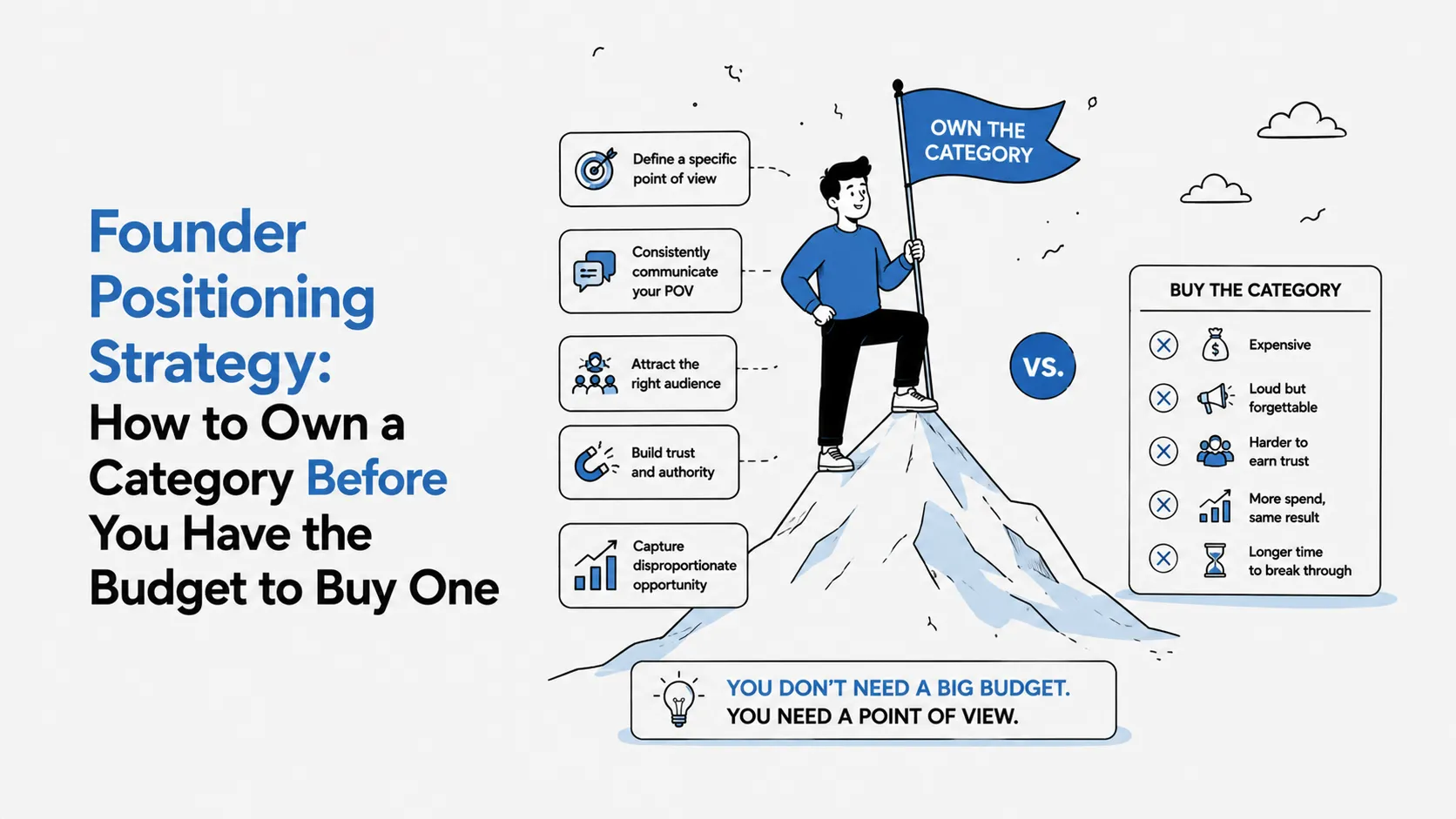
The founders who win that pre-decision phase are not the ones with the biggest budgets. They are the ones whose positioning is sharp enough that buyers associate a specific problem with a specific name. A founder positioning strategy is how that association gets built.
This guide covers what positioning means for founders specifically, the two most common mistakes that collapse pipeline, and a practical framework for getting positioned in a way that compounds over time.
A founder positioning strategy is the deliberate decision about which specific problem, for which specific audience, a founder and their company will be known for solving. It differs from brand messaging and marketing copy in one critical way: positioning is a strategic commitment, not a communication choice. It determines which buyers self-select in, which competitors you are compared against, and which content you publish on LinkedIn and other channels. A strong founder positioning strategy can be expressed in one sentence: for a specific buyer who faces a specific problem, this company delivers a specific outcome that the obvious alternative does not. The founders who build the most defensible pipelines are those who commit to a narrow enough position to own it, then build their public content and profile around that position consistently enough that the association becomes automatic in the buyer's mind.
Most founders treat positioning as something to refine after product-market fit. The data suggests that getting positioned before you scale is one of the inputs to finding product-market fit faster. 73% of B2B decision-makers trust thought leadership from a named individual more than any marketing material their company produces, according to the Edelman-LinkedIn B2B Thought Leadership Impact Report. That trust advantage is what clear positioning unlocks: buyers who associate a specific name with a specific problem arrive at sales conversations already convinced.
If 40% of buyers pre-decide before engaging with any vendor, the founders who win those decisions are the ones who built recognition in the dark funnel through consistent publishing, targeted commentary, and a profile that signals expertise in a specific domain. A vague positioning statement does not accumulate in the buyer's mind across repeated encounters. A sharp one does.
The compounding effect is measurable. Inbound leads generated through LinkedIn content close at 14.6%, compared to 1.7% for cold outbound, an 8.6x difference documented in Linkboost's 2026 State of LinkedIn. The mechanism is not volume of content. It is the clarity of the signal each piece of content sends about what the founder stands for and who they serve.
LinkedIn is now the second most cited source in AI-generated search results for B2B queries. Buyers using tools like ChatGPT and Perplexity to research solutions encounter LinkedIn profiles and posts as part of the answer. A founder who is keyword-indexed against a specific problem in their LinkedIn headline, featured section, and published posts becomes discoverable through AI search in a way that a founder with a generic profile does not.
For a detailed breakdown of how LinkedIn content drives pipeline, see LinkedIn ROI for founders.
Most founder positioning fails for one of two reasons.
The first is attempting to create a new category instead of entering an existing one with a specific angle. Category creation requires significant marketing investment and a long timeline to shift buyer mental models. Most early and growth-stage founders do not have either. The better move for most is vertical specialization: claiming an existing category for a specific audience. "We are revenue intelligence software" is category entry with no differentiation. "We are revenue intelligence for mid-market SaaS companies with 50 to 200 sales reps" gives buyers a reason to self-select and gives the founder a specific community to become visible in.
The second mistake is positioning to the broadest possible audience. Founders fear excluding buyers, so they write about a wide range of topics and claim they can serve multiple segments. The result is that no segment associates the founder's name with their specific problem. The LinkedIn algorithm compounds this: the March 2026 Authenticity Update introduced a Depth Score metric that rewards consistent engagement and dwell time on niche topics, as documented in Windmill Growth's 2026 LinkedIn research. Founders who publish across unrelated subjects see their distribution diluted. Founders who stay in one lane accumulate a topic authority signal that increases organic reach over time.
A founder positioning strategy that generates pipeline requires four decisions made in sequence. First, define the ICP at the intersection of problem and persona: not just who they are, but what specific pain they have that existing solutions address poorly. Second, choose between category entry with vertical specialization and pure niche creation. For most founders, entering a known category for a specific audience is faster and more defensible. Third, write the positioning sentence using this structure: for [ICP] who face [specific problem], [company] is the [category] that delivers [primary outcome], unlike [alternative], because of [evidence-backed differentiator]. Fourth, test the positioning through LinkedIn content before committing to it as a brand-level decision: three to four weeks of posts targeting a specific audience and problem set will surface whether the signal resonates with the right buyers. Positioning tested through content is more reliable than positioning tested through internal strategy sessions.
Step 1: Define the ICP with precision. Most founders can name their target industry. Fewer can name the specific role, the specific trigger that makes someone urgent to buy, and the specific failure mode that makes existing alternatives inadequate. That third layer is where positioning actually lives. "Growth-stage SaaS CFOs who need to reduce churn" is more actionable than "SaaS finance teams."
Step 2: Choose your positioning type. Vertical specialization works well for founders competing in established software or services categories. "We are [existing category] for [specific industry or company stage]" gives buyers a clear referral frame and gives the founder a defined community to publish in. Category creation, claiming a new name for a new way of solving a problem, is a longer play and requires existing market recognition before it compounds.
Step 3: Write the positioning sentence. The formula used across most B2B strategy frameworks follows this structure: "For [ICP] who face [urgent pain], [brand] is the [category] that delivers [primary benefit]. Unlike [alternative], we [evidence-backed differentiator]." The test is simple: can a buyer read that sentence and immediately know whether they are the right customer? If it requires explanation, it is not sharp enough.
Step 4: Test on LinkedIn before locking in. Publish four to six posts specifically aimed at your ICP using the language of the positioning. Watch which posts generate the highest dwell time, saves, and inbound messages from the right audience. Those signals are more reliable than internal debate. The founders who get positioned fastest are the ones who treat LinkedIn as a positioning laboratory, not just a distribution channel.
For a framework on building the content system that makes this sustainable, see founder content strategy: how to build a pipeline that compounds.
Once the positioning is defined, it needs to be expressed consistently across the founder's LinkedIn profile and content. The places where it matters most are the headline, the About section opening, and the content pillars.
The LinkedIn headline carries the highest keyword weight in the platform's search algorithm. A headline that includes the specific problem you solve and the specific audience you serve ranks higher in searches from that audience than one that lists a job title and company name. The difference between "CEO at Acme" and "Revenue intelligence for mid-market SaaS | Helping sales teams forecast accurately" is not just cosmetic. It determines whether buyers searching for solutions in your category find you or a competitor.
The About section's first 300 characters carry disproportionate keyword weight and are the preview text buyers see before clicking through to the full profile. Those characters should include the positioning sentence or a version of it, not an origin story or a resume summary.
Content pillar alignment is where positioning compounds. Founders who publish consistently on two to three specific topics associated with their ICP's core problems accumulate what the LinkedIn algorithm's March 2026 update measures as niche expertise signals. These signals increase content distribution to audiences the algorithm identifies as matching the topic, even beyond the founder's existing network.
For more on how thought leadership content reinforces positioning over time, see founder thought leadership: the pipeline asset most founders build too late.
Founder positioning strategy and personal branding address different questions. Positioning answers: what specific problem, for what specific audience, does this founder and company solve uniquely? Personal branding answers: how is this founder's expertise, perspective, and character expressed consistently across public channels? Positioning is a strategic decision that comes first and narrows the scope of everything else. Personal branding is the system built on top of that positioning to make it recognizable over time. A founder can have a strong personal brand with weak positioning, producing high engagement from a broad audience that does not convert. A founder with sharp positioning and a systematically built personal brand produces content that reaches the right buyers and arrives already primed to trust the founder's judgment. The two are not interchangeable, but positioning is the foundation that makes personal branding commercially useful rather than just professionally visible.
How long does it take for a founder positioning strategy to produce results? The first signals appear in 60 to 90 days: profile views from target buyers increase, inbound message relevance improves, and content begins reaching the right audience segments. Measurable pipeline impact typically appears between months four and six. The mechanism is the same as for all compound content strategies: each piece of content adds to an association the buyer builds over repeated encounters. Founders who commit to a specific positioning and publish consistently against it for six months typically see their LinkedIn Depth Score accumulate enough signal to drive meaningful organic distribution to their target ICP.
Does positioning need to be locked in before publishing content? No, and waiting until positioning is perfect before publishing is one of the most common delays founders create for themselves. Publish with a working hypothesis, watch what lands with the right buyers, and use those signals to sharpen the positioning. Four to six weeks of consistent content aimed at a specific ICP produces more reliable data than four to six weeks of internal positioning workshops.
How does a founder positioning strategy interact with a content partner or ghostwriter? A ghostwriter who does not understand the positioning will produce content that sounds like the founder but does not advance the strategic goal. The first and most important input to any content partnership is a clear articulation of the positioning: who the ICP is, what problem they have, and what the founder's differentiated perspective on that problem is. Without it, the content will be generic. With it, every post advances the positioning and builds the buyer association that drives pipeline. See how ghostwriting for executives works when positioning is the starting point, or read more about personal branding for founders.
Founder positioning strategy is not a marketing document. It is the decision that determines what you publish, who you talk to, how your LinkedIn profile reads, and which buyers self-select before any sales conversation starts.
The founders who build the most durable pipelines are not necessarily the most talented writers or the most prolific posters. They are the ones who know exactly who they serve and what they stand for, and publish that consistently enough that the right buyers arrive already knowing the answer to their most important question: is this the person who understands my problem?
If you want help building the positioning and content system behind that result, see how Rethoric works with founders.
