A practical LinkedIn content calendar for founders with a 30-day B2B plan, weekly post mix, and batching workflow to publish consistently with strategic focus.
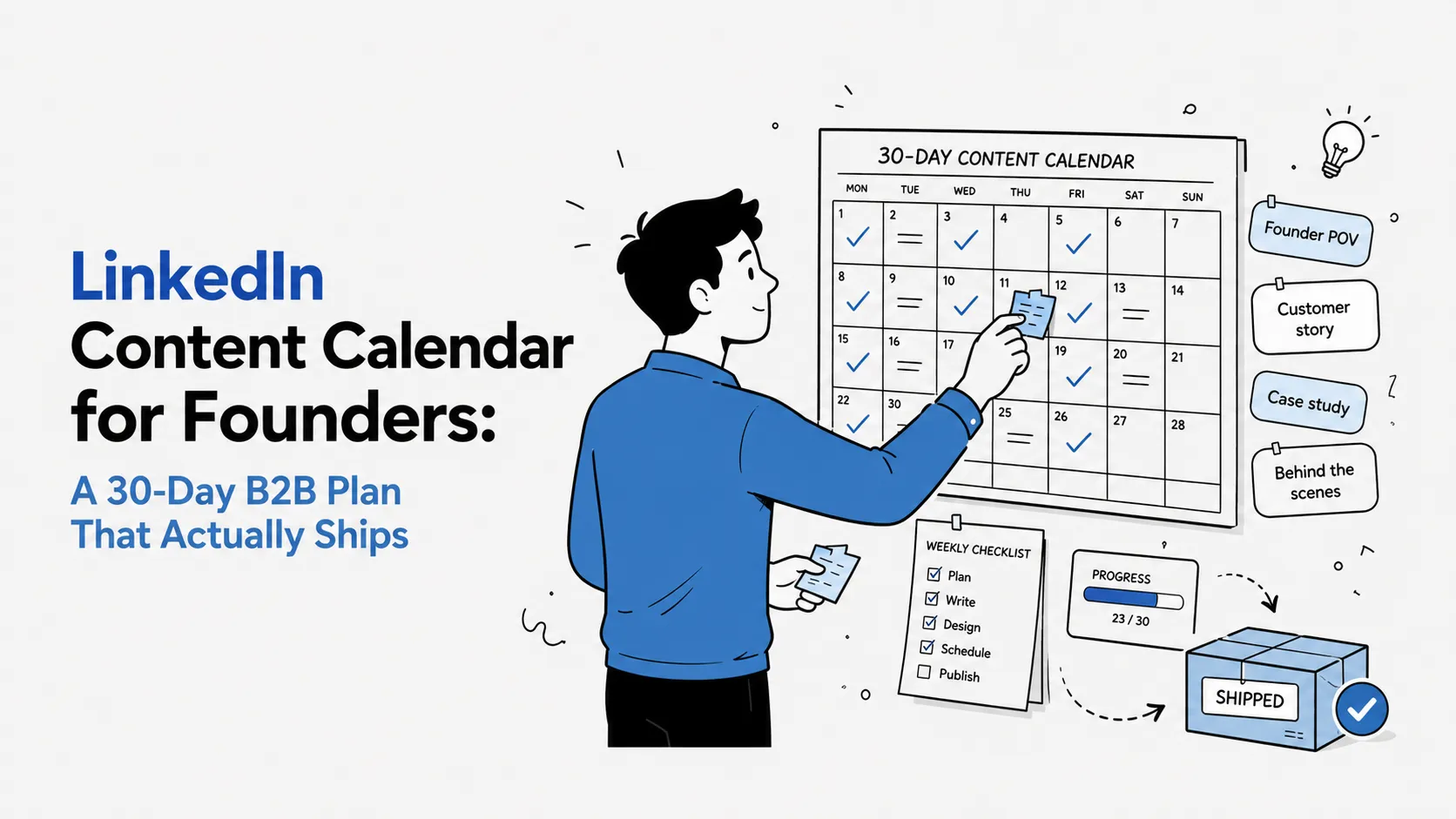
Most founders do not fail at LinkedIn because they lack ideas. They fail because ideas live in scattered notes, half-finished drafts, and late-night promises to post tomorrow. A LinkedIn content calendar fixes that execution gap. It turns random effort into a simple operating system you can run every week without burning founder time.
This guide gives you a founder-specific, B2B-focused LinkedIn content calendar you can implement in one afternoon. You will get the exact weekly post mix, a repeatable 30-day structure, and a batching workflow that keeps quality high while reducing decision fatigue. The goal is not vanity reach. The goal is consistent authority that compounds into pipeline.
A founder LinkedIn content calendar should include four things: clear content pillars, a weekly post mix across funnel stages, fixed publishing slots, and a lightweight review loop for performance. In practice, that means choosing three to five themes tied to your ICP, planning posts that balance authority and demand capture, scheduling them on specific weekdays, and checking each week what drove qualified profile views, saves, and inbound messages.
If the strategy layer is still fuzzy, start with this foundation on LinkedIn content strategy for founders. Your calendar should execute that strategy, not replace it.
Use a four-week cycle. Keep the structure fixed and rotate topics inside each slot. That gives you consistency without sounding repetitive.
Week 1 focuses on demand creation: one strong point-of-view post, one tactical framework, and one founder story tied to a customer problem. Week 2 leans into proof: one case-style breakdown, one myth-busting post, and one practical checklist. Week 3 deepens trust: one behind-the-decision post, one educational explainer, and one contrarian insight backed by real examples. Week 4 converts attention: one objection-handling post, one offer-adjacent post, and one recap that links your best insights from the month.
This cadence gives you 12 high-signal posts in 30 days, enough to stay visible with B2B buyers while keeping production realistic for a founder schedule.
A reliable mix is 50 percent top-of-funnel, 35 percent middle-of-funnel, and 15 percent bottom-of-funnel. Top-of-funnel posts earn distribution and new relevant followers. Middle-of-funnel posts prove expertise and create trust. Bottom-of-funnel posts convert accumulated trust into conversations.
Founders who over-index on promotion usually see engagement decay. Founders who lead with utility earn the right to sell occasionally. If you want examples of utility-first formats, these LinkedIn post ideas for founders are useful for filling each calendar slot quickly.
Block one weekly planning session and one writing session. In planning, collect raw inputs from your week: customer questions, sales objections, product decisions, team lessons, and industry signals. Then map each input to a slot in your calendar. In writing, batch two to four posts at once so you are never writing from zero on publish day.
A practical 90-minute workflow looks like this:
Strong openings dramatically increase read depth, so pair this process with the hook principles in how to write a LinkedIn hook.
Your LinkedIn content calendar works best when every post belongs to a pillar that matters to your buyer. For most B2B founders, five pillars are enough: customer pain patterns, founder decision-making, execution frameworks, category point of view, and lessons from wins and losses.
Each week, fill your three publishing slots from at least two different pillars. This keeps your feed coherent and prevents topic drift. Over time, repetition inside these pillars is what builds recognizable authority and improves high-intent inbound.
The first mistake is over-planning with under-shipping. A beautiful Notion board is irrelevant if posts never leave draft. The second is weak content inventory: if you do not capture raw ideas during the week, planning sessions become guesswork. The third is measuring only impressions. A founder calendar should be evaluated by qualified profile visits, saves, DMs from the right people, and pipeline conversations.
Another common issue is publishing frequency without content quality. Three low-value posts do less than one specific, high-utility post. If consistency feels hard, this diagnosis of why LinkedIn writing is hard for founders will help you fix the root cause rather than forcing volume.
How many posts per week should founders schedule? Three quality posts per week is a strong baseline for most B2B founders. It is frequent enough to stay relevant and realistic enough to sustain for months.
Should founders schedule every post in advance? Schedule most posts, but leave one flexible slot each week for timely commentary or live company moments.
How far ahead should the calendar be planned? Plan one month ahead at the slot level, then finalize exact angles one week ahead based on current conversations and market context.
What if performance drops for two weeks? Keep the cadence, tighten the hooks, and improve specificity of problems addressed. Most calendar breakdowns come from vague topics, not from the calendar itself.
A LinkedIn content calendar is not busywork for founders. It is a leverage system. When your calendar is tied to buyer problems, structured across funnel intent, and executed through weekly batching, your content stops being sporadic and starts compounding.
Build the calendar once, run it for 30 days, and improve from real signals. That simple discipline is what turns founder expertise into consistent market visibility and better inbound conversations. For support implementing a done-with-you system, talk to Rethoric.
