Founders don't lack expertise, they lack formats. A reusable system of content pillars, founder post types, and the funnel mix so you never run out of LinkedIn post ideas.
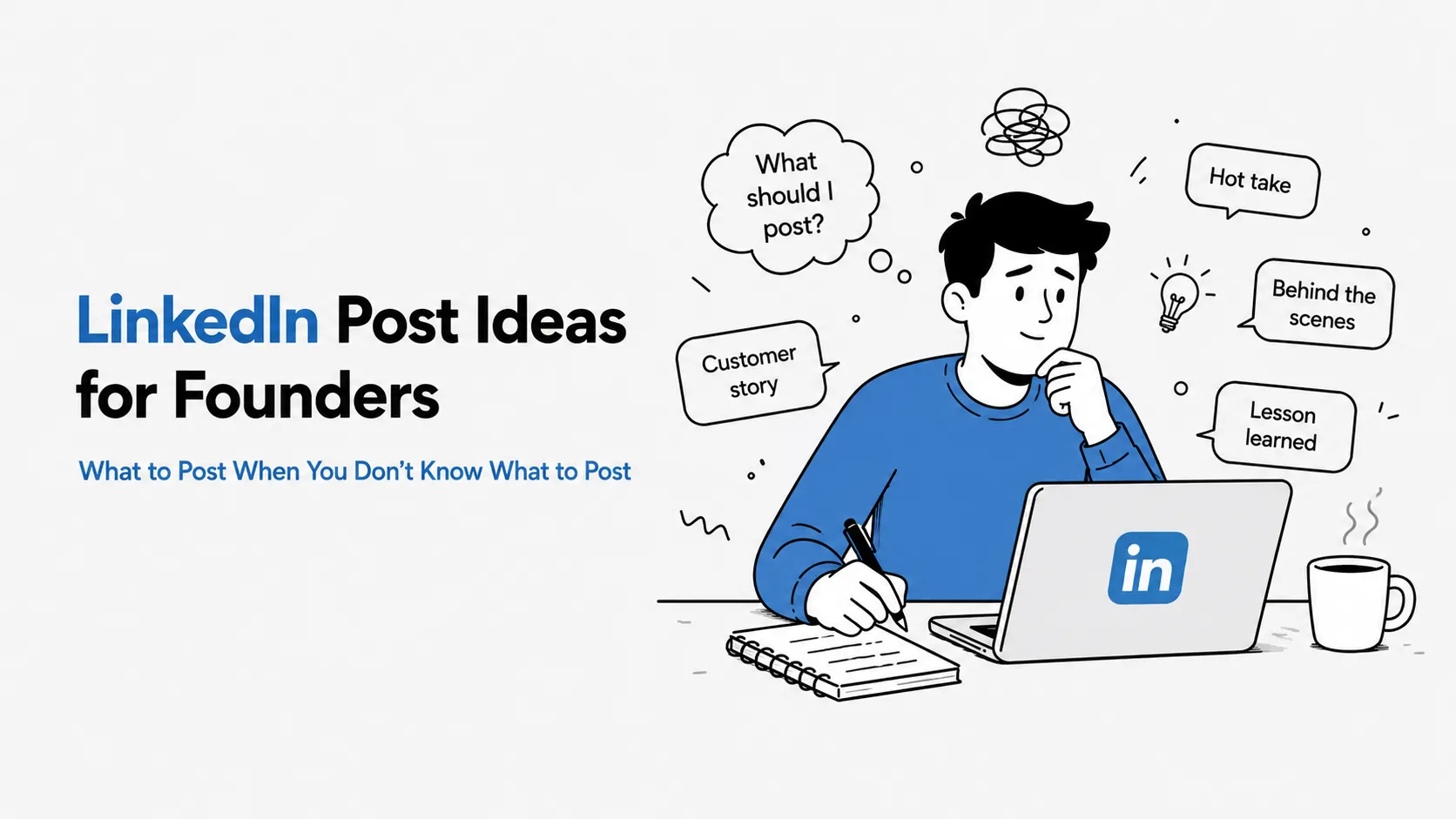
Most founders do not have a content problem, they have a format problem. You already hold more raw material than any marketer could invent: the decisions you agonize over, the deals you win and lose, the lessons that cost you real money. What you lack is a repeatable set of post types to pour that material into, so the blank page wins more weeks than it should. The fix is a small system of proven founder post formats plus a simple rule for how to mix them.
This guide gives you that system. It covers the handful of content pillars to build around, the specific post types that reliably earn attention from a B2B audience, the funnel mix that turns attention into pipeline, and a way to convert your ordinary working week into a steady supply of posts. The goal is not to help you go viral. It is to make sure you never again sit down to post and come up empty, because running dry is the real reason most founder LinkedIn accounts go quiet.
Founders should post about the questions their customers actually ask, the decisions they make running the company, and the lessons they learn in the process, framed so each post delivers one clear takeaway. The most reliable content is not clever, it is useful and specific: a framework that solves a problem your buyers face, a story behind a real business decision, or a contrarian take you can defend with evidence. Start by listing the questions prospects raise on sales calls and in your inbox, because every recurring question is a post that will keep getting found through search months after you publish it. Then layer in the things only you can say: the reasoning behind a pivot, a pricing change, a hire that worked or didn't. The trap to avoid is generic motivation, the posts that could have been written by anyone in any industry, which signal that you have no particular point of view. Pick one idea per post, make it concrete, and end with a single thing the reader remembers an hour later. That discipline, repeated, is what separates a founder feed that builds authority from one that fills space.
If sitting down to write each post still feels hard even once you know the topic, that is normal and worth addressing directly. We unpack the underlying reasons in why LinkedIn writing is hard for founders, because the ideas only help if you can get them onto the page.
The founders who never run out of ideas are not more creative, they are more organized. They post around a small set of content pillars, usually three to five themes they return to forever, rather than chasing a new topic every time. Pillars might be something like the category you are building in, the function you know best, the hard lessons of company building, and the customer problem you solve. Everything you post ladders up to one of them.
Pillars do two things at once. They make ideation almost mechanical, because instead of asking the impossibly broad question of what to post today, you ask the narrow one of what you have to say about a specific theme this week. And they make your presence legible to the people you want to reach, since a feed that circles a few clear ideas reads as expertise, while a feed that wanders reads as noise. Choosing those themes well is the foundation of a coherent LinkedIn content strategy, and it is the step most founders skip on their way to posting randomly and quitting.
Within your pillars, a handful of post types do most of the heavy lifting. Knowing them by name turns a vague pillar into a concrete post in minutes.
The behind-the-decision post shares the reasoning behind a major choice, a pivot, a pricing change, a hire, or a product you cut. It works because it shows how you think under real constraints, which is exactly what buyers and investors are trying to read.
The lessons-learned post mines something that went wrong and what you took from it. Painful lessons told honestly outperform polished wins, because vulnerability paired with insight builds trust faster than a highlight reel ever could.
The customer-story post walks through a client's challenge, the process you used, and the result they got, anonymized where needed. It is a case study that does not feel like one, and it moves people who are close to buying.
The framework post names and explains a simple model that simplifies a complex topic. A named framework is memorable and shareable, and it positions you as the person who has structured the problem rather than just observed it.
The industry-data post shares original numbers, survey results, or analysis from your own business. Specific data is the most citable content you can publish, which is why it travels and why it gets referenced by others.
The contrarian post challenges a widely held belief in your space, backed by evidence rather than just heat. It creates the tension that stops a scroll and signals that you have a genuine point of view worth following.
The prediction post stakes out where you think your industry is heading. It invites debate, ages into credibility when you are right, and gives your audience a reason to keep watching how your thesis plays out.
The hiring-insight post shares what you have learned about building a team and culture. It widens your reach beyond buyers to talent, which matters for founders who are recruiting as hard as they are selling. The question post, used sparingly, asks your audience something you genuinely want their input on, which can spark real conversation when it is specific rather than generic. Rotating across these types keeps your feed varied and feeds the steady visibility that builds LinkedIn authority over time.
Variety of format is not enough; the balance across the funnel is what turns a following into pipeline. The mistake most founders make in their first 90 days is posting almost entirely bottom-of-funnel content, product updates and announcements, to an audience that does not yet know or trust them.
A workable starting mix is roughly half top-of-funnel, a third middle-of-funnel, and the rest bottom-of-funnel. Top-of-funnel posts are broad enough to appeal beyond your immediate buyers, founder lessons and industry observations that maximize reach and earn new followers. Middle-of-funnel posts are specific to the people you sell to, the frameworks and tactical breakdowns that prove expertise without pitching. Bottom-of-funnel posts, the customer wins and product news, convert the audience you have already earned. The order matters as much as the ratio, because top-of-funnel content gets people to follow you, middle-of-funnel content makes them trust you, and only then does bottom-of-funnel content convert them.
However you express it, the underlying principle is that the large majority of your posts should give value and only a small slice should sell. A feed that is mostly promotion teaches people to scroll past you. A feed that is mostly useful earns the right to occasionally ask for something.
The most sustainable source of ideas is not a brainstorm, it is your calendar. The reason founders run dry is that they treat content as a separate task disconnected from the work, when the work itself is generating post material every single day.
Build the habit of reading your week through the lens of the post types. A tough meeting becomes a lessons-learned post. A deal you closed becomes a customer story, anonymized. A pricing change becomes a behind-the-decision post. A great hire becomes a hiring-insight post. A recurring question on a sales call becomes a framework or a how-to that will keep getting found in search. Once you start seeing your work this way, the supply problem inverts: instead of hunting for ideas, you are choosing which of the week's real moments is worth writing up.
A light system makes this repeatable. Keep a running note where you drop raw ideas the moment they happen, then set aside an hour or two each week to turn three of them into posts. Batching this way means you are never writing under the pressure of an empty feed, and it protects the consistency that LinkedIn rewards. Of course, a good idea still needs a strong opening line to get read, so it is worth pairing this with the craft of writing a LinkedIn hook that stops the scroll.
How many post ideas do I actually need? Fewer than you think. With three to five content pillars and the nine or ten post types above, you have a grid that generates dozens of specific prompts. The goal is not an endless list of topics, it is a reusable system so you can produce a fresh, specific post from your real work whenever you sit down.
How personal should founder posts be? Personal enough to be credible, not personal for its own sake. The strongest posts connect a real experience to a useful takeaway for the reader. Share the lesson, the decision, or the story, but always answer the reader's quiet question of why this matters to them.
How do I post about my company without sounding salesy? Keep the large majority of your posts focused on value and reserve only a small share for direct promotion, and even then wrap the product inside a story or a lesson rather than a pitch. People tolerate selling from someone who has consistently taught them something first. The ratio is what protects you from sounding like an ad.
Where do the best ideas come from? Your customers and your calendar. The questions prospects ask repeatedly are your highest-intent topics because they double as search-friendly content people will find later. The decisions and lessons from running the company are your most differentiated, because no competitor can copy your specific experience. Together they are a near-infinite well once you train yourself to notice them.
The founders who post consistently are not the ones with the most creativity, they are the ones with the best system. Build three to five content pillars, learn the founder post types that work, keep the funnel mix weighted toward value, and read your own week as a source of material. Do that, and the blank page stops being a weekly obstacle.
What to post on LinkedIn was never really the hard part for a founder. The hard part is turning the expertise you already have into a repeatable habit. Start with one pillar and one post type this week, pull the idea straight from something that actually happened, and let the system carry the consistency from there. For the bigger picture of how these posts compound into pipeline, our guide to founder thought leadership shows where this leads.
If you want help turning your expertise into a founder content engine that runs without eating your week, see how Rethoric works with founders.
