LinkedIn authority building for founders: what it means, the three foundations, how the March 2026 algorithm rewards niche expertise, and the realistic timeline to pipeline impact.
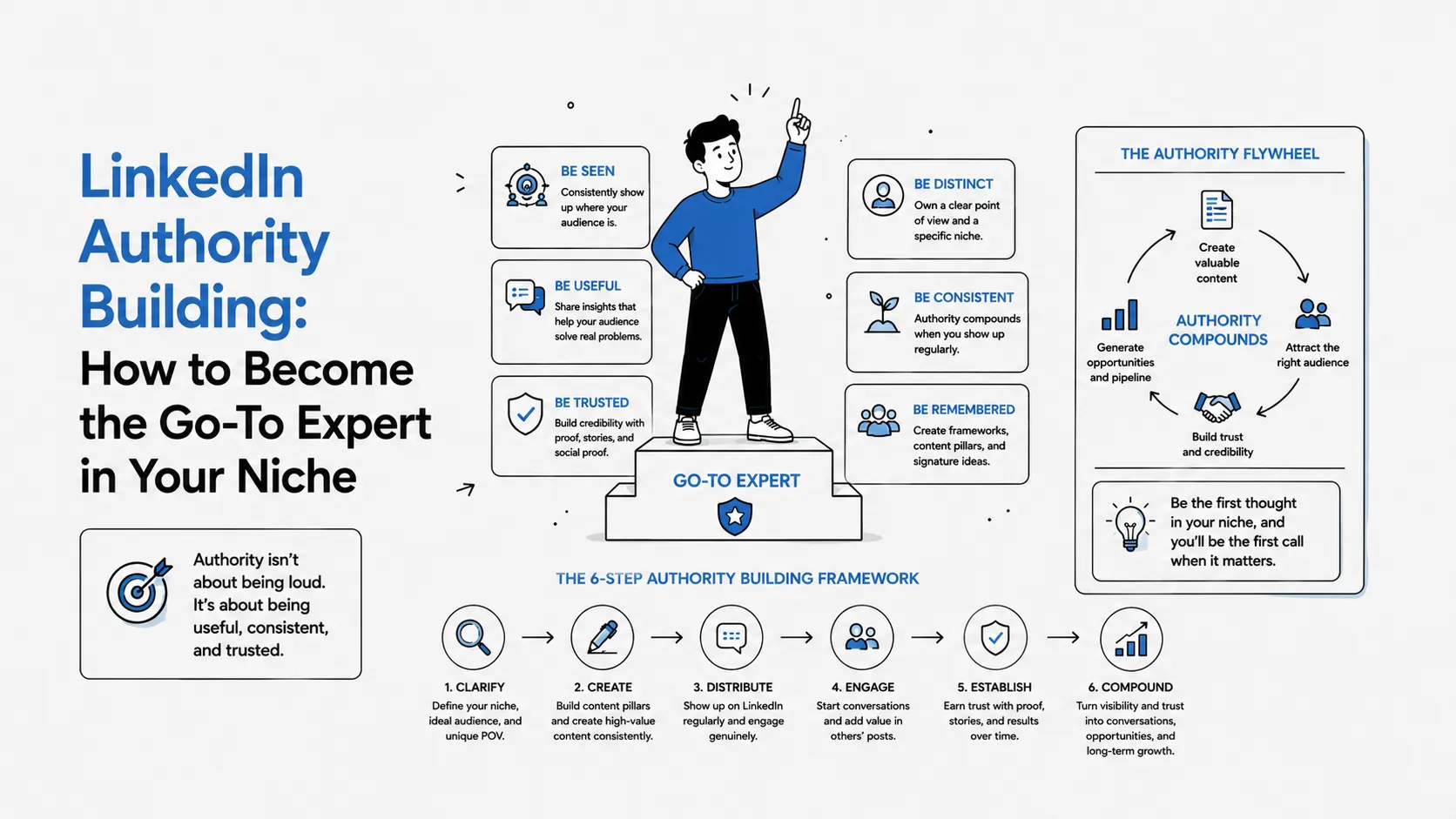
Published executives generate three times more inbound opportunities than non-published peers, according to Phantom IQ's 2026 thought leadership research. The gap between those two groups is not talent, credential, or company size. It is LinkedIn authority: the accumulated association between a name and a specific problem in the minds of the buyers who matter.
Most founders confuse LinkedIn authority with LinkedIn presence. Having a profile and posting occasionally is presence. Authority is something different: it is the state where buyers who have never met you already know how you think about their problem, already trust your judgment, and arrive at a sales conversation predisposed to work with you.
This guide covers what LinkedIn authority building actually requires, how the algorithm rewards it, what the realistic timeline looks like, and what separates the founders who build it from those who post for months without anything compounding.
LinkedIn authority building is the process of establishing a recognized association between your name and a specific professional problem in the minds of your target buyers, through consistent content publishing, strategic engagement, and a keyword-optimized profile. It differs from follower growth or engagement optimization in one critical way: authority is a buyer-side perception, not a platform metric. A founder can have 50,000 LinkedIn followers with no meaningful authority in their category, and a founder with 3,000 highly relevant followers can be the first name that comes to mind when a buyer describes the problem they need to solve. LinkedIn authority building works through a process called trust accumulation: buyers who encounter the same perspective on the same problem repeatedly, from the same named individual, begin to associate that name with expertise before any sales interaction begins. That pre-formed trust is what shortens sales cycles and improves inbound lead quality.
The data on what LinkedIn authority building produces commercially is specific. Companies with strong thought leadership programs report 23% shorter sales cycles due to pre-established trust and credibility. Inbound leads generated through consistent LinkedIn content close at 14.6%, compared to 1.7% for cold outbound, an 8.6x difference documented in Linkboost's 2026 State of LinkedIn. Content shared by executives is shared 24 times more than the same content posted from brand pages, according to Phantom IQ's thought leadership research.
The mechanism is not reach. It is the quality of the association buyers form after repeated exposure to a specific perspective on a problem they recognize. A founder with broad reach but no coherent point of view on a specific problem does not build authority. A founder with narrower reach but consistent, specific expertise on a defined problem builds the association that converts strangers into warm inbound leads.
For a deeper look at how LinkedIn content translates into measurable revenue, see LinkedIn ROI for founders.
LinkedIn authority building rests on three foundations that must work together. Optimizing one without the others produces partial results.
Profile as positioning signal. Your LinkedIn profile is the static layer of your authority. The headline, About section opening, and featured content should all reinforce the same specific problem domain in plain language. A headline that names your niche and the outcome you deliver for a specific audience is more valuable for authority building than one that lists your title and company. The About section's first 300 characters carry the highest keyword weight in LinkedIn's search algorithm and are the preview text buyers read before clicking through. The featured section should contain your best-performing post on your core topic, your company website, and one high-credibility asset that proves expertise. These three elements together tell both buyers and the algorithm exactly what you stand for.
Content as expertise signal. LinkedIn authority building requires consistent publishing on a narrow topic at a minimum of two to three times per week. The posts that build the most authority share a common structure: they name a specific problem, share a perspective that is not consensus, and support it with evidence from direct experience. Generic advice, motivational takes, and broad industry commentary do not accumulate authority because they do not create the association buyers need. The founders who build the strongest LinkedIn authority are the ones whose content makes a buyer think: this person understands my specific problem better than anyone I have encountered.
Engagement as distribution signal. ICP-targeted commenting drives 30 to 40% of total profile visibility on LinkedIn, according to Windmill Growth's 2026 LinkedIn research. Founders who combine consistent posting with ten or more thoughtful daily comments on posts from their target audience see twice as many inbound messages as those who only post. The commenting strategy matters because the algorithm uses engagement behavior to identify which professional community a founder belongs to and routes their content accordingly.
For more on how profile optimization and content strategy work together as the foundation of authority, see LinkedIn profile optimization for founders.
LinkedIn authority building affects content distribution through the platform's niche expertise signal system, introduced as part of the March 2026 Authenticity Update. When a founder consistently publishes content on a specific topic and earns genuine engagement from an audience that matches that topic, the LinkedIn algorithm accumulates what it measures as a Depth Score: a composite signal of dwell time, comment quality, saves, and topic consistency over time. Founders with high Depth Scores in a specific niche see their content distributed to larger cohorts of that audience in subsequent posts, even beyond their existing network. Founders who publish inconsistently or across unrelated topics see their Depth Score remain low, which means each post starts from zero audience accumulation rather than compounding on prior signals. The practical outcome is that authority and content reach are not separate goals. A founder who builds genuine topic authority on the platform gets increasing organic distribution as a byproduct.
The algorithm also rewards comment velocity: the engagement a post receives in the first 60 to 90 minutes after publishing carries more weight than engagement that accumulates over days. This means publishing when your ICP audience is most active, and prompting genuine conversation in the post itself, produces meaningfully better distribution than the same post published at a random time without a clear engagement hook.
For a detailed breakdown of how to build a content strategy that compounds on top of this algorithm behavior, see founder content strategy: how to build a pipeline that compounds.
The founders who build genuine LinkedIn authority follow a recognizable pattern. They pick one or two specific problems their buyers face. They develop a perspective on those problems that is not consensus: something they believe based on direct experience that most people in their field have not articulated clearly. They publish that perspective consistently, in different formats and with different examples, until their name becomes associated with a specific way of thinking about those problems.
The formats that carry the most authority weight are point-of-view text posts (200 to 250 words that stake a clear position on a specific industry question), document or carousel posts that teach a specific framework in depth, and experience posts that share a real outcome or lesson with specific numbers. Each format serves a different function in the authority-building system: point-of-view posts drive comments and profile visits, carousel posts drive saves and shares, and experience posts build the human trust that makes authority feel earned rather than performed.
What LinkedIn authority building does not require is a large existing audience, going viral, or posting about topics outside your expertise. The founders who get positioned fastest are the ones who treat LinkedIn as a positioning laboratory and stay in one lane long enough for the association to form.
For the full framework behind positioning before publishing, see founder positioning strategy: how to own a category.
LinkedIn authority building follows a documented timeline that most founders underestimate. The first 60 days produce almost no visible change: the algorithm is accumulating topic signals, and the audience is encountering the founder's name for the first time. Between days 60 and 90, the first leading indicators appear: profile views from target buyers increase, inbound message quality improves, and content begins reaching a slightly larger cohort. At six months of consistent posting on a specific topic, most founders see measurable pipeline impact: inbound inquiries traceable to LinkedIn content, warmer outreach response rates, and shorter discovery calls because buyers arrive already familiar with the founder's perspective. Recognized authority, meaning buyers proactively cite the founder as an expert when recommending vendors to peers, typically emerges between 12 and 24 months of sustained niche publishing, according to ConnectSafely's 2026 analysis of LinkedIn authority timelines. The founders who reach that outcome are the ones who stayed consistent through the first 90 days.
How is LinkedIn authority building different from thought leadership? Thought leadership is the content itself: the specific opinions, frameworks, and perspectives a founder publishes publicly. LinkedIn authority building is the cumulative effect of that content on buyer perception over time. You build authority by publishing thought leadership consistently enough that the association between your name and a specific problem becomes automatic in your buyer's mind. The content is the input. The authority is the outcome. For more on how the two interact, see founder thought leadership: the pipeline asset most founders build too late.
Can you build LinkedIn authority without a large following? Yes, and early-stage authority is often more commercially valuable than scale-stage authority. A founder with 2,000 highly relevant followers who engage consistently with a specific topic has more pipeline-generating authority than a founder with 20,000 mixed followers who engage sporadically across unrelated subjects. The algorithm routes content based on topic-audience match, not raw follower count. The buyers who matter are the ones who self-selected into your audience because they care about the specific problem you address.
Does LinkedIn authority building require writing every post yourself? No. The source material, the perspective, and the expertise must come from the founder. The writing can be handled by a content partner or ghostwriter, as long as the process is built around capturing the founder's actual thinking rather than producing generic content. Authority built on fabricated perspectives collapses the moment a buyer has a real conversation with the founder. Authority built on genuine expertise, expressed more consistently than the founder could manage alone, compounds the same way as authority built from self-written posts. See how ghostwriting for founders works when the process is designed around authentic voice capture.
LinkedIn authority building is not a brand exercise. It is pre-sales infrastructure. The buyers who find you through a consistent, specific point of view on a problem they recognize arrive at your first conversation already trusting your judgment, already familiar with your approach, and already past the objections that make cold pipeline difficult to close.
The founders who build the most durable pipelines on LinkedIn are not the ones who post the most. They are the ones who say the most specific, well-reasoned things about the fewest problems, consistently enough that the right buyers stop thinking of LinkedIn as a platform and start thinking of them as the person to call.
If you want help building a LinkedIn authority system that compounds over time, see how Rethoric works with founders.
