A founder-focused guide to turning customer wins into LinkedIn posts that build trust, show proof, and create pipeline without sounding like a case study.
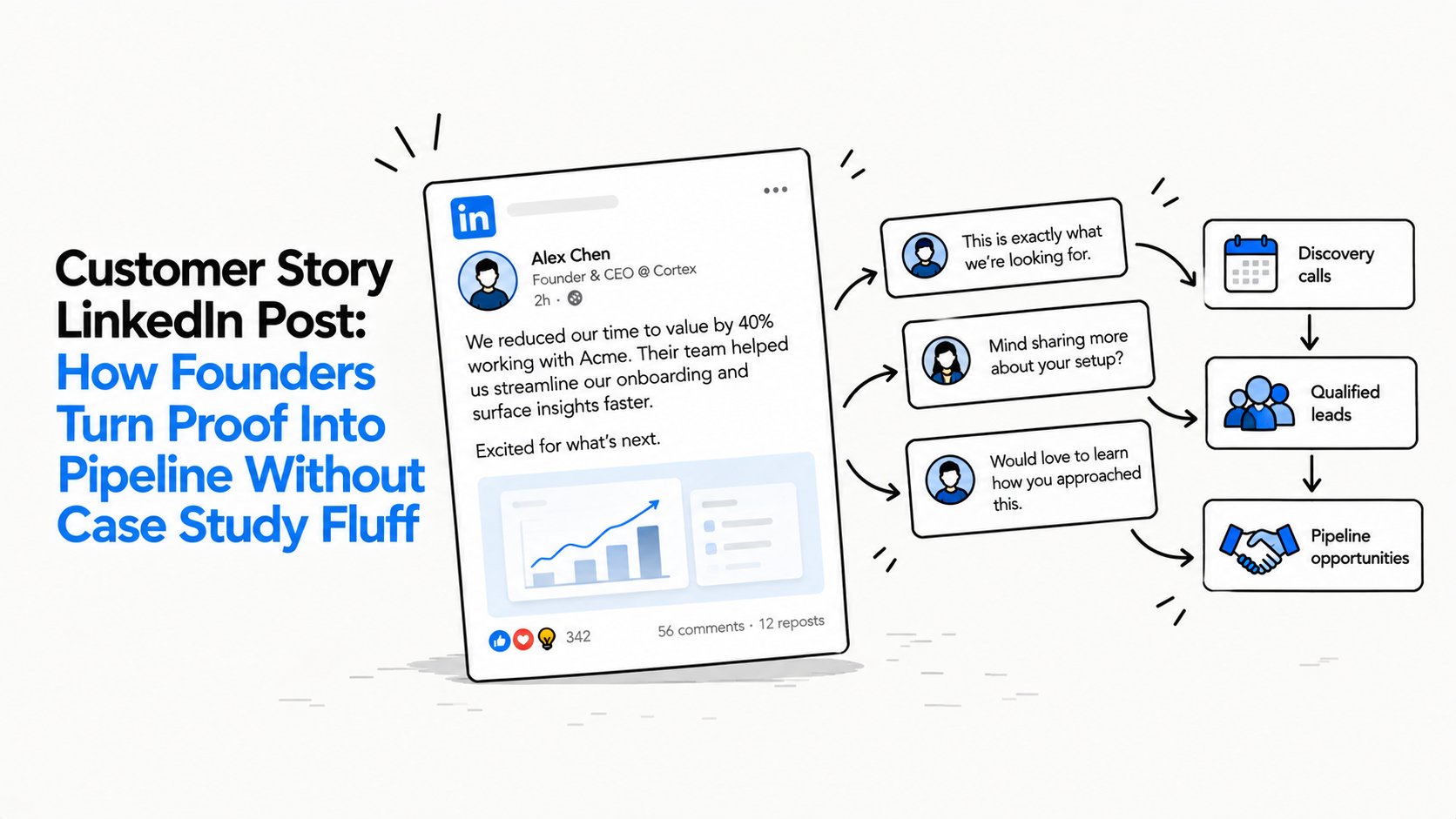
Most customer story LinkedIn posts sound like watered-down case studies.
The company won a recognizable customer. The founder wants to share the proof. Marketing turns it into a neat success story. The post says the customer had a challenge, used the product, achieved a result, and now everyone is excited.
It is accurate.
It is also forgettable.
Customer proof is one of the strongest assets a B2B founder can bring to LinkedIn because it shows the market that the company is not just making claims. Real people with real problems are getting value. But most teams flatten that proof into generic testimonial language, overpolished quotes, or vague "customer spotlight" posts that feel more like marketing collateral than founder judgment.
A strong customer story LinkedIn post does something sharper.
It turns proof into a market lesson. It shows the pattern behind the win, the problem the customer could no longer ignore, the reason the old approach broke, and the specific change that made the result possible.
The founder does not need to brag. The founder needs to explain what the customer win proves.
This guide breaks down how to write customer story LinkedIn posts that build credibility, educate buyers, and create pipeline without sounding like a case study brochure.
A customer story LinkedIn post is a founder-led post that uses a customer win, customer insight, implementation moment, result, objection, or workflow change to make a bigger point about the market.
It is not just a testimonial.
It is not a long case study pasted into the feed.
It is not a victory lap about landing a logo.
The best customer story posts answer a buyer's quiet question: what happens when a company like mine actually uses this?
That question matters because B2B buyers do not trust claims in isolation. They trust patterns. They want to see whether the founder understands the problem, whether the company has seen enough customer reality to be credible, and whether the outcome maps to their own operating pressure.
A customer story post should make that pattern visible.
Founders can say things in customer stories that a brand account usually cannot.
A company page can announce a win. A founder can explain why the win matters.
The founder can name the hidden pain that made the customer act. They can describe what the team learned during implementation. They can point out the misconception the customer had before switching. They can explain why the result says something larger about the category.
That is why customer stories fit naturally inside a LinkedIn content strategy for founders. The post is not just proof. It is a public sample of how the founder thinks about customers, urgency, product value, and market change.
Done well, a customer story can support sales without reading like sales copy. It gives prospects language for their own problem. It gives champions something to forward internally. It gives investors proof that the market is pulling the company forward. It gives candidates a clearer view of what the company is building and who it serves.
The public engagement may be modest. The private impact can be much larger.
Most customer posts start and end with the customer.
"We are thrilled to work with X."
"Customer Y achieved Z."
"Here is a quote from their VP."
Those details can be useful, but they are not enough. If the post only says a customer won, readers who are not already convinced may not know what to do with the information.
The stronger move is to use the customer as evidence for a market pattern.
For example:
The customer is the proof. The market pattern is the story.
Before writing the post, ask what the customer win taught the founder.
That insight should be more specific than "customers need our product."
Useful customer insights often sound like this:
That is the raw material for the post.
If there is no insight, there may still be a customer quote or a result, but the LinkedIn post will feel thin. The founder's job is to turn the proof into understanding.
A strong customer story LinkedIn post usually needs six parts.
Start with the problem the customer represents, not the customer logo.
Weak: "Excited to share how we helped Acme improve reporting."
Stronger: "Most revenue teams do not have a reporting problem. They have a trust problem. By the time the forecast dashboard says a deal is at risk, the real buying committee has already gone quiet."
The stronger version gives the right buyer a reason to keep reading.
Explain the customer situation in plain language. Who were they? What were they trying to do? What made the problem urgent?
You do not need to reveal confidential detail. Customer size, segment, team, workflow, or business pressure can be enough.
The goal is specificity without oversharing.
Every good customer story has a "before" state.
The old way might be a spreadsheet, a manual approval chain, a broken handoff, a slow vendor process, a generic tool, a consultant-heavy workflow, or a behavior everyone tolerated because there was no better option.
Name it clearly. Buyers trust founders who understand what they are replacing.
Describe what changed after the customer used the product or adopted the approach.
This does not have to be a full implementation story. It can be one workflow, one decision, one team behavior, one measurable result, or one quote that captures the shift.
Keep it concrete. "They moved faster" is weak. "Their sales managers could see stalled multi-threading before the forecast call" is stronger.
This is the part most posts miss.
After the result, explain what the customer story proves. Did it validate a product bet? Reveal a hidden buyer objection? Show that the category is moving? Confirm that a painful workflow is becoming impossible to ignore?
The founder lesson turns the post from a testimonial into thought leadership.
The call to action should match the story.
If the post is about a painful workflow, invite operators dealing with that workflow to compare notes. If the post is about a result, offer to show how the team got there. If the post is about a market shift, ask whether other teams are seeing the same pattern.
Do not turn the ending into a hard pitch unless the story has earned it.
Use this as a structure, not a script.
Hook: Name the painful pattern the customer represents.
Context: Describe the customer situation without overloading the reader.
Old way: Explain what they were doing before and why it stopped working.
Change: Show what changed after using the product, service, or new workflow.
Proof: Add a metric, quote, concrete workflow detail, or before/after contrast.
Lesson: Explain what the founder learned or what the story proves about the market.
Next step: Invite the right reader into a relevant conversation.
Here is the shape:
"Most [buyer/team] do not realize [problem] is costing them [business cost] until [trigger moment].
One of our customers hit that wall when [specific context].
Before working with us, they were [old way]. That worked while [old condition]. It broke when [new pressure].
After [product/workflow/change], they were able to [specific result].
The important part was not just the result. It proved [founder lesson].
If your team is dealing with [same painful pattern], I would be curious whether you are seeing the same thing."
Rethoric's guide to LinkedIn post ideas for founders has broader formats for turning founder expertise into demand. Customer stories need the same discipline: the template should organize real proof, not sand it into generic marketing language.
The best proof is specific, but it does not always have to be a public metric.
Strong proof can include:
Do not invent precision. If the metric is not approved or reliable, use a concrete qualitative signal instead.
Specificity beats fake certainty.
Customer quotes often get weakened by approval.
By the time legal, marketing, customer success, and the customer team have touched the sentence, the quote says something like: "We value the partnership and are excited about the impact."
That may be safe, but it is not very useful.
A stronger quote captures one of three things:
If the approved quote is generic, do not make it the center of the post. Use it as support, then let the founder explain the concrete customer pattern around it.
The quote should make the story more credible. It should not force the founder into a bland customer-marketing voice.
Naming the customer can increase credibility, but it is not always necessary.
Name the customer when the logo is approved, the use case is clear, and the story helps both companies. A named story can be especially useful when the customer represents the exact segment the company wants to attract.
Anonymize the customer when the details are sensitive, the approval process would slow the post down for weeks, or the insight matters more than the logo.
An anonymized story can still be strong if the context is specific:
The reader does not always need the name. They need enough context to know whether the story applies to them.
One customer win should not become one post and disappear.
A good customer story can support a full sequence:
This is where customer stories connect to a LinkedIn content flywheel. The win creates proof. The proof creates insight. The insight creates more content, better sales conversations, and clearer positioning.
The goal is not to squeeze the customer for attention. The goal is to extract the useful market lesson from real customer work.
Customer story posts can create pipeline because they reduce buyer uncertainty.
A prospect may not be ready to book a demo from a thought leadership post. But when they see a credible customer story, they can imagine the product inside their own company.
That matters for several reasons:
This is why customer stories belong near social selling on LinkedIn for founders, not in a separate brand-marketing bucket. The post builds trust before the direct conversation starts.
A good customer story does not beg for the meeting.
It makes the meeting easier to say yes to.
Do not judge customer story posts only by likes.
Useful signals include:
Rethoric's guide to measuring LinkedIn content ROI goes deeper on separating vanity metrics from pipeline signal. For customer stories, the key question is simple: did the post make proof easier for the right buyer to understand, share, and act on?
The first mistake is making the post too polished. Customer stories need clarity, not corporate shine.
The second mistake is leading with the logo instead of the problem. A recognizable customer helps, but the pain creates relevance.
The third mistake is hiding the founder's point of view. If the post could come from any vendor, it will not build founder authority.
The fourth mistake is using vague results. "Saved time" and "improved efficiency" are weaker than a concrete workflow change, even when the exact metric is confidential.
The fifth mistake is forgetting the buyer's internal reality. The customer story should help a champion explain the problem to someone else inside the company.
The sixth mistake is treating approval as an afterthought. If customer proof needs legal or customer approval, build that into the content workflow before the post is due.
Rethoric helps founders turn customer wins, product insight, market patterns, and founder judgment into LinkedIn content that builds authority and pipeline without generic AI slop.
That includes the operating work around customer stories: capturing raw proof, identifying the market lesson, shaping the founder point of view, managing approvals, scheduling the post, routing engagement, tagging useful replies, and measuring whether the right people responded.
The founder stays close to the customer insight.
The system handles the content operation.
That is the difference between posting a bland customer spotlight and turning customer proof into a founder-led demand asset.
A customer story LinkedIn post should do more than celebrate a win.
Start with the painful pattern. Add the customer context. Name the old way. Show what changed. Pull out the founder lesson. End with a next step that fits the story.
The goal is not to make the company look impressive for a day.
The goal is to make the market smarter about the problem you solve.
When customer proof is specific, founder-led, and tied to a real market lesson, it does not feel like a case study stuffed into the feed. It feels like evidence.
And evidence is what makes buyers trust the founder before the sales conversation begins.
If your team wants a founder-led LinkedIn system that turns customer proof, product insight, and executive expertise into pipeline without turning the founder into a full-time content operator, see how Rethoric works with founders.
