A founder-first social selling system for LinkedIn: how to generate qualified B2B pipeline without spammy DMs, generic automation, or cringe outreach.
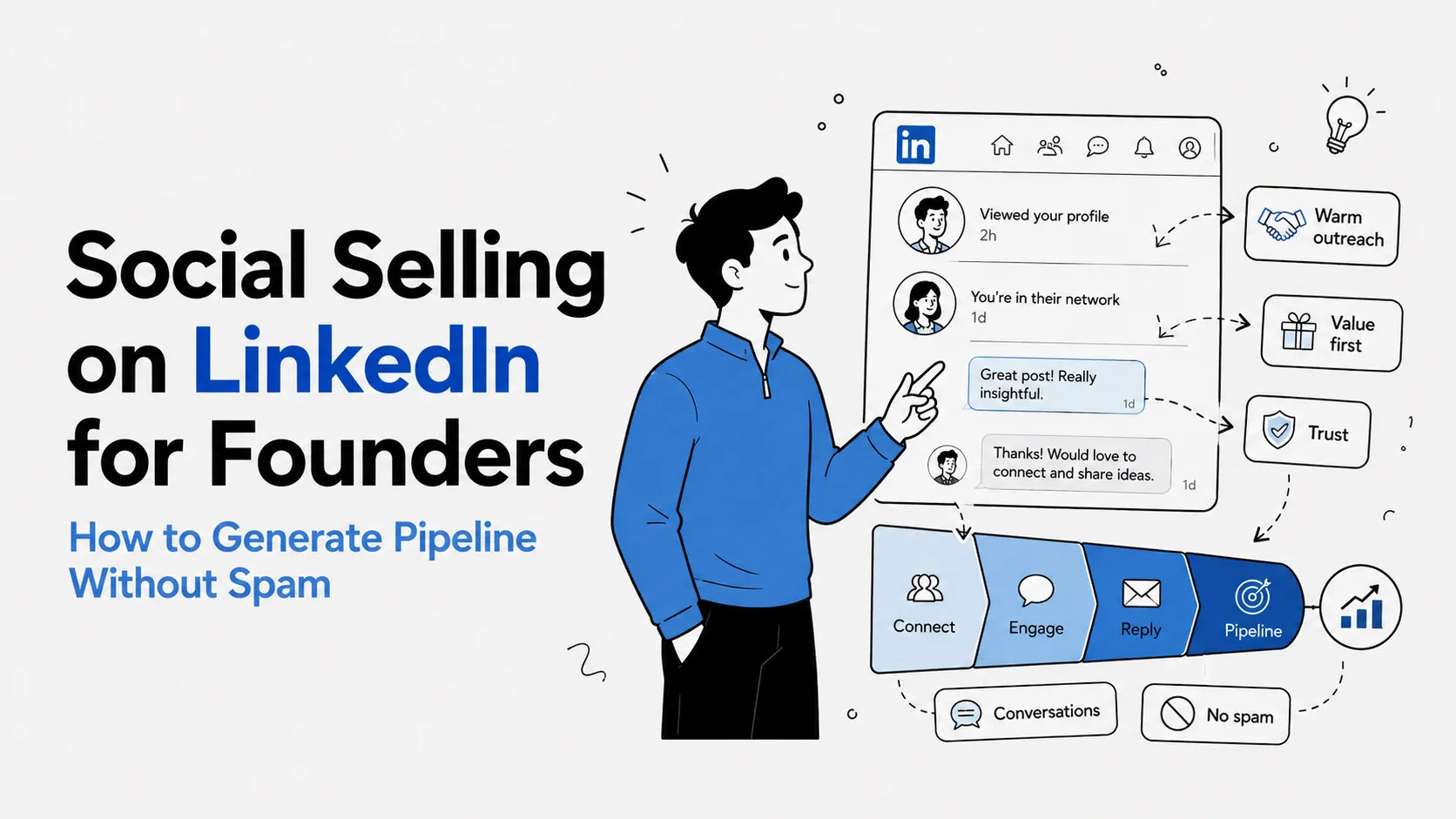
Most founders say they hate social selling, and for good reason. What passes as social selling on LinkedIn is usually mass connection requests, copy-paste DMs, and weak content that sounds like it was written for everyone and no one.
The problem is not social selling itself. The problem is bad execution. Done right, social selling on LinkedIn helps founders turn expertise into trust, trust into qualified conversations, and conversations into pipeline without burning brand equity.
This guide breaks down a practical founder workflow: what to post, how to engage, when to move to DMs, and which metrics actually matter if your goal is revenue, not vanity reach.
For founders, social selling means building buyer trust in public before asking for a sales conversation. It is not cold pitching in DMs. It is creating a visible track record of sharp thinking, relevant proof, and consistent interaction with the market you want to sell to.
If your profile is still generic, fix that first. Your social selling motion gets stronger when your profile already explains who you help and why that matters. Start with LinkedIn profile optimization for founders.
Most founder-led LinkedIn motions fail for three reasons.
First, they optimize for activity instead of signal. More posts, more comments, more messages, but no clear perspective. Buyers do not reward volume. They reward relevance.
Second, they skip the trust sequence. They ask for a call before establishing context, credibility, or a reason to continue the conversation.
Third, they measure the wrong things. Impressions and likes can move while pipeline stays flat. If your metrics do not connect to opportunities, your strategy is leaking effort.
Define the 3 to 5 recurring problems your ICP already talks about in calls, Slack groups, and internal meetings. That list becomes your content and outreach backbone.
If your content is not tied to those problems, it may still get engagement, but it will not create buying intent.
Use a weekly mix that feels practical:
Consistency matters more than short bursts. For cadence, this benchmark is useful: how often founders should post on LinkedIn.
Spend 15 to 20 minutes daily commenting on posts from:
Your comments should add a useful angle, not "great post." Good comments create profile visits from the right people and warm your future outreach.
The cleanest trigger points are:
No trigger, no DM. That single rule removes most spam behavior.
Instead of jumping to "want to hop on a call?", ask for a smaller next step first: share a one-page teardown, send a relevant benchmark, or offer one pointed observation on their motion.
Micro-commitments qualify interest fast and keep your tone consultative rather than salesy.
Context-first opener
"Saw your comment on [topic]. Strong point about [specific detail]. We’re seeing the same pattern in [relevant segment], especially around [problem]. Happy to share what’s working if useful."
Value-first follow-up
"Pulled a quick 3-point breakdown on [problem] based on what you posted. Want me to send it here?"
Low-pressure call transition
"If helpful, we can pressure-test this in 15 minutes and map what this would look like for your team. If not, I can just send the checklist."
Each message works because it is specific, contextual, and optional.
Track four numbers weekly:
These metrics force your strategy to stay revenue-adjacent. For a deeper measurement system, pair this with LinkedIn ROI for founders.
Automating too early
Automation before message-market fit multiplies bad outreach.
Posting with no distribution habit
Publishing without comments and follow-up leaves reach and relationships on the table.
Sounding like everyone else
Generic "thought leadership" kills conversion. Sharp positioning wins.
Weak hooks
If the first line does not create tension, the post will not travel. Use this breakdown: how to write a LinkedIn hook.
How often should founders send DMs?
Only when context exists. Quality beats quantity. Ten contextual DMs outperform 100 cold ones.
Can founders do social selling without posting daily?
Yes. Two to three strong posts weekly plus daily engagement is enough for most B2B founders.
Should founders sell from personal profile or company page?
Personal profile first. Company pages support the narrative, but founder trust usually starts from person-to-person visibility.
How long until LinkedIn social selling impacts pipeline?
You can see early signal in 30 to 60 days (better ICP profile views, stronger DM replies). Reliable pipeline impact typically compounds over 90+ days of consistent execution.
Social selling on LinkedIn works for founders when it is treated as a trust system, not a message volume game. Publish specific ideas, engage with intent, move to DM with context, and measure outcomes that tie to revenue.
Do that consistently and LinkedIn becomes a predictable pipeline channel without sounding like outreach spam. If you want a done-for-you system that keeps founder voice intact, talk to Rethoric.
