For most founders, 2-3 high-quality posts per week plus daily commenting is the sweet spot. Here is what the data on LinkedIn posting frequency really says, and how to find your cadence.
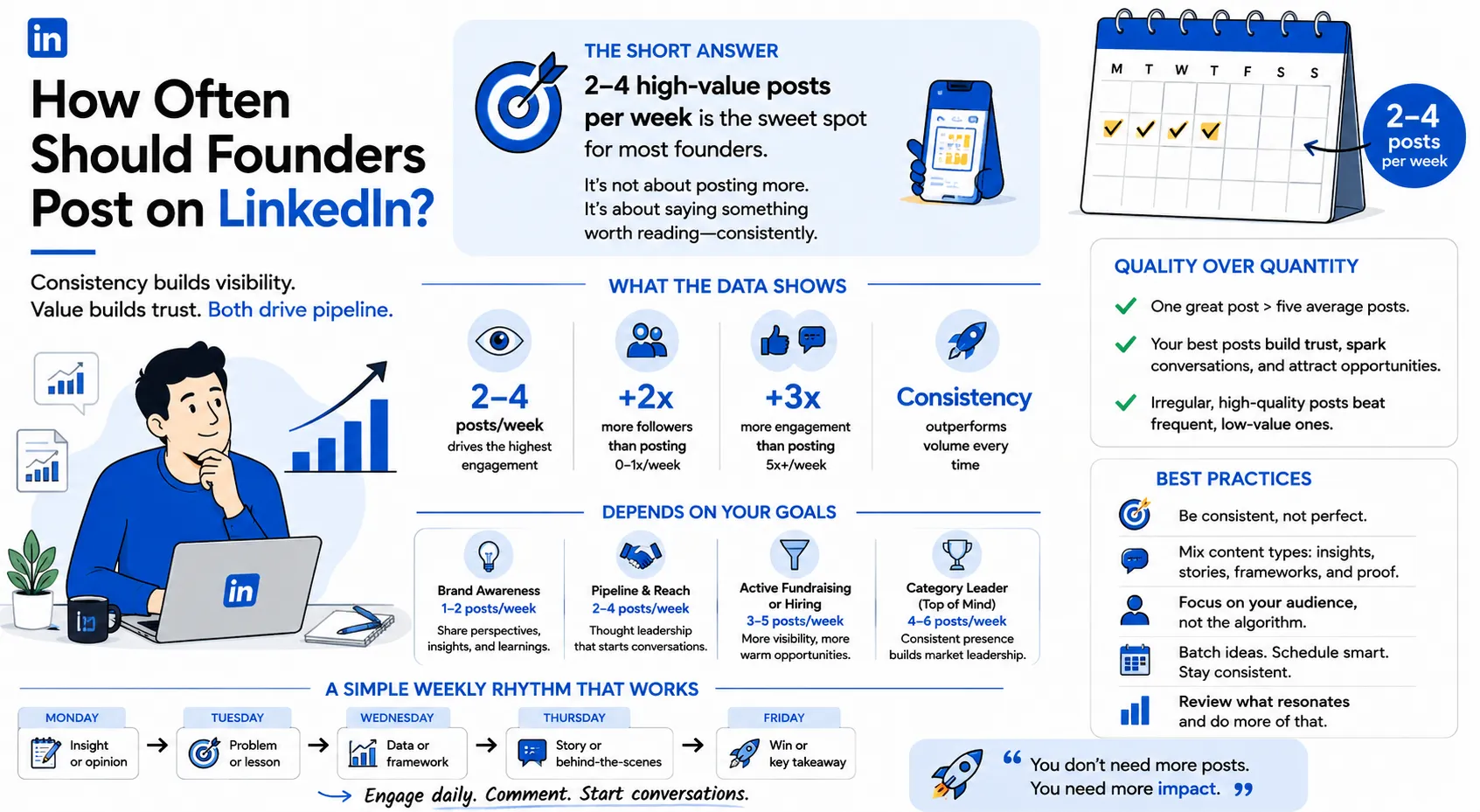
For most founders, the right answer is two to three high-quality posts per week, paired with a few minutes of daily commenting. That cadence captures the largest share of LinkedIn's reach reward without demanding the hours a daily content habit requires. The instinct to post more is understandable, but for a founder running a company, raw volume is rarely the constraint that actually matters.
The data supports the lighter cadence more than most founders expect. Buffer's analysis of more than two million posts found that simply moving from one post a week to two to five posts a week adds an average of 1,182 more impressions per post, with the gains climbing from there. So the question is not whether posting more helps. It does. The real question is how much a founder can sustain before quality, and the pipeline that quality produces, starts to slip.
The ideal LinkedIn posting frequency for most founders is two to three high-value posts per week, supported by ten to fifteen minutes of daily commenting. This range sits inside the two-to-five-posts-per-week band that platform-wide data identifies as the point where LinkedIn starts distributing content more widely, while staying realistic for someone whose primary job is building a company. Posting once a week keeps a founder visible but leaves meaningful reach on the table. Posting daily can work for full-time creators, but for founders it usually trades content quality for volume, and on LinkedIn quality is what turns a reader into a conversation. Founders also sell to a small, specific audience of buyers, investors, and potential hires, so the goal is not maximum impressions but consistent, credible contact with the right people. Two or three sharp posts a week, sustained for months, beats a daily cadence abandoned after six weeks.
This is the same logic behind a founder-first LinkedIn content strategy: match the cadence to the calendar you actually have, then protect the quality that makes each post worth reading.
The relationship between how often you post and how well you perform is real, but it is not linear, and the nuance is where most advice goes wrong. Buffer's study of two million posts found that each step up in frequency improved per-post results even after controlling for account size. Moving from one post a week to the two-to-five range added roughly 1,182 impressions per post. Pushing to six to ten posts a week added about 5,001 impressions per post. At eleven or more posts a week, the lift reached nearly 17,000 additional impressions per post and triple the engagements compared with posting once.
Those numbers make a daily-or-more habit sound irresistible, until you look at engagement quality. A separate analysis of more than 250,000 posts by Ordinal found that engagement rate stays essentially flat, between 1.81 and 1.88 percent, from one post a week all the way up to six. The only real drop appears at seven or more posts a week, where engagement rate falls to 1.56 percent. Total weekly reach keeps scaling with volume, but the biggest marginal return shows up at three to four posts a week. After five, the returns soften.
Read together, the studies tell a consistent story. More posts mean more total reach, but the cost-efficient zone, the place where each post still earns strong engagement and you are not burning out, lands squarely at two to four posts a week. For a founder, that zone is not a compromise. It is the target.
Generic posting advice is written for creators and marketers whose full-time job is content. Founders are not that, and the differences change the right answer.
Time is the obvious one. A founder's hours are spent on product, hiring, customers, and fundraising, and content competes with all of it. A cadence that assumes daily output will be the first thing to collapse during a hard week, and an inconsistent presence signals less than a steady one. Choosing a frequency you can defend through a chaotic quarter matters more than choosing the theoretically optimal number.
Audience is the subtler one. Founders are not chasing a general following. They are trying to stay credible in front of a few hundred people who can buy, fund, join, or refer. For that audience, two thoughtful posts that demonstrate how you think will do more than ten reactive ones that fill a feed. Research aimed specifically at B2B founders and executives found that two high-impact posts a week often produce better lead-generation results than daily output, precisely because the bar for each post stays high.
There is also a hard ceiling worth respecting. The same B2B analysis found that accounts posting two or more times in a single day saw a median drop in reach per post of more than 40 percent. Spacing matters. One strong post a day is the practical maximum, and for most founders, even that is more than the calendar allows.
A realistic founder cadence is two to three posts published on weekday mornings, plus ten to fifteen minutes of commenting every day. The posts do the broadcasting; the comments do the relationship building. Most platform data points to Tuesday through Thursday, roughly 8 to 10 in the morning, as the strongest window for business audiences, so anchoring posts there is a sensible default rather than a rule to obsess over. The more important habit is the daily commenting, because it puts a founder in front of other people's audiences, which is where most new, relevant connections actually come from. A founder who posts twice a week and comments thoughtfully five days a week will usually out-perform one who posts daily and never engages, because the second founder is broadcasting into a void while the first is building a network. Treat the post schedule as the skeleton and the commenting as the muscle that moves it.
One detail decides more than frequency does: the first ninety minutes after you publish. LinkedIn reads early engagement as a signal of quality and uses it to decide how far to push a post. That means a founder is better served by publishing two posts at a time they can actually be present to reply to comments than by scheduling a fifth post they will ignore. If you want the mechanics behind how that distribution works, our breakdown of LinkedIn's algorithm covers what changed and why early engagement carries so much weight.
Founders tend to treat posting frequency as a dial they can crank for more results. It is closer to a floor than a dial. Below a certain cadence you fade from the feed, but above the sustainable zone the extra posts mostly cannibalize each other while quietly eroding quality. The two levers that actually compound are consistency and engagement.
Consistency wins because LinkedIn, and your audience, reward reliability. Posting twice a week every week for a year builds far more authority than posting daily for a month and then disappearing. The platform's own data shows that the lift from a given cadence scales for small accounts and large ones alike, which means a founder with a modest following gets the same relative benefit from showing up steadily. Momentum is the asset, and momentum is fragile, so the cadence you can repeat beats the cadence that looks impressive on paper.
Engagement wins because comments are distribution. A strategy of two posts a week plus five substantive comments a day routinely beats daily posting with no commenting, because the comments place you inside conversations your own posts would never reach. This is also why chasing volume can backfire: every extra post you publish under time pressure is time not spent engaging, and engagement is the cheaper path to the same goal. If the deeper aim is turning that visibility into revenue rather than vanity metrics, our guide to LinkedIn ROI for founders shows how to connect the activity to pipeline.
The right number is partly personal, and the cleanest way to find it is a simple test rather than guesswork. Start with three posts a week for one full month and record three things: average impressions per post, engagement rate, and follower or connection growth. That becomes your baseline.
For the next month, move to four or five posts a week while holding content quality and format steady. Then compare the two periods side by side. If impressions and engagement climbed without a drop in per-post performance, the higher cadence is working and you can hold it. If your per-post metrics declined, that is the signal to scale back to the level where each post still earned its place. The goal of the test is not to find the maximum you can publish, but the maximum you can publish without the quality, or your willingness to keep going, falling off.
Most founders who run this honestly land between two and four posts a week. That is not a failure to hit some higher ideal. It is the cadence that pairs real reach with real sustainability, which is the combination that produces a founder thought leadership presence that lasts.
Can you post too much on LinkedIn? Yes. Beyond roughly six posts a week, engagement rate begins to fall, and posting more than once in a single day can cut per-post reach by more than 40 percent. Posts published close together compete with each other for the same audience, so spacing them at least a day apart protects the performance of each one. For founders, the practical takeaway is that there is almost no scenario where posting multiple times a day helps.
Is once a week enough? It is enough to stay visible, and for a founder with no bandwidth it is far better than nothing. But once a week leaves measurable reach unclaimed, since the jump to two-to-five posts is where LinkedIn noticeably widens distribution. If you can only manage one post, pair it with daily commenting so your presence does not rest on a single weekly touchpoint.
What are the best days and times to post? For business audiences, Tuesday through Thursday between 8 and 10 in the morning is the most reliable window. Treat it as a sensible default, not a law. Consistency and the quality of the first ninety minutes of engagement matter more than hitting an exact minute.
Does commenting count as posting? Not in the feed, but it may matter more. Commenting puts you in front of audiences you do not own, builds relationships faster than broadcasting, and feeds the network effects that make your own posts travel further. A founder short on time should protect commenting before adding another post. The two habits together are what turn a posting schedule into a LinkedIn growth strategy that builds pipeline rather than just followers.
How often should founders post on LinkedIn? Two to three high-quality posts a week, plus daily commenting, is the cadence that captures most of the platform's reach reward while staying sustainable for someone who is also running a company. More is possible, and more does add total reach, but the returns soften after four or five posts a week and the quality cost rises. For founders, the smarter play is to win on consistency and engagement, not volume.
The founders who get the most from LinkedIn are rarely the ones posting the most. They are the ones who picked a cadence they could hold for a year, showed up inside other people's conversations every day, and let the consistency compound. Once you know how often to post, the next lever is writing posts people actually stop for, which starts with the first line. Our guide to writing a LinkedIn hook covers exactly that.
If you want help building a founder posting cadence and content engine that fits your calendar, see how Rethoric works with founders.
