What B2B founders should agree on before a LinkedIn ghostwriting engagement begins.
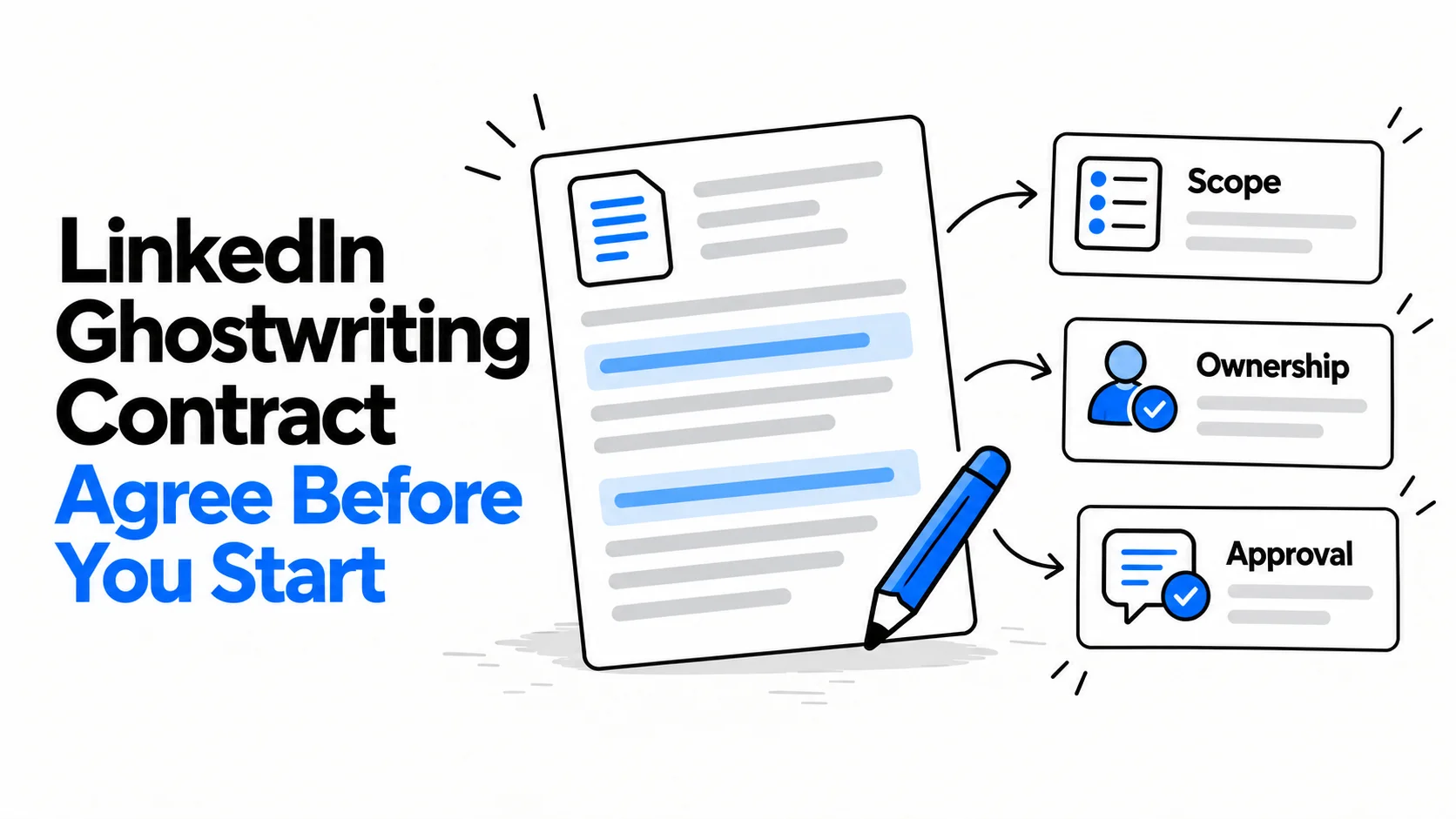
A LinkedIn ghostwriting contract gives a founder and a writer a shared operating model before the first interview or draft. It should make the work easier to review, not turn a straightforward editorial relationship into a legal maze.
The useful questions are practical: What is being delivered? What information can the writer use? Who approves a post? What happens when the founder's priorities change? A clear agreement does not guarantee a commercial outcome. It helps both sides protect the accuracy, voice, and pace of the work they can actually control.
This is not legal advice. Ask qualified counsel to review any agreement that needs to address your company, customers, jurisdiction, or risk profile. Use the checklist below to have a more precise conversation with a prospective writer or agency.
“LinkedIn ghostwriting” can describe very different services. One provider may conduct founder interviews and write posts. Another may also develop positioning, edit comments, coordinate approvals, prepare graphics, or help with distribution. Put the actual deliverables in the agreement instead of assuming that a monthly post count answers every question.
For example, a hypothetical scope might include two interviews each month, eight draft posts, one revision round per post, and a monthly planning call. It might exclude posting from the founder's account, responding to messages, customer approvals, and paid promotion. Neither version is universally right. The point is that both parties can see the boundary before work begins.
Ask how unused interviews, delayed feedback, product launches, and urgent company news are handled. A thoughtful process makes room for real business events without quietly adding new work to an unchanged scope.
The strongest ghostwriting starts with a founder's own experience: operating decisions, observations from customer conversations, and opinions the founder is prepared to stand behind. The agreement should say what materials the writer may use and how they will be stored, shared, or returned at the end of the engagement.
It should also distinguish a draft from a statement the founder has approved. LinkedIn says members are responsible for keeping profile information truthful and for content shared through their account. That makes a final founder review more than a nice editorial step. It is the point where the person speaking confirms that the post reflects what they mean.
In practice, this means agreeing on a source process. The founder can identify what is confidential, what needs customer approval, and what should never be reused. The writer can flag claims that need evidence or context rather than smoothing them into generic language.
A contract should name the approver and the expected feedback window. Without that, good drafts often wait because a founder assumes someone else will check facts, while a writer assumes silence means approval.
Interview or source review: Capture the idea, business context, sensitive details, and intended reader.
Draft: The writer prepares copy from the approved source material and flags claims that need confirmation.
Review: The founder or named approver checks accuracy, voice, confidentiality, and links.
Approval: A designated person confirms the version that is ready to publish.
Posting: The founder publishes personally or gives a clearly authorized teammate a defined role. Do not treat access to a personal account as the default.
Our guide to a founder-led content approval workflow goes deeper on making these steps fast without losing the founder's voice. The contract is where you decide who owns each step and what happens if a review is late.
Founder interviews can surface product plans, customer details, commercial terms, and personal context that should never appear in a post. The agreement should identify any existing confidentiality obligations, whether a separate NDA applies, and which people may see the source material.
A writer does not need every internal detail to make content specific. A useful interview process separates a publishable insight from the evidence that must remain private. If a customer story is in scope, name the approval path before the writer drafts it. Our guide to a customer story LinkedIn post can help a team turn approved proof into content without treating the customer as a prop.
Also clarify what happens after the engagement. You may want a practical return-or-delete process for confidential source files and a clear rule for using anonymized examples in a provider's portfolio. Those details are best agreed while both sides are aligned.
Writing a post and publishing it are different responsibilities. LinkedIn's User Agreement says a member must keep their password secret and not share their account. It also says the account belongs to the member. Build your workflow around that boundary.
For many founders, the simplest approach is for the writer to deliver approved copy and for the founder to post it themselves. If another teammate will schedule or publish, define the authorization, review sequence, and access method with care. Do not use an agreement as a reason to bypass platform rules or hand over credentials.
That distinction keeps accountability close to the person whose name and reputation are attached to the post. It also makes a handoff cleaner if the relationship ends.
Every engagement needs a workable way to change direction. Define the number and type of revision rounds, what counts as a new assignment, the notice period for pausing or ending the work, and what happens to work in progress. Avoid vague language such as “reasonable revisions” unless you also explain who decides what is reasonable.
It is equally useful to define the handoff. A founder may need final drafts, an editorial calendar, source notes, or a record of open approvals. The writer may need confirmation that unpublished drafts will not be used without the agreed payment or review process. Clear handoff expectations reduce friction without making either party dependent on the other.
These questions are not a substitute for legal review. They are a way to identify the operational decisions that are otherwise easy to discover after the first missed deadline or sensitive draft.
A useful LinkedIn ghostwriting contract makes room for the founder's judgment. It creates a repeatable path from interview to draft to approval while keeping claims accurate and account ownership clear.
Rethoric helps B2B founders turn real experience into credible LinkedIn content through interviews, human writing, review, and distribution. If you are evaluating a partner, explore LinkedIn ghostwriting for founders or book an intro call.
