A LinkedIn content team helps founders turn raw expertise into consistent founder-led content. Here is when to hire in-house, outsource, or use a hybrid model.
Most founders do not need a bigger content calendar.
They need a real LinkedIn content team.
That does not always mean hiring three people, buying five tools, and building a miniature media company inside the startup. It means putting the right people, workflow, and judgment around the founder so LinkedIn can become a repeatable growth channel instead of another task the founder keeps dropping.
For Series A and later B2B companies, the problem is rarely a lack of ideas. The founder has customer calls, sales objections, product decisions, investor questions, hiring lessons, and category beliefs happening every week. The problem is turning that raw material into consistent LinkedIn content without flattening the founder's voice or slowing the business down.
That is the job of a LinkedIn content team.
This guide breaks down what a founder-led LinkedIn content team actually does, when to build it in-house, when to outsource it, which roles matter, and how to avoid the expensive middle where everyone is busy but the founder's point of view never really ships.
A LinkedIn content team is the group responsible for turning a founder's expertise into planned, written, approved, published, distributed, and measured LinkedIn content.
For a B2B founder, that team has to do more than manage posts. It has to manage judgment.
A normal social team can plan campaigns, draft captions, schedule updates, and report engagement. A founder-led LinkedIn team needs to get closer to the source. It has to understand what the founder believes, what customers are saying, what sales is hearing, what the category is missing, and what the company needs the market to remember.
That work usually includes strategy, voice capture, ghostwriting, editing, approval management, scheduling, engagement support, internal distribution, tagging, analytics, and content reuse across sales and marketing.
If the system only creates posts, it is not enough. The team should help the founder become easier to find, trust, remember, and reference before buyers are ready to talk.
For the strategic foundation behind this, Rethoric's guide to LinkedIn content strategy for founders explains why founder content has to connect to pipeline and authority, not just posting consistency.
Founders are not typical executives in a content workflow.
They are the source of the insight, the final approval layer, and often the person whose credibility makes the content work in the first place. That creates a different operating problem.
If the founder writes everything, the channel depends on whatever time is left after customers, hiring, fundraising, product, and board work. That usually means inconsistent posting.
If the team writes everything without enough founder input, the channel may become consistent but generic. The posts sound polished, but the market cannot feel the founder's lived conviction.
If approvals are scattered across documents, Slack threads, and calendar reminders, even strong posts can die before publishing.
The right LinkedIn content team solves all three problems at once. It captures the founder's thinking, turns it into sharp content, gives the founder a small number of high-leverage review moments, and ships consistently enough for the market to recognize the point of view.
That is why this is not just a writing hire. It is an operating system around founder expertise.
A founder-led LinkedIn content team does not need to be large. It does need to cover the full workflow.
Most teams need five functions. One person can cover more than one function early on, but none of the functions should be missing forever.
The strategy owner decides what the founder should be known for.
This person connects LinkedIn content to business priorities: demand generation, fundraising visibility, recruiting, category education, sales enablement, partner credibility, or executive authority. They decide which themes matter, which audiences matter, and which ideas deserve repetition.
Without this role, the founder ends up posting whatever sounds interesting that week. Some of it may perform. Very little of it compounds.
A strong strategy owner keeps the content tied to the company's market thesis. They know when a post should educate buyers, arm sales, challenge a category belief, create investor familiarity, or reinforce the founder's positioning.
Rethoric's guide to founder-led marketing for B2B startups goes deeper on why the founder's point of view can become a growth channel when it is connected to the business instead of treated like personal branding.
The voice capture lead gets the founder's real thinking out of their head.
This can happen through weekly interviews, voice notes, sales-call reviews, internal memos, customer-call summaries, product notes, or async prompts. The method matters less than the discipline.
The founder should not have to open a blank page and invent a post from scratch. The team should pull content from the work the founder is already doing.
Good capture protects specificity. It saves the founder's exact phrases, strong opinions, examples, tradeoffs, and objections. It notices when the founder says something sharp in a customer call that would beat a generic content prompt by a mile.
Bad capture produces vague themes. Good capture produces raw judgment.
The writer turns raw founder thinking into posts people actually want to read.
This is where many systems fail. The writer cannot simply make the founder sound impressive. They have to preserve the claim, the edge, the examples, and the founder's way of seeing the market.
A good founder ghostwriter knows when to sharpen a point, when to simplify, when to keep an imperfect phrase because it sounds like the founder, and when to push back because the idea is not specific enough yet.
The goal is not to outsource the founder's brain. The goal is to remove the writing bottleneck while keeping the founder's judgment visible.
If you are comparing writing support models, Rethoric's LinkedIn ghostwriting vs DIY breakdown is a useful decision point.
The workflow manager makes sure the system actually ships.
This person owns the calendar, approval flow, scheduling, reminders, post status, assets, link checks, and handoffs. They make sure the founder knows what needs review, the writer knows what needs revision, and the team knows what is going live.
This role is not glamorous. It is also the role that prevents the whole program from becoming a graveyard of almost-finished drafts.
Founders are busy. A strong workflow makes approval easy enough that LinkedIn does not compete with every other urgent thing in the company. Mobile review, clear statuses, and tight approval windows matter more than most teams expect.
For the approval side, Rethoric's guide to content approval workflows for founder-led LinkedIn covers how to ship without losing the founder's voice.
Publishing is not the finish line.
The distribution and analytics owner makes sure strong founder content reaches the right people and creates useful feedback. They decide when sales should reuse a post, when the team should add context, when a post should become a newsletter idea, and when a theme deserves more coverage.
They also separate vanity metrics from business signal. A post with broad likes may be less valuable than a post that gets saved by target buyers, referenced in sales calls, or viewed by investors in the right category.
That owner should track audience quality, comments from relevant people, profile views, DMs, connection requests, target-account engagement, sales reuse, and themes that create pipeline signal.
Rethoric's guides to LinkedIn distribution strategy for founders and LinkedIn analytics for founders cover the distribution and measurement layers in more detail.
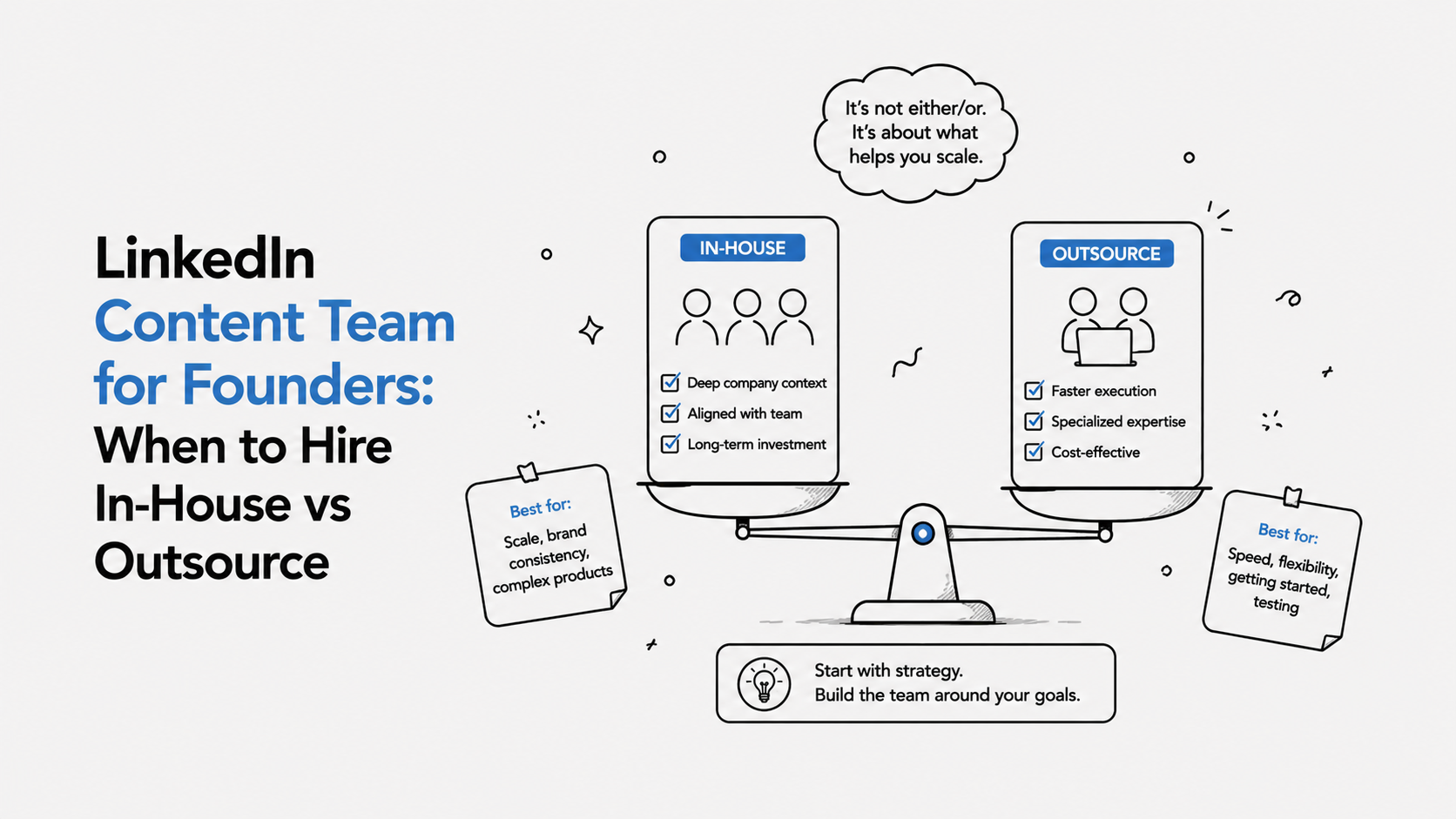
An in-house LinkedIn content team can work well when the company has enough volume, context, and management discipline to support it.
In-house is strongest when the founder needs close daily support, the company has multiple executives posting, the content is tightly connected to product launches or sales enablement, and there is already a marketing leader who can manage editorial quality.
It also works when the company has a complex category that requires deep internal context. A technical infrastructure company, for example, may need someone who can sit close to product, sales engineering, and customer success to understand what is actually worth saying.
The upside of in-house is proximity. The team sees more internal conversations, understands the product faster, and can coordinate across functions more easily.
The downside is cost and specialization.
Hiring one content marketer rarely covers strategy, founder interviews, ghostwriting, editing, approvals, scheduling, distribution, engagement, analytics, and executive stakeholder management at a high level. Hiring the full set of skills is expensive. Managing the system also takes real leadership attention.
In-house works when the company is ready to treat founder-led LinkedIn as a serious function, not a side project handed to the nearest marketer.
Outsourcing makes sense when the founder needs leverage faster than the company can build the function internally.
This is common when the founder already knows LinkedIn matters, but the team is too busy, the current posts are inconsistent, the company lacks a strong executive voice, or the channel needs to support pipeline, fundraising, or category credibility this quarter.
A good outsourced partner brings the system with them: strategy, capture, writing, approval workflows, scheduling, engagement support, tagging, and reporting. The founder should not have to stitch together freelancers, docs, spreadsheets, and tools just to get posts out the door.
Outsourcing is also useful when the company wants senior editorial judgment without hiring a full-time editorial lead. Founder-led content is easy to make bland. A strong partner should know how to keep the founder's real point of view intact while removing the operational drag.
The risk is distance.
If the partner does not have access to the founder, customers, sales objections, and market context, the content will drift into generic advice. The best outsourced teams solve that with structured capture and tight feedback loops.
Rethoric's guide to LinkedIn content agencies for founders covers what to look for before hiring a partner.
The best answer is often hybrid.
The founder does not need to choose between doing everything internally and disappearing into an external agency process. A hybrid LinkedIn content team keeps strategic ownership close to the company while using outside support for the repeatable work that creates leverage.
For example, the founder and marketing lead may own positioning, campaign priorities, and final approval. An external partner may handle voice capture, drafting, scheduling, workflow management, engagement prompts, and reporting. Sales may contribute objections and reuse the strongest posts in outreach. Product may flag technical or customer insights worth turning into content.
That model works because founder-led LinkedIn touches more than marketing. It needs input from the founder, but it should create value for sales, recruiting, fundraising, and category education.
The test is not whether the team is internal or external. The test is whether the founder's expertise moves through the system every week and comes out sharper than it went in.
Bad LinkedIn content teams are easy to spot once you know the pattern.
They start with posting frequency before they understand the founder's point of view. They ask for ideas in a blank document. They turn every post into the same hook and lesson. They rely on generic AI drafts. They measure likes without checking whether the right buyers are paying attention. They publish consistently for a few weeks, then stall when approvals get messy.
The biggest warning sign is interchangeability.
If the founder's posts could come from any executive in the category, the team is not doing founder-led content. It is doing content production with the founder's name attached.
Another warning sign is operational sprawl. Ideas live in call recordings, drafts live in docs, approvals happen in Slack, schedules live in a spreadsheet, analytics live in screenshots, and nobody can tell which themes are working. The team may be busy, but the system is weak.
A strong team creates a clear path from founder insight to published content to market signal.
Use five questions.
First, how close does the team need to be to internal context? If the content depends on deep product and customer detail every week, in-house ownership may matter more.
Second, how much founder time is realistically available? If the founder can give 30 minutes a week but not three hours, the capture and approval workflow has to be extremely tight.
Third, who owns editorial quality? If nobody can tell whether a post carries real founder judgment, the team will drift toward safe but forgettable content.
Fourth, what is the business goal? Pipeline, fundraising visibility, recruiting, category creation, and executive authority all require slightly different content and measurement.
Fifth, how fast does the channel need to work? Hiring and onboarding an in-house team can take months. A strong partner can usually stand up the operating rhythm faster, as long as the founder gives real access.
The practical rule is simple: build in-house when content is already a core operating function and you have the leadership to manage it. Outsource when you need senior judgment, workflow, and consistent shipping before you are ready to hire the full team. Use a hybrid model when LinkedIn matters enough to own internally but not enough to staff every function from scratch.
Do not start by hiring blindly.
Start by proving the workflow.
In week one, audit the founder's current profile, posts, audience, sales objections, customer language, and strongest market beliefs. Identify the three to five ideas the founder should become known for.
In week two, build the capture process. Decide where raw ideas come from, how often the founder is interviewed, who reviews customer and sales material, and how insights enter the content backlog.
In week three, draft and approve the first two weeks of posts. Test the approval workflow hard. If the founder cannot review quickly, fix that before increasing volume.
In week four, publish, distribute, and measure. Track not just impressions, but who engaged, which posts sales can reuse, which topics created better conversations, and where the workflow slowed down.
After 30 days, the question should be clear: do you need an in-house hire, an outsourced partner, or a hybrid system with clearer ownership?
Rethoric is built around a simple belief: founders should not have to become the content team for LinkedIn to work.
But the founder also cannot disappear from the system.
The strongest founder-led LinkedIn programs keep the founder's real expertise at the center while removing the operational weight around it. That means strategy, voice capture, drafting, approvals, scheduling, alerts, engagement support, tagging, mobile review, analytics, and a workflow that lets the team ship without chasing the founder through scattered tools.
That is the difference between outsourcing posts and building a founder-led growth channel.
Rethoric gives founders the leverage of an in-house social and content team without forcing them to hire, train, and manage the whole function from scratch. The founder stays close to the judgment. The system handles the machinery.
If you want that operating rhythm around your LinkedIn presence, see how Rethoric works with founders.
A LinkedIn content team for founders is not just a writer, a scheduler, or a social media manager.
It is the system that turns founder expertise into repeated market signal.
The right team captures raw judgment, sharpens it into a point of view, gets approvals without dragging the founder into endless edits, publishes consistently, distributes through the right people, and measures whether the right market is moving closer.
Build it in-house if you have the context, volume, budget, and leadership to manage it. Outsource it if you need a complete system faster than you can hire one. Use a hybrid model if LinkedIn is strategic but the internal team still needs leverage.
Whatever model you choose, do not settle for generic content production. The founder's voice is the asset. The team exists to make that voice easier to capture, ship, and compound.
