How founders should evaluate a LinkedIn content agency by voice capture, approvals, distribution, analytics, and business signal.
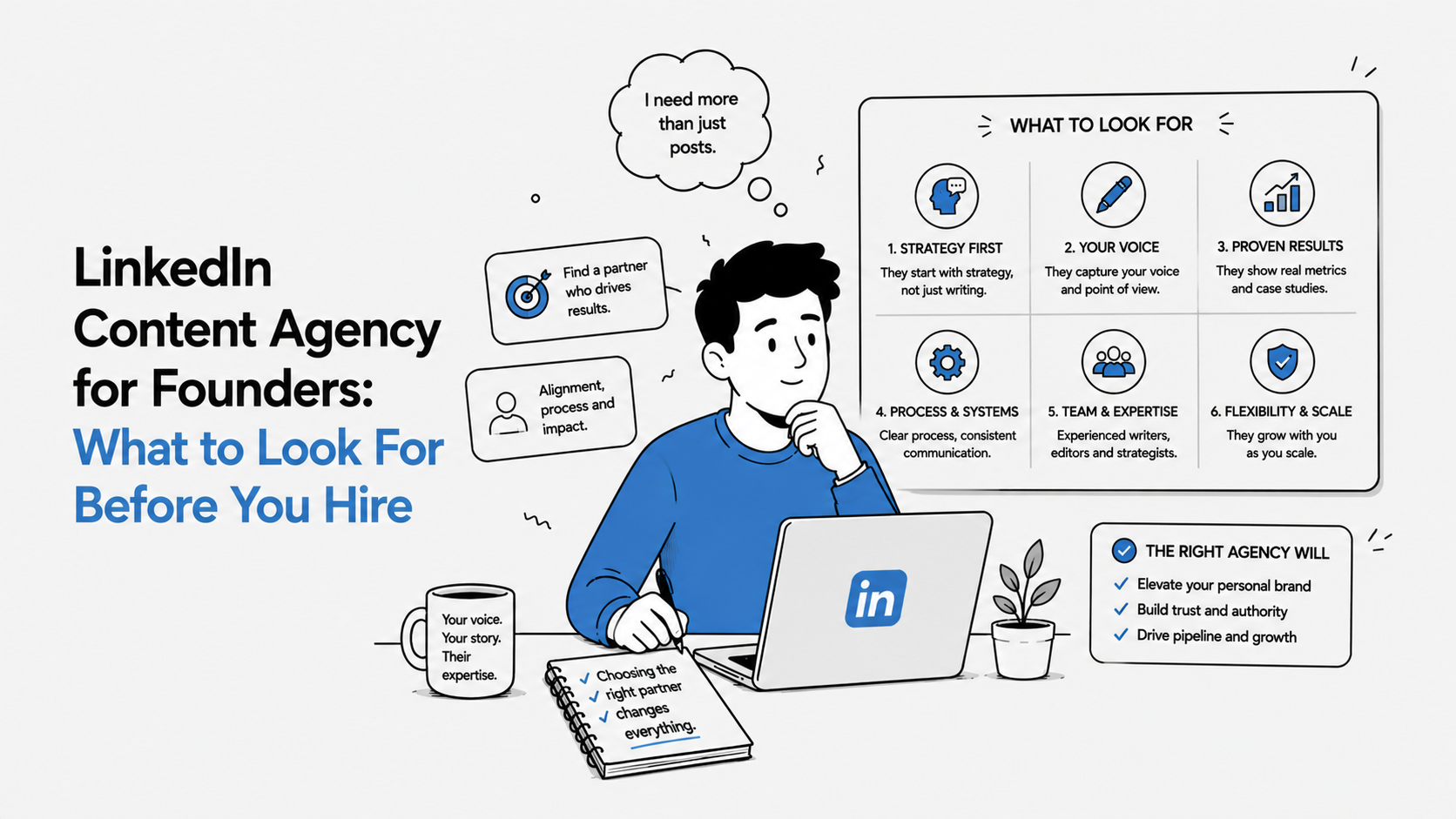
A LinkedIn content agency sounds simple on paper.
You hire a team. They write posts. The founder approves them. The company gets more visibility.
That is the clean version. The real version is messier.
Most founders do not need more LinkedIn activity. They need a system that turns their actual judgment into content buyers, investors, candidates, and operators can trust. If the agency cannot capture the founder's thinking, protect the founder's voice, and connect publishing to business outcomes, the output becomes another feed full of polished nothing.
That is why choosing a LinkedIn content agency is different from hiring a generic social media vendor.
For a B2B founder, LinkedIn is not a brand awareness side quest. It is a public trust surface. Prospects check it before calls. Investors scan it before introductions. Candidates use it to understand how the founder thinks. Partners and category peers decide whether the company has a real point of view.
The right agency gives the founder leverage without removing the founder from the work. The wrong agency removes the founder's judgment, adds a content calendar, and calls it strategy.
This guide breaks down what founders should look for before hiring a LinkedIn content agency, what questions to ask, what red flags to avoid, and how to know whether the agency is building a growth channel or just managing a posting habit.
A LinkedIn content agency should help founders turn expertise into consistent market visibility.
That sounds obvious, but it is where many agencies fail. They treat the work as writing posts. The better frame is operating a founder-led content system.
That system usually includes founder interviews, idea capture, editorial strategy, post writing, approvals, scheduling, engagement support, content tagging, performance reporting, and feedback loops from sales, recruiting, fundraising, and customer conversations.
The posts are the visible output. The system behind them is what determines whether the work compounds.
A strong agency does not start by asking, "What should we post this week?" It starts by asking what the founder knows that the market needs to hear. What buyer problems keep appearing? What category belief is the company trying to make familiar? What objections does sales hear repeatedly? What investor narrative needs more public proof? What internal ideas are too useful to stay buried in calls and memos?
That is the raw material. A good agency turns it into posts without flattening it into generic thought leadership.
If you already understand the strategic layer, Rethoric's guide to founder-led marketing for B2B startups explains why the founder's voice can become a growth channel when it is connected to pipeline, not vanity reach.
Founders usually hire a LinkedIn content agency for one of five reasons.
First, the founder has strong ideas but no consistent publishing rhythm. They see patterns in sales calls, customer conversations, investor updates, and product decisions, but those ideas never leave the company.
Second, the internal team has bandwidth but not founder voice. A marketer can write company copy, but founder content needs sharper judgment, more specificity, and a point of view that sounds like a real operator.
Third, the company needs a more credible demand channel. Cold outbound is getting harder. Paid ads are expensive. PR is episodic. Founder-led LinkedIn gives the market repeated exposure to the company's thinking before a sales conversation starts.
Fourth, the founder is raising, recruiting, or entering a more competitive market. Public credibility matters more when the company needs investors, senior hires, strategic partners, or category attention.
Fifth, the existing LinkedIn effort is too random. The founder posts when inspired. The team shares company updates. Someone tracks impressions. Nobody can say what the program is supposed to do.
A LinkedIn content agency should create structure around all of that. Not just "more content." More content is easy. Better market signal is harder.
The strongest agencies are operationally boring in the best way. They make the founder's expertise easier to capture, approve, ship, distribute, and measure.
Look for these workflows before you sign.
The agency should have a clear process for learning how the founder thinks. That usually means recurring interviews, call review, voice notes, past writing samples, sales call themes, internal memos, and direct feedback on drafts.
A kickoff call is not enough. A founder's voice is not a tone-of-voice document. It is the founder's specific way of framing problems, pushing against lazy assumptions, choosing examples, and deciding what is worth saying.
If every sample in the agency's portfolio sounds like the same person wrote it, that is a problem.
The agency should define the founder's core themes before filling a calendar. For a Series A or later B2B founder, those themes usually connect to buyer pain, category belief, customer proof, product judgment, hiring perspective, market timing, and founder conviction.
Without themes, the content becomes a rotating set of tips, lessons, and company updates. It may look active, but it does not teach the market what the founder stands for.
A good LinkedIn content calendar for founders is not a list of dates. It is an operating plan for repeating the right ideas until the market starts associating the founder with a specific point of view.
Founders do not have time for a messy review process. The agency should make it easy to review posts quickly, comment on angle or wording, approve from mobile, and know what is scheduled before it goes live.
This matters because the founder must stay in the loop. The goal is leverage, not disappearance. If the agency publishes without real founder review, the voice risk goes up fast.
The approval workflow should protect taste, accuracy, timing, and sensitivity without turning every post into committee copy.
Posting is not distribution. A serious agency should know what happens after a post goes live.
That can include targeted engagement, sales follow-up, employee amplification, investor visibility, comment monitoring, inbound triage, and turning strong posts into follow-up assets. The point is to connect the public post to private business conversations.
This is where many agencies stop too early. They deliver content, schedule it, and move on. But founder-led LinkedIn creates value when the right people see the right ideas and the team knows how to use the signal.
For the deeper mechanics, see Rethoric's guide to LinkedIn distribution strategy for founders.
The agency should report on business signal, not just content activity.
Reach matters, but it is not the whole job. A founder needs to know which topics create profile views from target accounts, buyer comments, relevant DMs, sales-call mentions, investor engagement, recruiting signal, and reusable narratives for the team.
A post with modest reach can be valuable if the right VP, investor, or operator responds. A post with broad engagement can be useless if it attracts the wrong audience.
That is why LinkedIn analytics for founders should be tied to company goals, not creator metrics.
The fastest way to evaluate an agency is to ask how the system works.
Ask how they capture founder expertise. If the answer is mostly "we send prompts" or "we use AI to generate ideas," keep digging. Prompts can help, but they cannot replace actual founder input.
Ask how they learn the founder's voice. You want to hear about examples, revisions, calibration, interview notes, and how they avoid making every client sound the same.
Ask how they choose topics. A good answer connects topics to business priorities, market narratives, sales objections, ICP pain, and content gaps. A weak answer talks mostly about trending formats.
Ask who reviews drafts and how approvals work. If the founder has to dig through docs, Slack threads, and spreadsheets every week, the process will break.
Ask what happens after posts go live. If the agency has no view on engagement, comments, sales use, or distribution, you are buying copy, not a growth system.
Ask what metrics they report. If the dashboard is mostly impressions, likes, and follower growth, it is incomplete. Those numbers can matter, but they should sit next to audience quality and business signal.
Ask for samples from different founders. The question is not whether the samples are polished. The question is whether they sound meaningfully different from each other.
Finally, ask what they will not automate. This is a useful test. A strong agency should be comfortable saying that workflow can be automated, but founder judgment cannot.
Some LinkedIn content agencies are built for volume. That is not automatically bad, but founders should be careful.
Be skeptical of any agency that promises fully automated founder content. Automation can help with calendars, approvals, scheduling, alerts, tagging, and analytics. It should not replace the founder's point of view.
Be skeptical of agencies that lead with viral hooks before they understand the business. Hooks matter, but if the idea underneath is weak, the founder becomes more visible for the wrong reasons.
Be skeptical of agencies that treat every founder like a creator. B2B founders do not need to chase creator culture. They need credibility with a specific market.
Be skeptical of agencies that cannot explain how content supports sales, fundraising, hiring, or category creation. If they only talk about engagement, they may not understand the job.
Be skeptical of agencies that want to publish without a real approval loop. Speed is useful, but not if it creates voice, accuracy, or reputational risk.
And be skeptical of agencies whose samples sound smooth but empty. The most dangerous content is not badly written. It is polished content that says nothing specific.
Founders often compare four options: hiring a LinkedIn content agency, hiring a ghostwriter, assigning the work to an internal marketer, or buying a tool.
A ghostwriter can be enough if the founder only needs writing support and already has strategy, approvals, distribution, and analytics handled elsewhere.
An internal marketer can work if they have enough founder access, editorial judgment, and time. The challenge is that internal teams are often pulled into launches, sales enablement, website work, events, and every urgent request from leadership.
A tool can help if the process already exists. It can make calendars, approvals, scheduling, and reporting cleaner. But a tool will not decide what the founder should believe or how to say it.
A LinkedIn content agency makes the most sense when the founder needs both editorial support and operating infrastructure. The agency should bring strategy, capture, writing, review workflows, scheduling discipline, distribution support, and reporting.
For founders deciding between writing help and a broader system, Rethoric's LinkedIn ghostwriting vs DIY breakdown is a useful comparison.
The first 90 days with a LinkedIn content agency should not feel like random posting at a higher volume.
In the first 30 days, the agency should learn the founder's voice, audit existing content, define themes, map business priorities, and build the first content queue. Some posts may go live quickly, but the real work is calibration.
By day 60, the founder should have a cleaner approval rhythm, recurring source material, sharper themes, and early signals about which ideas attract the right audience.
By day 90, the program should have a visible operating cadence. The team should know what is being posted, why it matters, how the founder reviews it, how sales can use it, and which topics are creating useful signal.
Do not judge the agency only by whether one post overperformed. Judge whether the system is getting smarter. Are the drafts sounding more like the founder? Are the topics becoming more specific? Are the right people noticing? Is the team using the content outside the feed?
That is how a LinkedIn content agency earns its keep.
Rethoric's view is direct: founders need leverage, but the leverage cannot erase the founder.
The market does not want generic AI slop with a founder's headshot attached. It wants the founder's actual judgment, shaped into content that ships consistently and reaches the right people.
That requires more than writing. It requires interviews, content calendars, approvals, scheduling, alerts, engagement, tagging, mobile review, analytics, and enough editorial taste to know when a post sounds too clean to be believed.
The founder should not have to become a full-time content operator. But the founder's expertise has to stay at the center of the system.
That is the standard a LinkedIn content agency should meet.
A LinkedIn content agency is worth hiring when it helps the founder become more consistently visible without making the founder sound less real.
Look for voice capture, editorial strategy, clean approvals, distribution thinking, and reporting tied to business signal. Avoid fully automated content promises, generic samples, creator-first advice, and agencies that cannot explain how LinkedIn connects to pipeline, fundraising, recruiting, or category authority.
The goal is not to outsource a personal brand. The goal is to build an operating system around the founder's expertise.
If you want that system without hiring an in-house social team, see how Rethoric works with founders.
