Most founders obsess over what to post. The founders who win obsess over who sees it. Here is a practical LinkedIn distribution strategy that gets your best ideas in front of the right buyers, not just the biggest crowd.
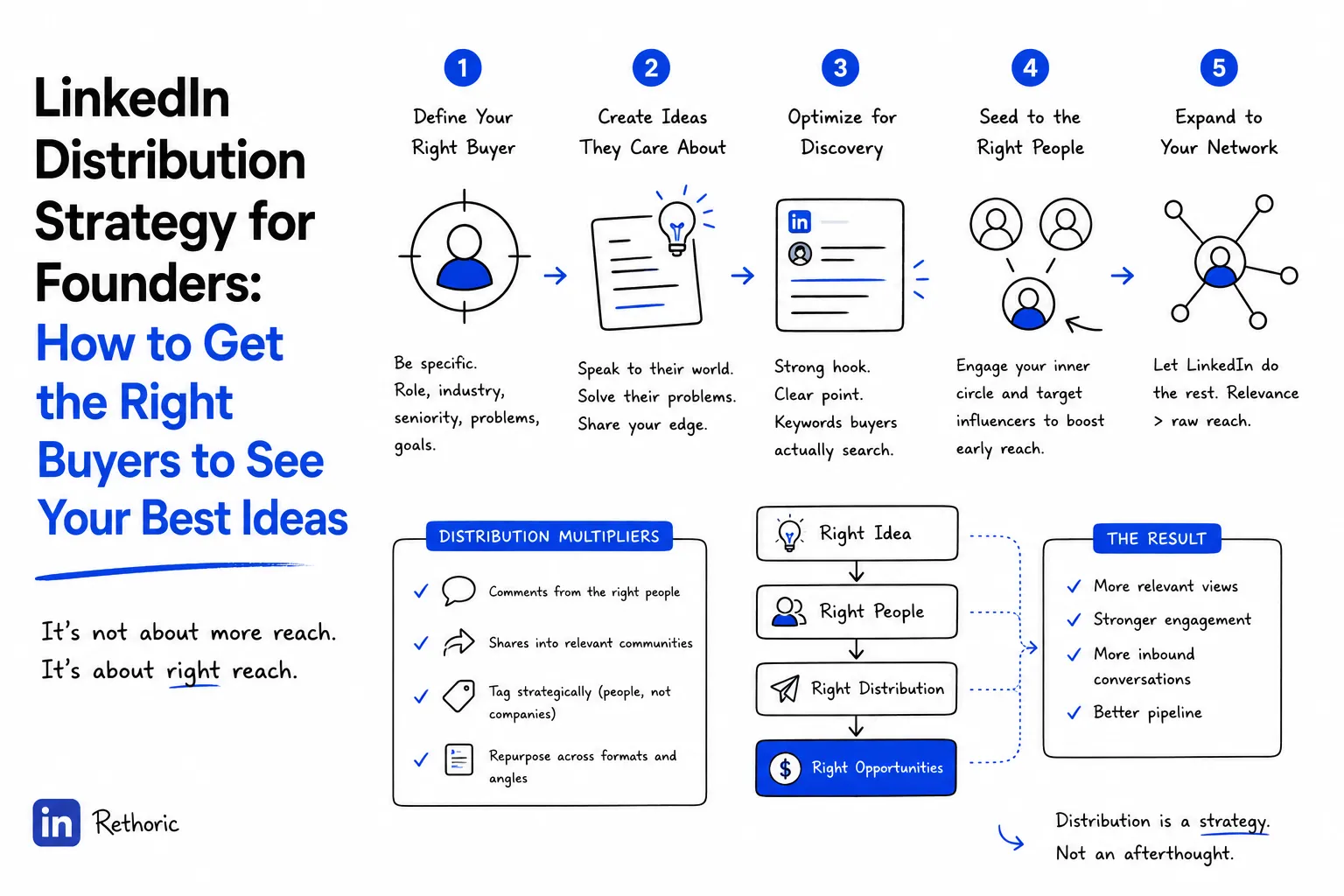
Here is the uncomfortable truth about founder content on LinkedIn. Your best idea, the one that would move a real buyer, is probably getting seen by the wrong people. Other founders. Job seekers. People who will never buy from you and never send you a deal. Meanwhile the VP of engineering who could become your next six figure customer never saw it at all.
That is not a writing problem. That is a distribution problem. And most founders never separate the two.
A LinkedIn distribution strategy is the system that decides who sees your content, how far it travels, and whether it lands in front of buyers or just racks up vanity likes from your peers. Publishing is the easy part. Distribution is where founder-led growth is actually won or lost. This is a founder-to-founder playbook for building that system, so your sharpest thinking reaches the people who can act on it.
Most people use "content" and "distribution" as if they are the same activity. They are not. Content is the idea and the words. Distribution is everything that happens after you hit post: who the algorithm shows it to first, who engages, who reshares, who sees it in a second wave, and who eventually reads it because a colleague sent it to them.
If you already have a system for what to publish, like a LinkedIn content calendar for founders, then distribution is the missing half. A great post with no distribution plan is a great idea whispered in an empty room.
The founders who compound on LinkedIn treat every post as having two jobs. The first job is to be worth reading. The second job is to be built for travel. This article is about the second job.
It is easy to fall in love with impressions. A post hits fifty thousand views and it feels like a win. But if forty thousand of those views came from other founders, marketers, and people outside your buying universe, you did not build pipeline. You built an audience of spectators.
Series A and later founders do not need the biggest audience. They need the right audience seeing the right ideas often enough to trust them. A post that reaches two thousand of the exact right operators is worth more than one that reaches fifty thousand strangers.
So the first move in any distribution strategy is to define the audience you actually want, in plain terms:
Once you know who you are trying to reach, distribution stops being about volume and starts being about aim.
You do not need to reverse engineer the algorithm to use it well. You need to understand the shape of how a post travels.
When you publish, LinkedIn shows your post to a slice of your network first. How that slice responds decides whether the post gets a second, larger wave of distribution. Early engagement from relevant people is the signal that pushes a post outward. Early silence kills it.
That single mechanic has three consequences for founders.
The people most likely to see and engage with your post early are the ones who interact with you often. If your immediate network is full of the wrong people, your early signal is noise, and the algorithm carries your post to more of the wrong people. Curating who you are connected to is a distribution lever, not a vanity metric.
A post that gets thoughtful engagement in its first hour tends to keep traveling. One that sits quiet rarely recovers. This is why timing and a warm engagement lane matter so much, and why posting into a void and hoping is not a strategy.
A real comment, especially a substantive one, signals to the platform that your post is worth a conversation. It also exposes your post to that commenter's network. Distribution is social proof made visible, so the goal is to earn conversation, not applause.
An engagement lane is a group of relevant people who reliably see and engage with your content early, giving it the signal it needs to travel to the right second wave. This is the most underused distribution asset founders have.
You are not buying engagement and you are not joining a spammy pod that comments "great post" on everything. You are building genuine, mutual attention among people whose audiences overlap with your buyers. Here is how to construct it.
Your employees have networks full of exactly the people you want to reach: peers in their function, former colleagues, and industry contacts. When your team engages early and authentically, your post reaches all of those adjacent networks. This is the fastest distribution multiplier most startups already have and never use. We wrote a full playbook on turning your team into a channel in LinkedIn employee advocacy for B2B startups.
Build real relationships with ten to twenty founders and operators in adjacent spaces. You engage with their work, they engage with yours, and both audiences benefit because the content is actually relevant. The key word is adjacent, not identical. You want overlap in audience, not competition for the same deal.
Your happiest customers are your most credible distributors. When a customer comments on your post, their network sees a real practitioner vouching for your thinking. Make it easy for them by tagging them where relevant and by publishing ideas they would be proud to be associated with.
Buyers consume content differently. Some read long posts. Some only watch video. Some never open LinkedIn but read the newsletter your post links to. If you publish an idea once, in one format, you reach only the slice of your audience that happens to prefer that format that day.
Repurposing is distribution, not laziness. One strong idea should show up as several assets:
The same idea, shaped for different readers, reaches more of the right buyers without asking you to generate more ideas. For a founder with limited time, this is the highest leverage move in distribution.
This is where founder distribution separates from generic content marketing. Your LinkedIn content is not just feed fuel. It is an asset you can place directly in front of the exact people who matter.
When your team is working a deal, your best content becomes a credibility tool. A rep sharing your post that articulates the problem the buyer is living, or a video where you explain your point of view, does more than a case study. It lets the buyer meet the founder's thinking without a meeting. Feed your sales team a running library of your strongest posts and teach them to place the right one at the right moment.
Investors watch founders on LinkedIn long before a raise. A consistent, sharp presence is passive fundraising visibility. When you are ready to raise, the partners you want already know how you think. Distribution here means making sure the ideas that show your category insight and momentum are the ones reaching your investor network, not just your operational updates.
If you want the deeper argument for why founder authority compounds into revenue and access, we cover it in founder-led marketing for B2B startups.
Organic distribution has a ceiling, and once you have a post that clearly resonates with the right buyers, paid amplification can extend its reach to more of exactly those people. This is not about boosting weak content. It is about pouring fuel on the posts that already earned attention from your target audience.
Thought leader ads let you put spend behind a founder's organic post so it reaches a targeted set of accounts and roles. Used well, it turns a proven organic idea into repeatable reach among named buyers. We break down the timing and mechanics in LinkedIn thought leader ads for founders.
The rule of thumb is simple. Earn the signal organically first. Amplify only what the right audience has already validated.
If you only track likes and impressions, you will optimize for the wrong audience. The founders who win measure whether their content reaches and moves buyers.
Pay attention to signals that connect to pipeline:
These tell you whether distribution is working where it counts. For the full framework on which metrics predict pipeline, see LinkedIn analytics for founders, and for tying it all back to revenue, LinkedIn ROI for founders.
You do not need a complex operation to start. You need a repeatable loop.
Run that loop consistently and your distribution compounds. The same effort reaches better people over time, because your network, your lanes, and your library all get sharper.
A LinkedIn distribution strategy is the system that controls who sees your content and how far it travels, as opposed to what you publish. It covers your network quality, early engagement, team and peer amplification, repurposing across formats, and placing content directly into sales and fundraising conversations. The goal is reaching the right buyers, not the largest crowd.
A content strategy decides what you say and when you say it. A distribution strategy decides who actually sees it and whether it reaches buyers. You can have a great content calendar and still fail if your ideas only circulate among peers who never buy. Distribution is the half that turns good posts into pipeline.
You do not need many. Ten to twenty genuinely relevant people across your team, peer founders, and customers is enough to generate the early signal a post needs to travel. Quality and relevance matter far more than size. A handful of the right people beats a large pod of unrelated accounts.
Yes. Different buyers prefer different formats, and most people miss any single post. Publishing one strong idea as a text post, a carousel, a short video, and a longer article reaches more of your target audience without forcing you to constantly invent new ideas. Repurposing is distribution, not repetition.
Only after a post has proven it resonates with your target buyers organically. Paid amplification, such as thought leader ads, should extend the reach of ideas your audience already validated, not prop up content that did not earn attention on its own. Earn the signal first, then amplify what works.
You already have the ideas. The gap is a system that gets them in front of the people who can act on them, consistently, without eating your week. That is exactly what Rethoric builds for founders: an in-house social and content team on autopilot, running distribution so your sharpest thinking reaches the right buyers while you run the business.
If you want founder-led LinkedIn to become a real growth channel instead of a guessing game, talk to our team.
