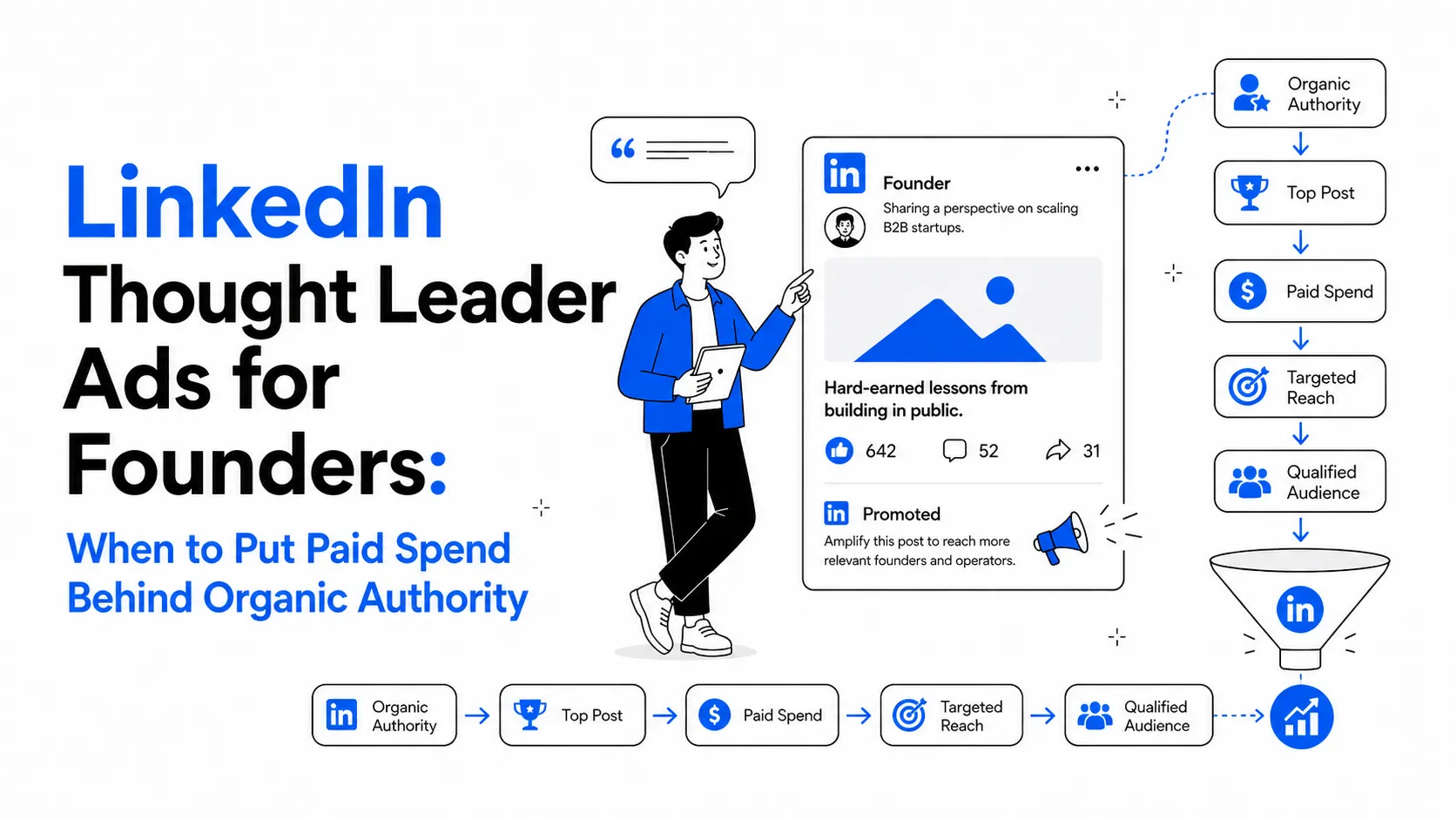
LinkedIn Thought Leader Ads can amplify founder authority, but only when the organic post already proves the founder has a point of view worth scaling.
Most B2B teams reach for LinkedIn ads too early.
They have a founder with a thin content history, a company page with low trust, and a market that still does not know what the company believes. Then they put budget behind a polished campaign and wonder why the clicks feel expensive, the leads feel cold, and the brand lift is impossible to see.
Thought Leader Ads change the equation, but they do not remove the hard part.
LinkedIn Thought Leader Ads let a company sponsor posts from real people: founders, executives, employees, customers, creators, or industry experts. That matters because B2B buyers trust people before they trust logos. A founder's post can carry context, conviction, and proof in a way a standard company ad usually cannot.
But paid amplification only works when there is something worth amplifying. If the founder's organic content is generic, the ad will scale generic. If the post has no sharp point of view, paid spend will not create one. If the founder has not earned trust in the feed, the ad format will not magically manufacture it.
This guide explains when founders should use LinkedIn Thought Leader Ads, what kind of posts deserve spend, how to avoid burning budget on vanity reach, and how paid amplification should fit inside a founder-led LinkedIn system.
LinkedIn Thought Leader Ads are sponsored posts that run from a real person's LinkedIn presence rather than only from the company page. The company uses Campaign Manager to request permission to promote a post, the author approves or denies the request, and the approved post can then run as ad creative.
That is the mechanical definition. The strategic definition is more interesting.
Thought Leader Ads are a way to put paid distribution behind trust that already exists, or behind a point of view that deserves a larger audience. Instead of saying, "Our company is credible," the ad lets the market hear from a founder, executive, customer, expert, or operator with a named perspective.
For founders, that distinction matters. Most startup brands do not yet have enough gravity for a company-page ad to carry the whole message. The founder often has the clearer signal: direct customer exposure, category conviction, product judgment, fundraising context, hiring perspective, and a lived understanding of the market.
A founder post can say what a brand ad cannot: here is what we believe, here is what we are seeing, here is the mistake most people make, here is the problem buyers are underestimating, and here is why our company exists.
That is why this format fits founder-led marketing so well.
Standard company ads have a trust problem.
They often look like campaigns. They lead with the brand, the offer, the asset, or the CTA. That can work for retargeting, bottom-funnel offers, and clear demand capture. But it is weaker when the buyer does not yet know why they should care.
Founder-led posts work differently. They can create belief before they ask for action. They can explain the problem in the buyer's language. They can show judgment. They can attract comments from the right people. They can make the founder familiar before the sales team ever reaches out.
Thought Leader Ads let a company scale that kind of trust without forcing every message through the company page.
The best use case is not "boost everything the founder posts." That is lazy. The best use case is selective amplification of posts that already show strong organic signal or strategic value. If a founder post creates buyer comments, saves, profile views, DMs, or sales-call mentions organically, paid spend can help that post reach more of the same market.
Paid distribution should extend a proven signal, not replace the work of finding one.
This is the same principle behind LinkedIn ROI for founders. The value is not the impression count by itself. The value is whether the right people become more familiar with how the founder thinks before a buying conversation starts.
Founders should use Thought Leader Ads when three conditions are true.
First, the founder already has a clear point of view. The post should make a claim the market can recognize. It should not sound like a generic brand awareness message with a face attached.
Second, the company knows who should see it. Thought Leader Ads are not a replacement for ICP clarity. If the target audience is vague, the spend will be vague. The team should know the roles, industries, company stages, pain points, and buying triggers that matter.
Third, the post connects to a business goal. That goal might be warming a target-account list, building category awareness before a launch, supporting fundraising visibility, creating demand around a market shift, or giving sales a stronger trust layer before outbound.
If those conditions are not true, wait.
A founder should not sponsor posts just because a competitor is doing it. The format is powerful because it scales named authority. If the authority is not there yet, build the organic foundation first.
The posts most worth amplifying usually fall into five categories.
Category point-of-view posts. These explain what the market gets wrong and how the founder sees the future differently. They are strong for awareness because they give buyers a reason to remember the founder.
Problem reframes. These name a buyer pain in sharper language than the buyer usually sees. They are useful when the company sells into a problem that is familiar but misunderstood.
Customer-pattern posts. These share anonymized lessons from sales calls, onboarding, implementation, or customer outcomes. They work because they prove the founder is close to the market.
Proof posts. These use specific traction, customer wins, product data, or operational lessons to make the company's credibility more concrete.
Founder conviction posts. These show why the founder is building the company, what they refuse to compromise on, and what they believe the category needs next.
The common thread is substance. A post deserves paid spend when it teaches the market something, sharpens the company's positioning, or creates trust with the right buyer.
A post does not deserve spend just because it got likes. Broad engagement can be a trap. The better question is: did the right people respond, and would more of those people benefit from seeing this?
Thought Leader Ads can support different campaign objectives, but founders should be honest about what the post is meant to do.
If the post is a category take, use it for awareness and engagement. The goal is to make the founder's thinking familiar to the right audience. Do not judge it like a direct-response ad.
If the post is tied to a launch, event, report, or webinar, the campaign can carry more explicit action. But even then, the post should create belief before it asks for the click.
If the post is meant to warm target accounts, the goal may be account engagement and later sales context rather than immediate form fills. Sales should know which posts are being amplified so they can reference the same ideas in outreach and discovery.
The mistake is forcing every Thought Leader Ad into lead-gen logic. Some founder posts are demand creation. Some are trust creation. Some are retargeting fuel. Some are sales enablement. Use the objective that matches the job.
A simple workflow keeps teams from wasting spend.
Start with organic founder content. Publish consistently around the founder's core themes for at least several weeks. Track which posts earn relevant comments, saves, profile views, DMs, connection requests, and mentions in sales conversations.
Then shortlist posts for amplification. Do not pick only the biggest reach winners. Pick posts that match a business priority and show quality signal from the right audience.
Next, define the audience. A Thought Leader Ad for Series A CFOs should not use the same targeting as a post meant for enterprise CMOs. The post, audience, and business goal have to line up.
Then run a small test. Put controlled spend behind the post, watch engagement quality, check who is responding, and compare paid performance against the original organic baseline.
Finally, feed the learning back into content. If a point of view travels with the right buyer, it should become a content series, sales talk track, webinar angle, or landing-page narrative.
This is where founder-led marketing becomes more than posting. The founder's content becomes market research, positioning, distribution, and sales context at once.
Paid should not replace organic. Paid should learn from organic.
Organic LinkedIn tells you what the market actually reacts to when the founder speaks without media spend. Which topics create thoughtful comments? Which posts earn saves? Which opinions get buyers into DMs? Which ideas show up later on sales calls?
That feedback is valuable because it is not purchased. It tells you what already has market pull.
Thought Leader Ads can then extend the best signals to a more precise audience. Instead of guessing what message should go into an ad, the team starts with posts that have already shown proof of resonance.
This is also why a founder should not wait until a paid campaign to start posting. If there is no organic history, every campaign is a guess. If there is a strong organic record, paid spend becomes a multiplier.
The best paid strategy starts with unpaid evidence.
Do not judge Thought Leader Ads only by cheap clicks.
Track engagement quality: who commented, who shared, who followed, and whether the audience matches the ICP. Track profile lift: whether the founder's profile views and relevant followers increased during the campaign. Track account signal: whether target accounts engaged with the post. Track downstream sales context: whether prospects referenced the idea in calls, replies, or DMs.
If the campaign includes a link, track clicks and conversions, but do not make clicks the only success condition. Many founder-led posts are designed to build familiarity before the buyer is ready to convert.
The best reporting combines paid metrics with founder-led growth signals: audience quality, topic resonance, sales mentions, inbound conversations, and pipeline influence.
This is where LinkedIn analytics for founders becomes useful. The dashboard should show whether paid amplification is creating the right kind of attention, not just more attention.
The first mistake is boosting weak posts. Paid spend does not fix a weak point of view. It only makes the weakness more visible.
The second mistake is using the founder as a mascot for company copy. If the post reads like a brand ad pasted into a founder's mouth, the format loses its advantage.
The third mistake is optimizing for broad engagement. A viral founder post that reaches the wrong audience can waste budget and muddy the signal.
The fourth mistake is disconnecting paid from sales. If sales does not know which founder ideas are being amplified, they cannot use that warmed context in conversations.
The fifth mistake is skipping permission and expectation-setting. The founder should know which post is being promoted, why it was chosen, who will see it, and how performance will be judged.
Thought Leader Ads are not a shortcut around strategy. They expose whether the strategy is strong.
Rethoric's view is simple: do not put paid spend behind founder content until the founder's organic point of view is worth scaling.
The work starts before Campaign Manager. It starts with capturing the founder's actual expertise, turning it into sharp posts, publishing consistently, tracking what resonates, and building a content library that proves the founder knows the market.
Once that system is working, Thought Leader Ads can become useful. They can expand the reach of the strongest ideas, warm target accounts, support launches, and help the market associate a specific founder with a specific problem.
But the founder should not become a paid-media asset detached from the business. The content, targeting, sales motion, and analytics all need to connect.
That is the difference between boosting posts and building a founder-led growth channel.
LinkedIn Thought Leader Ads are powerful because they scale a trusted voice, not because they make any post worth reading.
For founders, the sequence matters. Build the organic authority first. Find the posts that create real buyer signal. Put paid spend behind the ideas that deserve a larger audience. Measure quality, not just reach. Feed the learning back into the content strategy.
If you want founder-led LinkedIn content with the strategy, approvals, scheduling, engagement, and analytics needed to know which posts are worth amplifying, see how Rethoric works with founders.
