LinkedIn employee advocacy works when your team amplifies a founder-led point of view, not when everyone is forced to post generic company updates. Here is the system B2B startups can use to turn employees into credible distribution without sounding scripted.
Most B2B startups think LinkedIn employee advocacy means asking the team to repost company announcements. That is why it usually fails. Nobody wants to sound like a corporate megaphone, and buyers can tell when a post was copied from a shared doc five minutes before it went live.
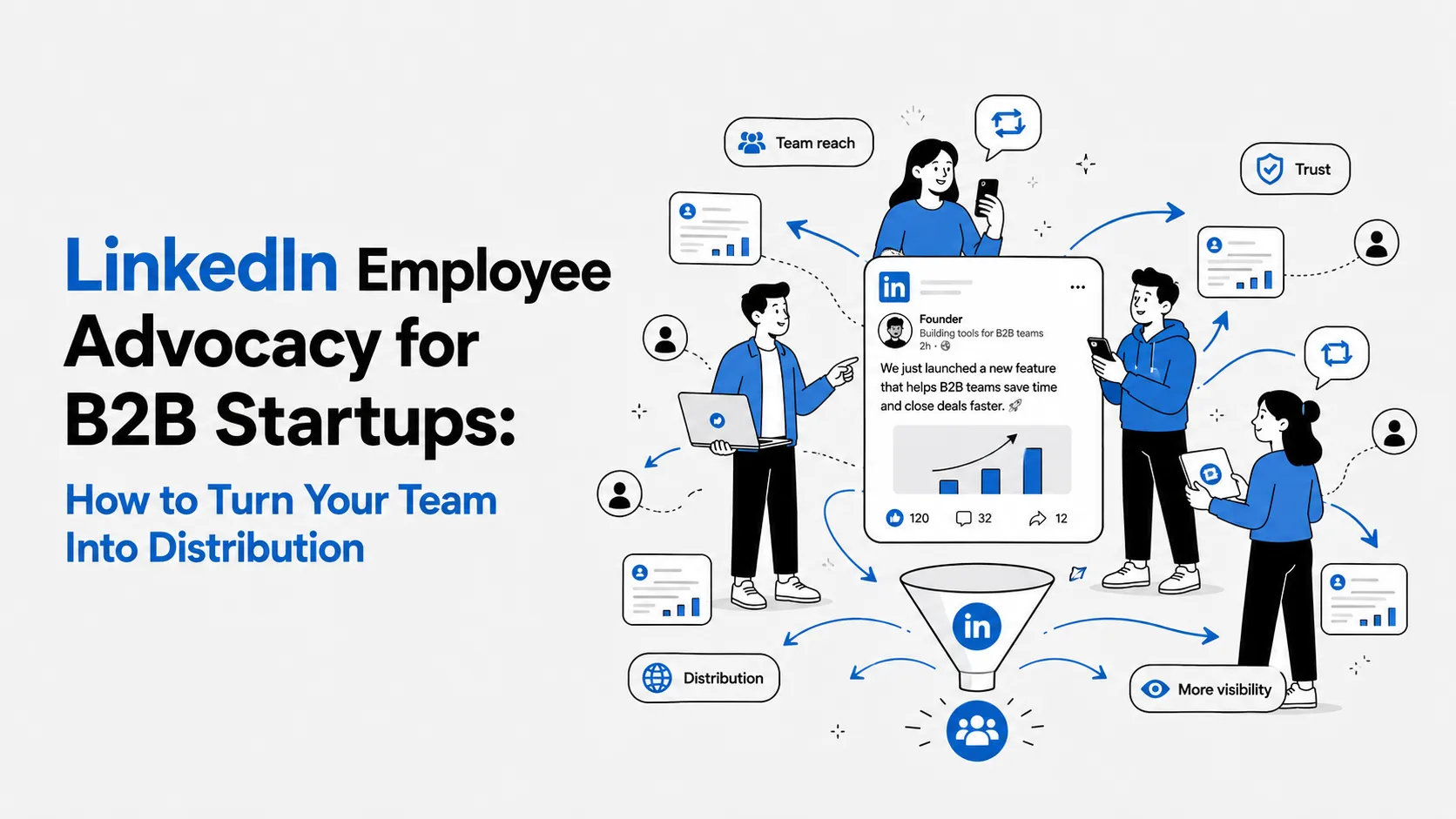
Real LinkedIn employee advocacy is different. It turns the company's actual expertise into a distributed signal across the people buyers already trust: the founder, the leadership team, customer-facing operators, and the subject-matter experts closest to the problem. The founder still sets the point of view. The team helps it travel.
This matters because a B2B startup rarely has enough brand demand on its own. The company page reaches a limited audience, paid channels get expensive, and cold outbound keeps getting noisier. But a credible founder voice, amplified by a few relevant people inside the company, can create repeated visibility in the exact network where buyers, investors, candidates, and partners already pay attention.
LinkedIn employee advocacy is the practice of helping employees share, comment on, and expand the company's point of view through their own LinkedIn profiles. For B2B startups, the best version is not a top-down content mandate. It is a system that gives the team clear topics, approved context, and simple engagement prompts so they can participate without losing their own voice.
The key distinction is ownership. The company owns the strategic narrative: what market shift you believe in, what customer problem you are solving, what you think the category gets wrong, and what proof you can share. Employees own their personal context: what they see in sales calls, onboarding, product work, customer success, recruiting, or operations. Advocacy works when those two layers meet. It fails when everyone is asked to paste the same brand-safe paragraph.
This is why employee advocacy should sit next to your founder profile and company page strategy, not replace it. The founder profile carries the sharpest point of view. The company page provides the official surface. The team creates reach, credibility, and repetition around the same narrative.
In early and growth-stage B2B, distribution is usually the bottleneck. The company may have strong ideas, strong customer wins, and strong product insight, but none of it matters if it only appears once from the brand account and disappears.
Employee advocacy solves three problems at once. First, it increases surface area. A single founder post can travel far, but the post reaches more relevant networks when operators, sales leaders, and executives comment with substance or share a personal angle. Second, it adds proof. A claim from the founder is stronger when the people doing the work can validate it from their own vantage point. Third, it keeps the conversation alive. LinkedIn rewards posts that earn meaningful comments early, and a team that knows how to engage can extend the life of the best ideas without manufacturing fake engagement.
The goal is not to turn every employee into a creator. That is the wrong standard. The goal is to make it easy for the right people to participate in the company's market conversation a few times a week. For a busy startup team, that is enough to change the distribution curve.
Employee advocacy breaks when the company has no clear narrative. If the founder is posting random updates, the team has nothing coherent to reinforce. If the content calendar is just product announcements, employees have no reason to add their own perspective. Before asking the team to amplify anything, define the few ideas you want the market to associate with the company.
A useful founder-led narrative has four parts. The market shift: what is changing that makes your company necessary now. The enemy: what outdated practice or bad default your buyers need to move away from. The expertise: what your team knows because of the work you do every day. The proof: customer outcomes, product patterns, data, or operational lessons that make the point credible.
Once that narrative is clear, the team's role becomes obvious. Sales can add what buyers are asking in live conversations. Customer success can share patterns from implementation. Product can explain trade-offs behind roadmap decisions. Recruiters and operators can show how the company thinks about talent, culture, and execution. Everyone is pulling from the same strategic spine, but nobody has to sound identical.
If you do not yet have that spine, build it before you ask for amplification. A scattered advocacy program only creates scattered visibility. A focused one compounds the same market position over and over.
The workflow should be light enough that people actually use it. Most programs fail because they ask employees to write from scratch, guess what is approved, and remember to post on top of their real job. The system has to remove those decisions.
Start with a weekly content calendar built around the founder's priority posts. Each post should have a short internal brief: the point of view, who the post is for, why it matters, and two or three suggested ways the team can engage. Those prompts should be specific. Not "please support this post." More like: "If you work with customers, comment with one pattern you are seeing in onboarding," or "If you are on sales calls this week, add the objection you hear most often." Specific prompts create useful comments instead of empty applause.
Then give the team optional share angles. One person might share the founder's post with a customer story. Another might write a short post on the same topic from a product perspective. Another might simply leave a substantive comment. All three count. Advocacy should include commenting, sharing, and original posting because different employees have different levels of comfort and different audiences.
Finally, protect the approval path. If legal, brand, or leadership needs to review sensitive topics, make the rules clear before the post goes live. A good LinkedIn content calendar is not just a schedule. It is the operating system that lets founder ideas, team input, approvals, and distribution happen without chaos.
The fastest way to kill advocacy is to hand the team a paragraph and ask everyone to post it. That may create short-term activity, but it damages trust. Buyers notice identical phrasing. Employees feel awkward. The company looks like it is gaming LinkedIn instead of contributing to a real conversation.
Use guardrails instead. Define the themes employees can talk about, the claims that need proof, the customer details that cannot be shared, and the tone that fits the brand. Then give examples of strong comments and posts without requiring exact language. The more senior or customer-facing the employee, the more their own perspective matters.
A practical format is a weekly advocacy note with three sections. "What we are saying" summarizes the main point of view. "Why it matters" explains the customer or market context. "How you can add your angle" gives optional prompts by function. That is enough structure to make participation easy without turning people into copy-paste accounts.
The standard is simple: if the post would make the employee cringe in front of a customer, do not ask them to publish it. Employee advocacy should make smart people more visible, not make them sound less human.
Follower growth and impressions are useful diagnostics, but they are not the goal. For B2B startups, the real question is whether advocacy is creating more of the right conversations.
Track four signal groups. First, reach quality: which titles, companies, investors, or partners are engaging. Second, engagement depth: whether comments are thoughtful or just internal likes. Third, relationship creation: new connection requests, warm DMs, event invites, podcast requests, referrals, and recruiting conversations. Fourth, pipeline influence: mentions in sales calls, inbound demo requests, expansion conversations, and opportunities where LinkedIn content helped create familiarity before outreach.
This is where advocacy connects to social selling without spam. The team should not use LinkedIn visibility as an excuse to pitch everyone who engages. They should use it to start better conversations with people who have already shown interest in the company's thinking. Content creates context. Sales still has to be human.
Should every employee participate? No. Start with the founder, leadership team, sales, customer success, product, and anyone with credible subject-matter expertise. A small group of relevant voices beats a large group of reluctant posters. Expand only after the workflow is working.
How often should employees post or engage? For most B2B startups, two or three meaningful touchpoints per week is enough. That might be one substantive comment, one share with a personal angle, and one original post per month. Consistency matters more than volume.
What should employees avoid? Avoid copied company language, unsupported claims, confidential customer details, internal-only metrics, and engagement pods that create fake activity. The point is credible distribution, not inflated numbers.
Who should own the program? Usually marketing or founder office owns the calendar and prompts, but the founder must own the point of view. Without founder-level narrative, the program becomes generic brand amplification. With it, employee advocacy becomes a multiplier on the company's actual expertise.
LinkedIn employee advocacy is not a hack for getting more likes on company updates. For B2B startups, it is a distribution system around founder-led expertise. The founder sets the narrative. The team adds proof, context, and reach. The company earns repeated visibility in the networks where deals, hires, partnerships, and investor familiarity actually happen.
Keep the system simple: one clear narrative, a weekly content calendar, specific engagement prompts, approval guardrails, and measurement tied to pipeline signals. Do that, and your team's LinkedIn presence stops being random individual activity. It becomes a coordinated growth channel that still sounds like real people.
If you want help turning founder expertise and team knowledge into a LinkedIn engine that runs without eating everyone's week, see how Rethoric works with founders.
