Most founders overinvest in the LinkedIn company page and underinvest in founder visibility. Here’s the practical split that drives B2B pipeline without adding content chaos.
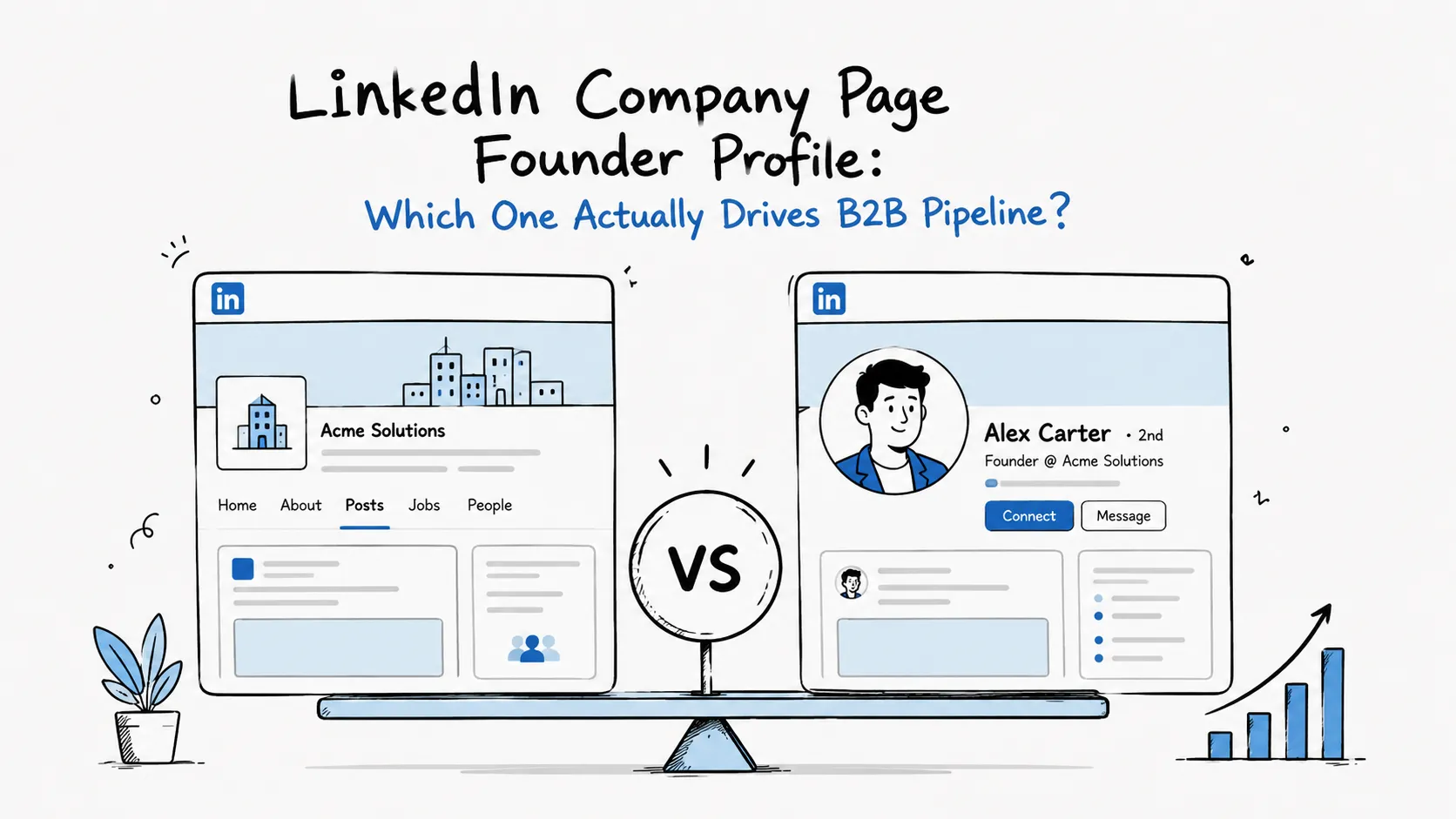
Many B2B founders treat their LinkedIn company page like the center of their growth strategy. It feels logical: the company is what you sell, so the company page should carry the demand motion. In practice, that almost never happens.
Buyers trust people faster than logos. On LinkedIn, distribution and credibility usually start with founder profiles, then compound through the company page. If you flip that order, you burn time publishing into a low-trust channel and wonder why pipeline is flat.
This guide breaks down the right split between founder profile and LinkedIn company page, when each channel matters, and how to run both without creating a second full-time job for your team.
For most Series A+ B2B companies, founder profiles should lead and the LinkedIn company page should support. Founders create the initial trust, conversation, and distribution. The company page acts as proof infrastructure: brand consistency, hiring signals, and social proof for buyers who want to validate the company after discovering the founder.
If your founder profile positioning is still generic, fix that first with this guide to LinkedIn profile optimization for founders.
LinkedIn is fundamentally a person-to-person network. Founder posts often get higher engagement because people evaluate ideas through individual credibility, not brand voice. That matters for B2B cycles where trust is built before the demo request.
Founder-led posts also travel further through second-degree networks. A strong founder opinion can reach decision-makers outside your existing followers in ways most company page posts cannot. The result is more qualified profile visits, more contextual DMs, and more warm conversations that eventually become pipeline.
Company pages still matter, but mostly after interest exists. Buyers check the page to validate momentum, team quality, and consistency. They rarely discover you there first.
A LinkedIn company page is useful when it is treated as a support channel, not the top-of-funnel engine. It works best for four specific jobs.
When teams expect the company page alone to generate demand, they usually over-post low-signal updates and under-invest in founder perspective. That is the core strategic mistake.
Use a simple operating model: founder profile drives conversation, company page reinforces trust. A practical split is 70/30 effort allocation.
If cadence is currently inconsistent, this structure pairs well with a LinkedIn content calendar for founders so execution does not depend on founder availability every day.
The best founder-led teams do not create separate content universes. They produce one core idea, then distribute it through both surfaces with different framing.
Example workflow:
This is how you convert visibility into opportunity while keeping brand and founder voice aligned. If your team needs the outbound-to-inbound bridge, use this playbook for social selling on LinkedIn for founders.
Track channel performance separately, then evaluate pipeline impact together.
Do not optimize for raw impressions alone. High reach without qualified conversations is activity, not demand. For measurement discipline, align this with your LinkedIn ROI framework.
Using the company page as the main thought-leadership voice
Brand pages can inform, but founder authority usually carries stronger trust and distribution.
Copy-pasting the same post across both channels
Repackage the angle for each surface instead of duplicating text.
Ignoring employee amplification
A quiet team network weakens company page ROI.
Publishing without a pipeline hypothesis
Every post stream should map to a buyer problem and a desired next action.
Can a company page grow without founder activity?
It can grow slowly, but demand impact is usually weaker. Founder activity accelerates trust and discovery.
How often should a company page post?
One to two high-quality posts per week is enough for most B2B companies when founder channels are active.
Should founders repost company updates?
Yes, but add context and opinion. Personal framing performs better than plain resharing.
What if the founder has limited time?
Use a managed workflow with approvals and batching so founder input stays strategic, not operational.
The LinkedIn company page is important, but it is rarely the engine of founder-led demand. In B2B, founder profiles usually create trust first and company pages convert that trust into validation.
Run both channels with clear roles, one shared narrative, and metrics tied to pipeline. That is how LinkedIn becomes a reliable growth channel instead of another content treadmill. If you want this system fully executed without losing founder voice, talk to Rethoric.
