A LinkedIn newsletter can turn founder expertise into a durable audience, but only when it has a sharp point of view and a reason to exist beyond reposting content.
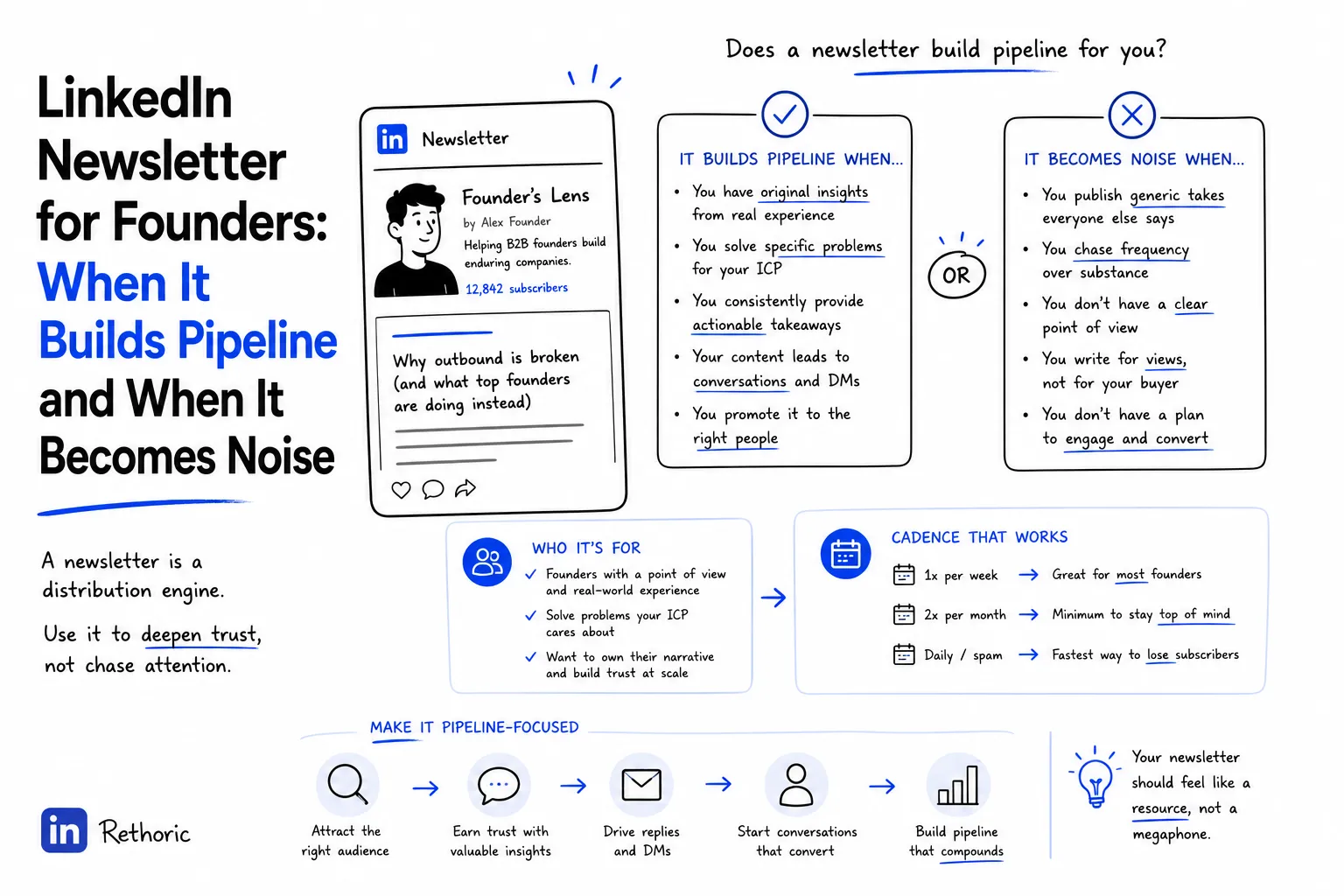
A LinkedIn newsletter sounds like an obvious move for a founder.
You already have ideas. LinkedIn already has the audience. Subscribers get notified when you publish. The content lives longer than a normal post. In theory, it should be the clean bridge between founder-led LinkedIn content and a more durable owned audience.
In practice, most founder newsletters become noise.
They launch with a broad title, publish two generic editions, then turn into a dumping ground for company updates, podcast recaps, and long posts that should have stayed short. The founder feels like they added another content channel. The audience feels like they subscribed to another obligation.
A LinkedIn newsletter only works when it has a job. For founders, that job is not to become a media company. It is to deepen trust with the exact people who need repeated exposure to the founder's judgment before they buy, invest, refer, or hire.
This guide explains when founders should start a LinkedIn newsletter, what it should be about, how it should fit with normal LinkedIn posting, and how to keep it from becoming another content treadmill.
A LinkedIn newsletter is a recurring article series published natively on LinkedIn. Members and Pages can publish newsletters around a specific topic, and people can subscribe to receive future editions.
That sounds tactical, but the strategic question is more important: why would someone want a recurring edition from this founder?
The answer cannot be, because we need another place to post content. A newsletter asks the audience for more commitment than a post. A post can earn attention once. A newsletter asks for permission to keep showing up.
That permission has to be earned with a clear promise. The newsletter should help the reader understand a market, solve a recurring problem, make better decisions, or see patterns they would not see without the founder's perspective.
If the founder cannot name that promise in one sentence, the newsletter is not ready.
A LinkedIn newsletter makes sense when the founder has three things already working.
First, the founder has a repeatable point of view. A newsletter needs a narrow enough lane that subscribers know what they are signing up for. If one edition is about hiring, the next is about fundraising, the next is about AI, and the next is a product launch, the audience cannot form a habit around it.
Second, the founder has enough raw material. The best newsletters are built from sales calls, customer conversations, product decisions, investor questions, market shifts, and internal debates. If the founder is not close to the market, the newsletter will drift into generic commentary.
Third, the company has a business reason for deeper education. A newsletter is useful when buyers need repeated context before they act. That is common in complex B2B categories, new markets, expensive products, long sales cycles, and founder-led companies where trust in the person affects trust in the company.
If those conditions are not true, keep posting first. A newsletter should be a layer on top of a working founder-led content system, not a replacement for one.
A strong founder newsletter does not try to cover everything the company cares about. It does one or two jobs extremely well.
It can create market education. This works when buyers understand the pain but not the deeper cause. The founder uses the newsletter to reframe the problem, explain patterns, and make the buyer smarter before a sales conversation.
It can build category conviction. This works when the company is selling into a market shift. The founder explains why the old way is breaking, what the new way requires, and what operators should change before the cost becomes obvious.
It can support fundraising visibility. This works when investors need to see how the founder thinks over time. The newsletter becomes a record of market understanding, execution lessons, and category judgment.
It can create sales context. This works when the sales team can send specific editions to prospects before or after conversations. A good newsletter issue can explain a problem better than a deck, because it reads like the founder thinking in public instead of the company pitching.
The best newsletters are not content for content's sake. They are a trust asset that sales, fundraising, hiring, and partnerships can all use.
Company updates are not a newsletter strategy.
Most people do not subscribe because they want quarterly announcements, feature releases, webinar reminders, and recap posts. They subscribe because they expect a useful perspective that helps them do their job, understand their market, or make a better decision.
That does not mean a founder can never mention the company. It means the company cannot be the center of every issue.
A product launch can become a strong newsletter edition if it explains the customer problem that led to the launch, the tradeoff the team made, and what the founder learned about the market. A funding announcement can become useful if it explains the category bet behind the raise and what the founder believes will change next. A customer win can work if it teaches a broader pattern other buyers can apply.
The difference is framing. The weak version says, look at us. The strong version says, here is what this reveals about the problem you care about.
Founders should not choose between posts and newsletters. They do different jobs.
Posts are discovery. They travel through the feed, test ideas quickly, create comments, drive profile views, and help the founder learn what the market reacts to. A good post can expose an idea to people who have never heard of the founder.
Newsletters are depth. They give the founder more room to explain a point of view, connect ideas, and build a habit with subscribers. A newsletter is better for people who already have enough interest to opt into a recurring relationship.
The workflow should move in that order. Test ideas as posts. Watch which topics create high-quality comments, saves, DMs, and sales-call mentions. Turn the strongest themes into newsletter editions. Then break each edition back into posts.
This keeps the newsletter from becoming a guessing exercise. The founder is not inventing long-form topics from scratch. They are expanding ideas that already showed market signal.
That is the same principle behind LinkedIn content strategy for founders: build a system that learns from the market instead of publishing into a vacuum.
The strongest newsletter topics usually sit at the intersection of buyer pain, founder expertise, and business strategy.
A founder selling to revenue leaders might publish a monthly breakdown of patterns from hundreds of sales calls. A founder building infrastructure software might explain one hard technical tradeoff operators keep underestimating. A founder selling into HR might write about the hiring risks they see across customer conversations.
The topic should be specific enough to attract the right reader and repel everyone else. A newsletter called Startup Lessons is too broad. A newsletter called Notes on Enterprise AI Procurement is clearer. A newsletter called Founder Updates is weak. A newsletter called What Series A Teams Get Wrong About Demand Creation is sharper.
Founders should avoid topics that only create applause from peers. The newsletter should serve the market the company needs to influence, not the audience most likely to compliment the founder.
If the newsletter cannot be tied to a customer pain, investor thesis, hiring narrative, or category point of view, it is probably too soft.
A founder newsletter should be simple enough to sustain.
Start with a monthly cadence. Weekly sounds disciplined, but most founders do not have the time or raw material to keep weekly quality high unless they already have a mature content operation. Monthly creates enough pressure to publish without forcing filler.
Build each edition from one source of truth. That source might be a customer pattern, a market shift, a strong LinkedIn post, a sales objection, a board conversation, or a product decision. One issue, one core idea.
Draft around the reader's decision. What should the reader understand differently after this issue? What mistake should they avoid? What conversation should they be ready to have internally?
Keep the CTA light. Most newsletter issues should not hard-sell. Point readers to a deeper article, invite replies, suggest a related post, or link to a relevant page when the connection is natural. When every issue asks for a demo, the newsletter becomes an ad.
Finally, repurpose deliberately. One newsletter can become three to five LinkedIn posts, a sales follow-up asset, a blog section, and a founder voice memo prompt for future content.
This is where founder content strategy matters. The newsletter should be part of the system, not another disconnected task on the founder's calendar.
A founder should not judge a newsletter only by subscriber count.
Subscriber growth matters, but it is a weak metric by itself. The better question is whether the right people are subscribing and whether the newsletter is creating useful business signal.
Track who subscribes when you can. Track which editions create comments, DMs, profile views, connection requests, and sales mentions. Track whether sales uses specific editions in follow-up. Track whether investors, candidates, partners, or target-account buyers reference the founder's ideas later.
Also track topic performance. Which issues create the best conversations? Which ones get ignored? Which ones help explain the company's market belief? Which ones create language the team starts reusing in sales calls?
The point is not to manufacture perfect attribution. The point is to understand whether the newsletter is deepening the right relationships.
This connects directly to LinkedIn ROI for founders. The value of founder-led content often shows up before the conversion is visible in a dashboard.
The first mistake is launching too early. If the founder has not found a clear content lane, the newsletter will make the lack of focus more obvious.
The second mistake is choosing a vague name. The newsletter title should tell the right reader exactly why it exists. Clever is less useful than clear.
The third mistake is publishing recycled posts with no expansion. If subscribers already saw the idea in the feed, the newsletter needs to add depth, examples, or a stronger framework.
The fourth mistake is using every issue as a campaign. A newsletter should create trust before it extracts attention.
The fifth mistake is ignoring distribution after publishing. A newsletter edition still needs support from short posts, comments, DMs, sales follow-up, and internal enablement. Publish and pray is not a strategy.
The sixth mistake is outsourcing the thinking. A team can help structure, edit, schedule, and repurpose the newsletter. The founder's real judgment still has to be inside it.
Rethoric's view is that a LinkedIn newsletter should never be a generic content add-on.
It should come from the same source as the founder's best LinkedIn posts: real expertise, customer patterns, market conviction, and a voice that sounds like the founder instead of a marketing department.
The platform mechanics matter, but they are not the hard part. The hard part is deciding what the founder is uniquely qualified to say, capturing that thinking consistently, turning it into sharp content, approving it without slowing the founder down, and measuring whether the right audience is moving closer.
A newsletter can be useful inside that system. It can deepen the strongest ideas, give sales a more durable asset, and give subscribers a reason to stay close to the founder's thinking.
But if the founder's normal LinkedIn content is generic, the newsletter will be generic too. Longer does not mean sharper. Recurring does not mean valuable. The system has to start with the founder's actual point of view.
A LinkedIn newsletter can be a strong founder-led growth asset when it gives the right audience a recurring reason to trust the founder's judgment.
It should not be a company update feed, a recycled post archive, or a vanity subscriber project. It should be a focused, recurring explanation of the market, the buyer problem, or the category shift the founder understands better than most people.
Start with posts. Find the themes that create real market signal. Turn the strongest ideas into newsletter editions. Use those editions across sales, fundraising, hiring, and content. Measure whether the right people move closer.
If you want a founder-led LinkedIn system with strategy, capture, approvals, scheduling, engagement, tagging, mobile review, and analytics, see how Rethoric works with founders.
