A founder-focused guide to writing a product launch LinkedIn post that turns release news into credibility, conversation, and pipeline without empty hype.
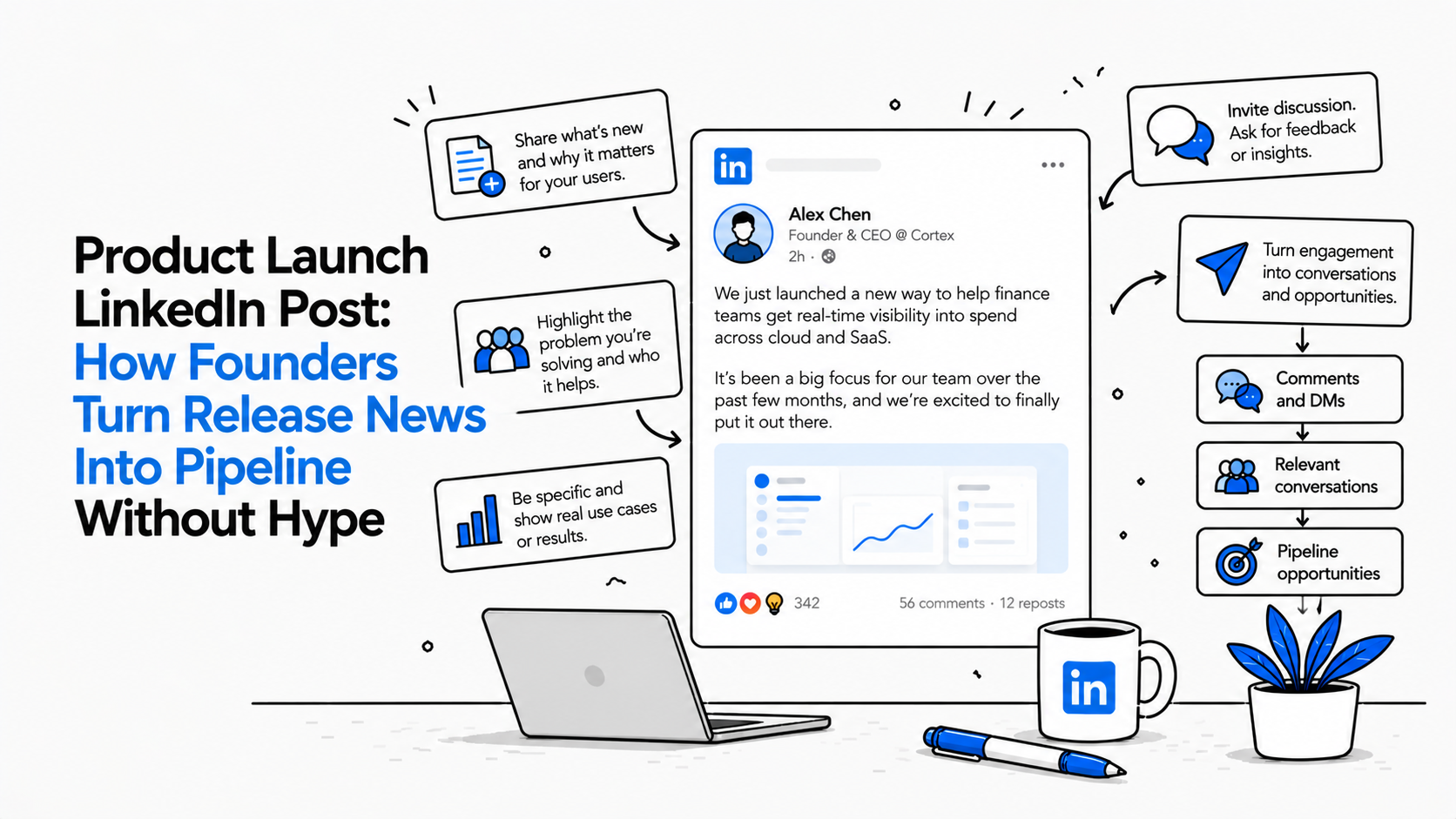
Most product launch LinkedIn posts waste the moment.
The team ships something important. The founder posts a polished announcement. The copy says the company is excited, thrilled, or proud. There is a product screenshot, a few tags, a vague promise about helping teams do more with less, and then the post asks people to book a demo.
That is not a launch narrative.
It is a status update.
A product launch is one of the few times the market is already willing to ask, "What changed?" Buyers want to know whether the product solves a painful problem. Investors want to know whether the company is learning faster than the market. Candidates want to know whether the team is building something with momentum. Customers want to know whether the product roadmap matches their reality.
The founder's LinkedIn post should not just announce that something shipped.
It should explain why the product exists, what customer pain made it inevitable, what old assumption it challenges, who should care, and what the launch says about the company's point of view.
This guide breaks down how to write a product launch LinkedIn post that turns release news into trust, conversation, and pipeline without sounding desperate, overproduced, or generic.
A product launch LinkedIn post is a founder-led announcement that explains a new product, feature, integration, or major release in a way the market can actually care about.
It is not a changelog pasted into the feed.
It is not a press release with line breaks.
It is not a demo request disguised as thought leadership.
The strongest product launch posts do three things at once:
Without that context, the post becomes another company update in a feed full of company updates.
Founders often treat launch posts as marketing distribution. Marketing writes the announcement. Sales shares it. A few teammates comment. The company page repeats it. The launch gets a bump of attention, then disappears.
Founder-led launches can do more.
A founder has permission to explain the product in a way a brand account usually cannot. They can name the customer pattern that led to the build. They can explain the tradeoff behind the roadmap. They can say what most companies misunderstand. They can connect the feature to the market shift the company is betting on.
That is why launch posts can influence pipeline even when they do not look like lead generation.
A buyer may not comment. They may not like the post. But they may forward it internally, mention it on the next sales call, visit the founder's profile, ask for the roadmap, or finally understand why the company is different.
Rethoric's guide to LinkedIn inbound marketing for founders covers how trust turns into warm pipeline. A launch post is one of the moments where that trust can become concrete because the market can see what the company is actually building.
The easiest launch post to write is also the weakest:
"We are excited to announce..."
That opening centers the company. The reader is asked to care because the team is excited.
But buyers do not care that the company shipped something. They care whether the release makes their world clearer, easier, faster, safer, more credible, or more profitable.
The launch should start with the market, not the company.
Instead of opening with the announcement, open with the tension that made the product necessary:
Once the reader understands the tension, the launch has a reason to exist.
Before writing the LinkedIn post, define the launch thesis.
The launch thesis is the one-sentence belief behind the release. It explains what the company now believes the market needs, and why this product move matters.
Examples:
The thesis keeps the post from becoming a feature list.
It also gives the founder a sharper point of view. Instead of saying, "We launched X," the founder can say, "We launched X because we think the old way of solving Y is breaking."
That is the difference between an announcement and a market argument.
A strong product launch LinkedIn post usually needs five parts.
Start with the pain, not the release. Be specific enough that the right reader recognizes themselves immediately.
Weak: "Teams need better visibility."
Stronger: "Most sales leaders do not find out a deal is slipping until the rep has already lost control of the next step."
The second version creates a scene. It tells the buyer that the founder understands the problem from the inside.
The launch should create contrast. What are teams doing today that no longer works?
This is where the founder's judgment matters. Name the workaround, the tradeoff, the blind spot, or the hidden cost.
For B2B founders, this is usually where the best content lives. The product is interesting because the founder sees a pattern the market has been tolerating for too long.
Now announce the release.
Keep the explanation plain. What shipped? Who is it for? What does it help them do?
Avoid stuffing the post with every feature. The launch post does not need to replace the product page, demo, documentation, or release notes.
It needs to make the product bet legible.
Give the market a reason to trust the claim.
Proof can include customer quotes, beta results, design constraints, use cases, product screenshots, early demand, implementation details, or a concrete example of the workflow.
If proof is not available yet, use specificity. Explain exactly what changed in the product and why that change matters.
Specificity is often more credible than inflated claims.
End with a clear next step, but do not make the whole post feel like a pitch.
The call to action might ask for feedback from teams dealing with the problem, invite buyers to see the workflow, point customers to release notes, ask candidates to look at the product problem, or invite operators to compare notes on the old way.
The best CTA matches the intent of the launch. A major category bet may deserve a conversation. A tactical feature may deserve a product walkthrough. A beta may deserve feedback.
Use this as a structure, not a script.
Hook: Name the painful market pattern.
Context: Explain why the old way is not good enough anymore.
Launch: Say what you shipped in one clear sentence.
Why it matters: Connect the product move to the customer problem and the company's point of view.
Proof: Add one specific example, customer signal, beta result, workflow detail, or product constraint.
Next step: Invite the right audience to engage, try it, book time, or give feedback.
Here is the shape:
"Most [target buyer] still handle [painful workflow] by [old workaround].
That worked when [old condition]. It breaks when [new reality].
Today we launched [product or feature] to help [specific audience] [specific outcome].
The bet behind it is simple: [founder point of view].
In beta, we saw [proof or specific example].
If your team is dealing with [problem], I would love to compare notes, show you what we built, or hear how you are handling it."
Rethoric's guide to LinkedIn post ideas for founders has more structures for turning founder expertise into content. For launch posts, the important rule is simple: the template should organize the founder's thinking, not replace it.
A useful launch post can include more than product facts.
Do not cram every ingredient into one post. Pick the ones that match the launch moment.
A small feature update might need customer pain, product clarity, and next step. A major product launch might need market shift, founder conviction, proof, team credit, and a stronger call to action.
Skip the empty launch language.
Words like thrilled, excited, game-changing, revolutionary, powerful, and innovative usually weaken the post unless the surrounding proof is extremely concrete.
Skip the feature dump. A long list of capabilities makes the post harder to understand. Choose the two or three details that best explain the product bet.
Skip the fake humility. "I am humbled to announce" often reads like a performance. Be direct instead.
Skip the desperate CTA. If the post has done its job, the reader understands why the launch matters. The next step can be clear without sounding needy.
Skip the founder disappearing act. If the post sounds like a brand account wrote it, the company is wasting the founder's distribution and trust.
Use a stronger market thesis. Explain why the product exists, what old assumption it challenges, and what customer problem it solves in a new way.
Anchor the post in one workflow improvement. Show how the feature changes a painful task, decision, or handoff.
Explain why the integration matters in the customer's actual operating system. Buyers care less that two tools connect and more that the connection removes friction from a workflow they already run.
Ask for the right kind of feedback. Be clear about who should join, what problem they should have, and what the team wants to learn.
Use customer signal. Explain what the team learned from early users and how that shaped the release.
The format changes, but the principle does not: make the launch about the market problem, not the company's internal milestone.
A strong launch post still needs distribution.
Do not assume the algorithm will deliver the announcement to the right buyers. The team should know who needs to see the post before it goes live.
Build a simple distribution plan:
Rethoric's guide to LinkedIn distribution strategy for founders explains this operating layer in more detail. The launch post is the asset. Distribution is how the right market actually encounters it.
The launch post should not be the only piece of content.
One launch can support a full sequence:
This is where a LinkedIn content flywheel matters. The launch creates market signal. That signal should feed the next posts, the sales narrative, the product page, and the founder's comments.
If the launch performs well, do not move on too quickly. The market usually needs to hear the idea more than once before it registers.
Measure more than likes.
For launch posts, useful signals include:
A launch post with modest public engagement can still be commercially strong if the right buyers take private action.
The question is not "Did the post get attention?"
The better question is "Did the right people understand what changed and why it matters?"
The first mistake is burying the reason behind the launch. If the reader has to guess why the product matters, the post will not create demand.
The second mistake is overexplaining the product. A LinkedIn post should create understanding and curiosity. It does not need to answer every product question.
The third mistake is using screenshots without narrative. A screenshot can support the post, but it cannot carry the launch alone.
The fourth mistake is making the post too polished. Buyers trust specificity more than polish. A blunt founder observation often beats a perfectly approved announcement.
The fifth mistake is treating launch day as the finish line. The real value often comes from the follow-up content, conversations, and sales context the launch creates.
Rethoric helps B2B founders turn product launches, market insight, customer proof, and founder judgment into LinkedIn content that builds authority and pipeline without generic AI slop.
That means the launch is not just one post. It becomes part of a founder-led content system: voice capture, content calendar, approval workflow, scheduling, engagement, tagging, alerts, mobile review, analytics, and agency support when the founder is busy running the company.
The founder stays close to the conviction.
The system handles the operating load.
That is the difference between announcing a release and using a release to make the market smarter about the problem you solve.
A product launch LinkedIn post should do more than say the company shipped.
Start with the market tension. Explain why the old way breaks. Introduce the product move clearly. Add proof or specificity. Give the right audience a useful next step. Then distribute the post intentionally and turn the response into follow-up content.
The goal is not hype.
The goal is clarity.
When a founder can explain why the launch matters, the product becomes more than release news. It becomes evidence that the company understands the market, hears the customer, and is building toward a sharper point of view.
If your team wants a founder-led LinkedIn system that turns launches, customer insight, and founder expertise into pipeline without turning the founder into a full-time content operator, see how Rethoric works with founders.
