Startup PR can create useful credibility spikes, but LinkedIn gives founders the repeatable surface where trust compounds before buyers, investors, and candidates are ready to act.
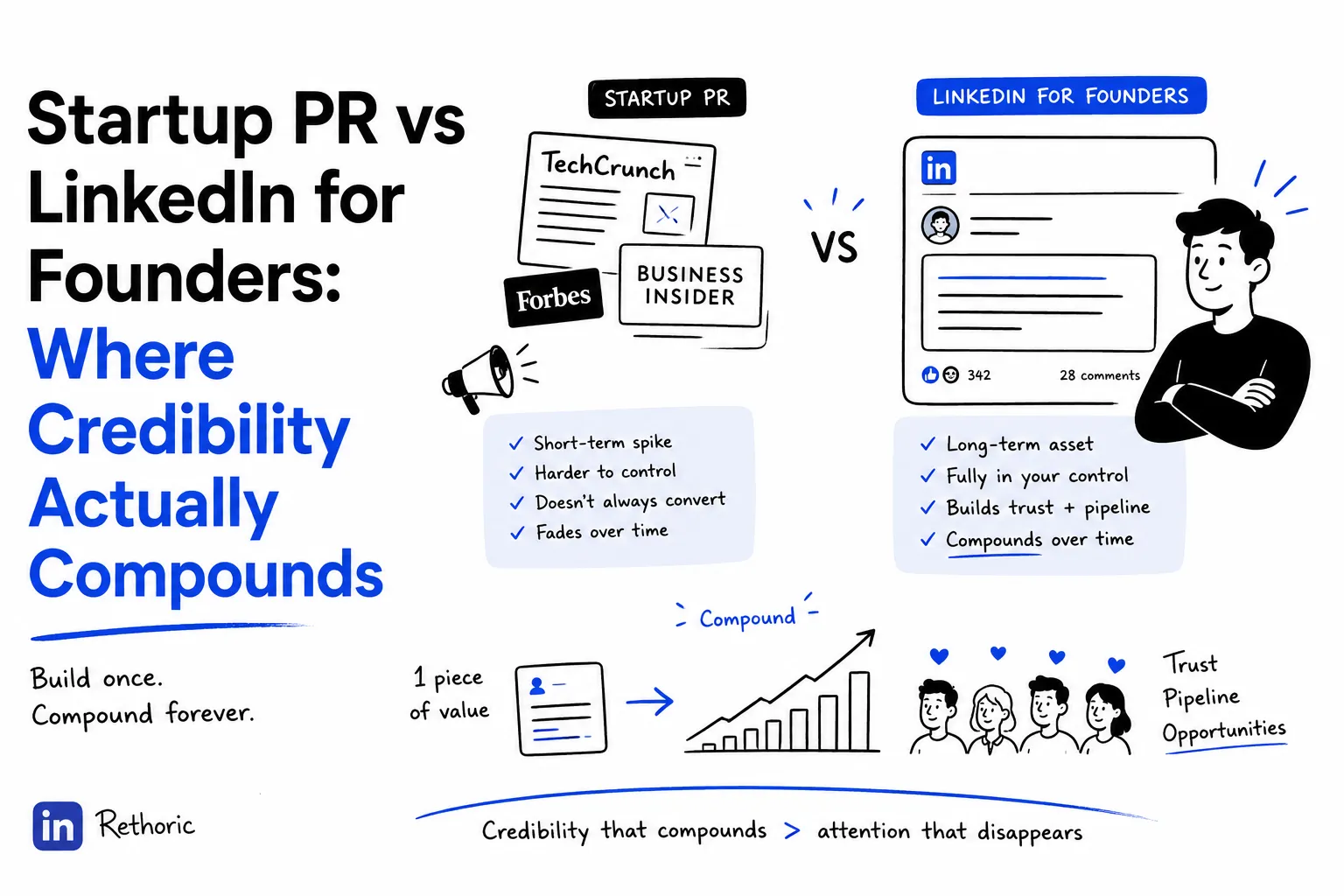
Startup PR has a clean story.
A founder gets quoted in a respected publication. The company announces a raise. A product launch gets covered. The logo goes on the website. Investors notice. Candidates see momentum. Buyers get a third-party signal that the company is real.
That signal matters.
But most founders overestimate what PR can do by itself. Press can create a spike of attention. It can validate a moment. It can make a company easier to trust when someone is already looking. What it usually cannot do is build a repeated relationship with the market every week.
That is where LinkedIn is different.
LinkedIn is not a replacement for startup PR. It is the place where the founder turns market judgment into repeated visibility. PR says someone noticed you. LinkedIn shows why the market should keep paying attention.
This guide breaks down startup PR vs LinkedIn for founders: what each channel is good at, where each one fails, when to invest in PR, when to prioritize founder-led LinkedIn, and how to make the two work together without turning the founder into a full-time content operator.
Startup PR is public relations for startups: media relationships, announcements, founder commentary, thought leadership placements, podcast appearances, analyst mentions, awards, and other third-party visibility.
The strongest PR creates borrowed credibility. A buyer may not know the company, but they know the publication. An investor may not have met the founder, but they see market validation. A candidate may not understand the category, but they see momentum from outside the company's own website.
That is useful because early and growth-stage companies have a trust deficit. The product may be strong, but the market has not had enough time to decide whether the company matters. PR can shorten that distance.
For founders, PR is especially useful around moments: funding announcements, major customer wins, category shifts, original data, executive hires, product launches, partnerships, and strong points of view on a timely market story.
The mistake is treating PR like a permanent demand engine. A press hit can create attention. It does not automatically create a content system, a sales narrative, or a founder voice the market learns to recognize.
Founders overestimate PR because press feels concrete.
There is a headline. There is a link. There is a logo. There may be a traffic spike, a few investor texts, and a burst of employee excitement. Compared with the slow compounding of founder-led content, PR feels like a win you can point to.
But the shelf life is short.
Most articles get one wave of distribution. The audience sees the story, reacts if it matters, and moves on. Unless the company has a way to keep the conversation alive, the press hit becomes a credibility artifact instead of a growth channel.
PR also depends on external timing. A founder can have a strong story and still lose the cycle to bigger news. A reporter can be interested and still never publish. A launch can be meaningful to the company but not newsworthy to the market.
That does not make PR bad. It makes PR episodic.
Founders get into trouble when they expect an episodic channel to do a compounding channel's job. PR can validate a moment. LinkedIn can turn that moment into repeated market education.
LinkedIn gives founders control over the cadence.
A founder does not need a reporter to approve a post about a customer pattern, a category belief, a hiring lesson, a sales objection, or a product decision. They can publish directly to the market and see what happens.
That speed matters because B2B trust is built through repetition. Buyers rarely change their mind because of one article. Investors rarely build conviction from one quote. Candidates rarely decide a founder is worth following from one announcement.
They need repeated exposure to how the founder thinks.
LinkedIn makes that possible. A founder can explain the problem before the buyer is ready to buy. They can make the category feel urgent before the sales team reaches out. They can show judgment before a fundraising process starts. They can answer objections in public before those objections show up on calls.
This is the same reason founder-led marketing works. The founder becomes the clearest carrier of the company's market belief, because the founder is closest to the customer, product, category, and risk.
PR can amplify credibility. LinkedIn can manufacture familiarity.
The real difference is not earned media versus social media. The real difference is borrowed trust versus repeated trust.
Startup PR borrows trust from a publication, podcast, analyst, community, or third-party voice. That borrowed trust is valuable when the audience respects the source. It can help a young company look more legitimate faster.
LinkedIn builds repeated trust through the founder's own voice. The market sees the founder make claims, explain tradeoffs, respond to comments, share customer patterns, and take a position over time. The trust is not borrowed. It is earned in public.
Both matter, but they solve different problems.
Use PR when the company has a moment the market should notice. Use LinkedIn when the founder has a point of view the market should remember.
Use PR to make a milestone more credible. Use LinkedIn to explain why the milestone matters.
Use PR when a third-party source can validate the company. Use LinkedIn when the founder needs to teach the market how to think about the problem.
The best B2B founders do not choose one forever. They know which job they are hiring each channel to do.
Startup PR wins when third-party validation matters more than direct explanation.
Funding is the obvious example. A raise is not just capital. It is a market signal. A good funding announcement can support investor relations, recruiting, customer confidence, and partner interest. LinkedIn can distribute the story, but the outside coverage gives it weight.
PR also wins when the company has original data. If a startup can show a market shift with credible numbers, a reporter or industry publication can help the insight travel beyond the founder's immediate network.
PR is useful for category moments. When regulation changes, a new platform launches, a market breaks, or a well-known company creates a debate, a founder with a sharp take can become part of the public conversation.
PR helps with legitimacy in conservative markets. Enterprise buyers, public-sector buyers, financial services buyers, and risk-sensitive categories often care about external proof. A strong press footprint can reduce the feeling that the company is too unknown.
PR can also help with executive recruiting. Senior candidates want to know whether the company has momentum. Coverage gives them something to inspect beyond the careers page.
In all of those cases, PR is doing the job it should do: creating external validation around a real moment.
LinkedIn wins when the market needs repetition, education, and founder trust.
If buyers do not fully understand the problem yet, LinkedIn is stronger than PR. The founder can explain the pain from different angles every week. They can name the pattern buyers feel but have not articulated. They can make the category more urgent through repeated examples.
If the company sells into a long B2B sales cycle, LinkedIn is stronger. Buyers may not be ready today, but they can still become familiar with the founder's thinking long before procurement starts.
If the founder's judgment is part of the sale, LinkedIn is stronger. This is common in founder-led companies, technical products, new categories, and high-trust services. Buyers want to know whether the founder actually understands the market.
If fundraising visibility matters, LinkedIn is stronger between announcements. PR can support the raise when the moment arrives. LinkedIn builds the track record investors quietly watch before the meeting. That connects directly to what investors look for in a founder's LinkedIn.
If sales needs warmer context, LinkedIn is stronger. A founder post can become an outbound opener, a follow-up asset, an objection handler, or a reason for a buyer to accept a connection. That is why founder-led sales on LinkedIn is not just posting. It is sales context created before the pitch.
LinkedIn wins when the work is not one big announcement. It wins when the market needs to hear the same founder make the same sharp point in enough ways that it finally sticks.
The strongest workflow is not PR or LinkedIn. It is PR plus founder-led distribution.
Before a PR moment, the founder should use LinkedIn to prepare the market. If a funding announcement is coming, publish the category thesis before the round is public. If a product launch is coming, explain the customer problem and the old way that is breaking. If original data is coming, test the underlying narrative in posts first.
During the PR moment, LinkedIn should translate the headline into founder thinking. Do not just repost the article with a generic caption. Explain what the milestone reveals, why the company made the bet, what customer pattern led to it, and what the market should understand next.
After the PR moment, LinkedIn should keep the story alive. Break the coverage into smaller ideas. Turn the founder quote into a post. Turn the customer problem into a series. Turn the data into sales enablement. Turn the announcement into recruiting context.
This is how PR stops being a one-day spike and becomes part of a larger content system.
A single press hit can support weeks of founder-led content if the team knows how to extract the underlying point of view.
Founders should invest first in the channel that matches the current constraint.
If the company lacks credibility around a major milestone, PR may be the right move. A strong announcement can make the market take the company more seriously.
If the company lacks a clear narrative, LinkedIn should come first. PR cannot fix a weak point of view. If the founder cannot explain what the market gets wrong, why the problem matters, and why the company is credible, press will only expose the lack of clarity.
If the company needs pipeline, LinkedIn usually comes first. PR can create awareness, but founder-led LinkedIn is better at building repeated familiarity with buyers and giving sales usable context.
If the company needs investor awareness months before a raise, LinkedIn comes first. PR is useful when there is news. LinkedIn is useful before there is news.
If the company has original data or a genuinely timely market angle, PR may come first. But the LinkedIn plan should be ready before the story goes live.
The practical rule is simple: PR works better when the founder already has a point of view. LinkedIn is how that point of view gets built, tested, and sharpened.
Do not measure PR and LinkedIn with the same scoreboard.
For PR, track the quality of the placement, relevance of the audience, referral traffic, branded search lift, investor or customer replies, candidate mentions, sales usage, and whether the story created a credibility asset the team can reuse.
For LinkedIn, track profile views, follower quality, comments from the right people, DMs, connection requests, sales-call mentions, target-account engagement, investor familiarity, and topic patterns that create pipeline signal.
The shared question is whether the channel moved the right people closer.
That is the same lens behind LinkedIn ROI for founders. The value is not always visible in a clean attribution report. Sometimes it shows up as a warmer reply, a faster investor meeting, a candidate who already understands the mission, or a buyer who says they have been following the founder for months.
PR and LinkedIn both create trust. The mistake is pretending trust always converts on the same day it is created.
The first mistake is using PR before the narrative is ready. If the story is vague, press will not make it sharper.
The second mistake is treating a press hit as the finish line. The coverage is the start of distribution, not the end.
The third mistake is reposting articles without founder commentary. A link alone does not teach the market anything. The founder has to explain why the story matters.
The fourth mistake is chasing publications the buyer does not read. A smaller industry placement can be more useful than a broad startup mention if the right operators see it.
The fifth mistake is outsourcing the founder's point of view. A PR team can pitch. A content team can edit. But the market needs the founder's real judgment, not a sanitized quote that sounds like every other startup announcement.
The sixth mistake is separating PR, sales, and LinkedIn. If sales does not know which story is live, they cannot use it. If LinkedIn does not extend the story, it fades. If PR does not understand the founder's public narrative, it pitches disconnected moments.
The channels should reinforce one another.
Rethoric's view is that PR is strongest when it has founder-led content around it.
The founder should not show up only when there is an announcement. By then, the market has no context. The best founders build the context first. They publish the category thesis, customer patterns, hard lessons, product beliefs, and market frustrations before the press cycle needs them.
Then, when PR lands, the audience already has a reason to care.
That requires a system. Founders need a way to capture raw thinking, turn it into sharp posts, approve without slowing down, schedule consistently, engage with the right people, tag content by theme, and measure which ideas create business signal.
That is what keeps founder-led LinkedIn from becoming random posting. It also makes PR more useful, because every external mention has a stronger narrative to plug into.
PR gives the market proof that something happened. LinkedIn helps the founder explain what it means.
Startup PR and LinkedIn are not enemies. They are different trust tools.
PR creates credibility spikes around moments that deserve outside validation. LinkedIn creates repeated familiarity with the founder's judgment before buyers, investors, candidates, and partners are ready to act.
If you only do PR, the market may notice you and forget why it should care. If you only do LinkedIn, you may build familiarity but miss moments where third-party validation would strengthen the story.
The strongest founders use LinkedIn to build the point of view, PR to validate important moments, and founder-led content to keep the story alive after the headline fades.
If you want founder-led LinkedIn content with strategy, capture, approvals, scheduling, engagement, tagging, mobile review, and analytics, see how Rethoric works with founders.
