Evaluate a LinkedIn ghostwriter's writing sample for voice, accuracy, buyer relevance, and revision quality, with a worked example and checklist.
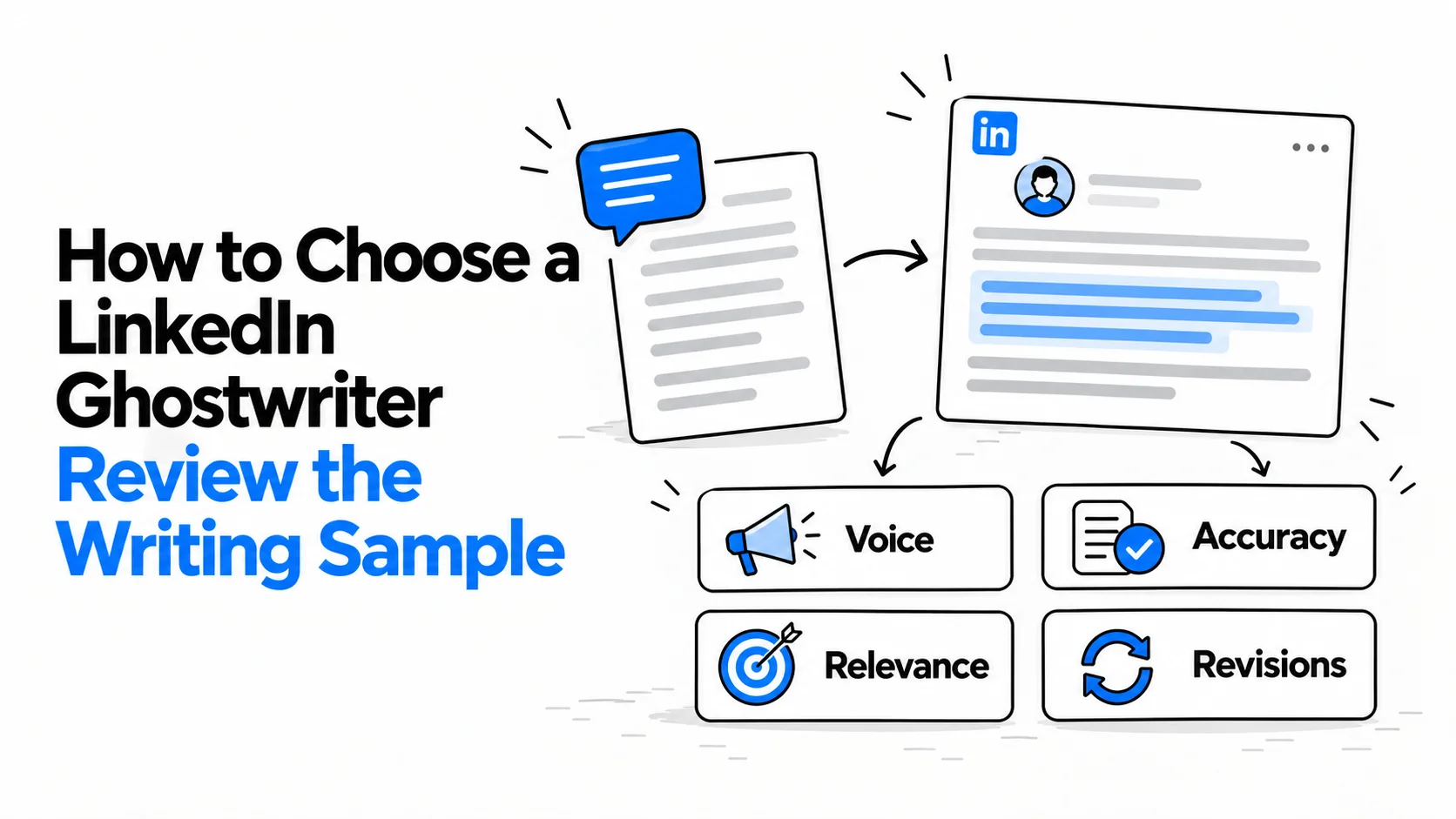
To evaluate a LinkedIn ghostwriter's writing sample, compare the draft with its source material. Check whether it preserves the founder's meaning, makes only supportable claims, and gives the intended buyer something useful to understand. Then see what happens when the writer receives specific feedback.
A polished opening is worth noticing. It does not tell you whether the writer understood the idea or quietly replaced it with a more dramatic one. You need to look past fluency and ask what changed between the original thought and the finished post.
This guide focuses on that close reading. For the wider questions about service models and onboarding, see our guide to a founder ghostwriting service.
If you are comparing writers on a small assignment, give them the same source notes, audience, boundaries, and format. Otherwise, you may reward the person who had a better brief rather than the person who handled the writing well.
Keep a source copy beside each sample. Mark the original observation, the evidence available, and anything that must remain uncertain. Add a short piece of the founder's own writing or a transcript excerpt so there is something concrete to discuss when reviewing voice.
A published portfolio sample needs a different approach. Ask what the writer contributed and what context they can share with permission. If the original source cannot be disclosed, assess what you can see, such as clarity and relevance, and record factual fidelity as unknown. Do not ask for a private client recording to satisfy your curiosity.
For a custom assignment, agree on a small paid scope where appropriate. A sample does not need to be published to be useful. Its purpose here is to reveal editorial judgment, not to predict reach or leads.
Everything in this example is synthetic. The source notes, founder voice, posts, and feedback were invented for illustration. They do not describe a Rethoric customer, a real product result, or a testimonial.
The fictional founder is building onboarding software for B2B service teams. The intended reader is an operations leader responsible for customer handoffs.
The founder's observation: teams can finish a handoff checklist while still disagreeing about who owns an exception.
In an internal walkthrough, the fictional team tested adding one explicit question: “Who owns the next decision if this falls outside the usual process?”
The change is being explored. There are no measured customer outcomes or approved customer stories behind the notes.
The founder's sample phrasing is plain and cautious: “A completed checklist doesn't tell me who will pick up the awkward case.”
The assignment is to turn that observation into a short LinkedIn post for the operations leader. It is not an announcement that a product has solved onboarding.
Onboarding delays are a thing of the past.
We found the missing piece: one simple ownership question. Now our customers can move every handoff forward without confusion.
Our platform gives every team complete clarity, so nothing falls through the cracks. This is the future of onboarding: less friction, more momentum, and a better experience for everyone.
If you're ready to transform your onboarding, it's time to rethink your process.
This intentionally flawed sample turns an internal experiment into a customer outcome. “Every handoff” and “nothing falls through the cracks” are guarantees the notes do not support. The writer also replaces the founder's specific question with broad language about transformation.
The problem is more than tone. Removing a few promotional words would still leave a false account of what happened.
A completed checklist doesn't tell me who will pick up the awkward case.
That is the question I keep coming back to in customer handoffs. The standard steps can be clear while the next decision still belongs to nobody in particular.
In an internal walkthrough, we tried adding a question: “Who owns the next decision if this falls outside the usual process?”
We're still exploring it. We don't have customer outcome data to attach to the change.
But it gives an operations leader something concrete to check: before calling a handoff complete, can the people involved name who takes the exception?
This version keeps the experiment internal, preserves the limit on evidence, and makes the observation useful to the intended reader. It is not automatically the right final voice for every founder. It is a better starting point because the writing can be traced to the brief.
Underline every factual statement in the sample. For each one, ask where it came from. A claim may be supported by the notes, supported by an approved source, clearly labeled as an opinion, or unresolved.
Pay attention to small changes that create a much larger claim. “We tested” becoming “we proved,” or “one internal workflow” becoming “our customers,” changes the substance of the post. A confident sentence is not evidence.
In Sample A, ask the writer to identify the source for the customer result. A useful response acknowledges the unsupported leap and corrects it. Defending it as stronger marketing language does not resolve the problem.
The same check applies to examples involving customers. Names, quotes, and results should come from material approved for use. Our guide to customer story posts covers how to make real evidence useful without turning it into generic praise.
“It doesn't sound like me” is a valid reaction, but it needs a concrete follow-up. Identify the phrase, level of certainty, or framing that feels wrong. Compare it with the founder's own words.
In the example, “the awkward case” comes from the source. “Transform your onboarding” does not. The first offers something specific to discuss about voice; the second could fit many unrelated businesses.
Look at what the writer preserves and what they simplify. Do they keep the founder's distinction between a completed task and an unresolved decision? Do they make a careful observation sound like an absolute rule? Do they add a level of enthusiasm the founder would never use?
Voice is not a requirement to preserve every hesitation in a recording. A writer can shorten, reorder, and clarify while keeping the speaker's meaning. Ask why a change was made and whether the founder recognizes the thought that remains.
When reviewing portfolio work, compare different examples carefully. Similar formatting alone does not prove that every founder has been given the same voice. Look for differences in judgment, language, and point of view, and ask how the writer arrived at them.
A sample should have a reader beyond the founder approving it. Name that reader and ask what the piece helps them understand, question, or decide.
Sample B gives an operations leader a question to bring to a handoff review. Sample A asks a broad audience to rethink onboarding without explaining what to inspect. That difference matters even if both openings sound smooth.
Look for a connection between the detail and the reader's work. Product jargon without an explanation can obscure the point. Removing all detail can leave a post that says little. The writer needs to make the idea understandable without erasing what makes it useful.
A strong sample can end with a practical observation rather than a booking prompt. The question is whether the ending fits the idea and the reader's situation. A sales call is not the necessary next step for every useful post.
Give feedback that tests a meaningful decision, rather than asking for a different adjective. For the synthetic example, imagine the founder says:
“I don't want this to sound like we're blaming the operations team. The gap can come from how responsibilities are set up. Keep the ownership question, but make that distinction clear.”
A useful revision could replace the middle of Sample B with:
The standard steps can be clear while responsibility for an exception is left undefined. That can be a gap in how the handoff is set up, rather than someone failing to do their job.
This edit addresses the founder's concern without inventing a new outcome or abandoning the original idea. Ask the writer to explain the change. They should be able to identify the distinction they preserved and the implication they removed.
If the response is a completely new generic post, check whether the writer understood the feedback. If the response changes only a few words, check whether the unwanted implication remains. You are assessing how accurately the writer handles a correction, not whether they can avoid feedback altogether.
One revision is a useful observation, not proof that an ongoing partnership will work. Record what you learned and what remains uncertain.
For each item, record a short observation and mark it ready, revise, or unknown. Keep those notes with the source and the draft.
Source fidelity: can you trace the central point and factual claims to the material provided?
Limits: does the sample preserve what is uncertain, unmeasured, or not approved for public use?
Voice: can you identify language and judgments that fit the founder, beyond familiar formatting?
Buyer relevance: does the intended reader get a useful explanation, distinction, or question?
Structure: does the opening lead into a point the body actually delivers?
Revision: does the writer address the meaning of the feedback without introducing a different problem?
Open questions: what could you not assess from this sample, and what evidence would help?
Do not average away a serious accuracy problem because you like the opening. A short checklist helps you explain the decision; it is not a scientific score or a prediction of LinkedIn performance.
A writing sample can show how a ghostwriter interprets material, handles claims, and responds to feedback. It cannot establish how many leads a future post will generate or replace a discussion about the ongoing workload.
If the sample gives you confidence in the writing, evaluate the wider service separately. Our guide to a LinkedIn content agency for founders covers the operating responsibilities around the work.
Choose based on the thinking you can inspect, not only the polish of the finished paragraph. To discuss how that kind of editorial work fits your LinkedIn program, explore Rethoric's founder ghostwriting service.
