How to evaluate a founder ghostwriting service: the three service models, what onboarding should look like, red flags to avoid, and questions to ask before signing.
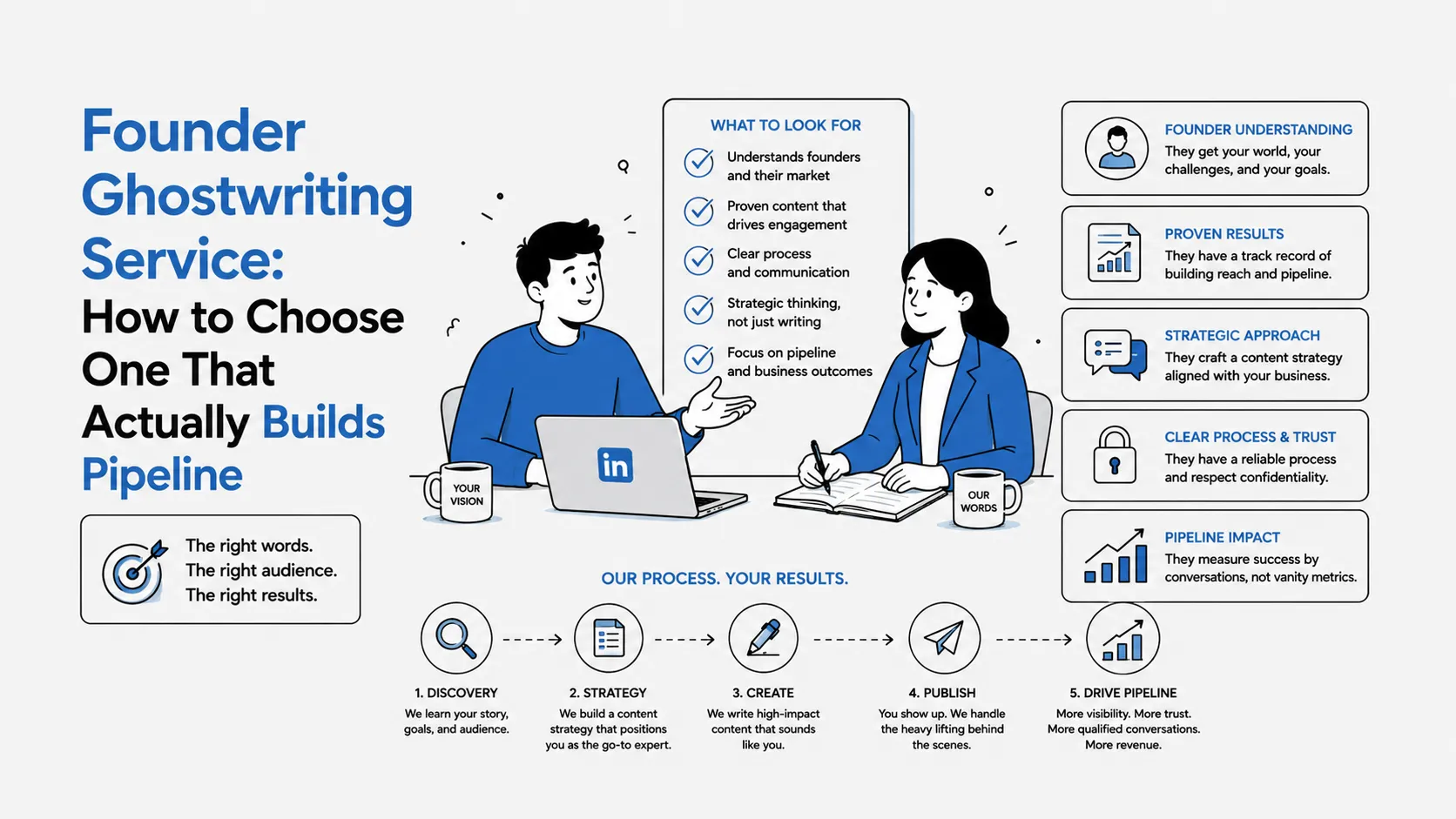
Someone searching for a founder ghostwriting service has already made the core decision. They are not asking whether to hire a ghostwriter. They are asking which service is the right fit, what separates good providers from generic ones, and what the engagement will actually look like day to day.
That is a different question from "should I ghostwrite my content?", and it deserves a different answer. The global ghostwriting market reached $4.3 billion in 2025 and is projected to hit $6.7 billion by 2030. That growth reflects real demand. It also means there are now dozens of services competing for the same clients, with widely varying quality, process, and outcomes. Knowing what to look for before signing a contract saves months of wasted investment.
This guide covers what a founder ghostwriting service actually delivers, how the three main service models differ, what the onboarding process should look like, and the questions worth asking before committing.
A founder ghostwriting service is a professional content partnership in which an experienced writer or agency creates LinkedIn posts, articles, and other thought leadership content in the founder's voice, under the founder's name, using the founder's expertise and perspective as source material. It differs from general content marketing in one critical way: the output is attributed to a specific individual, not a company, and the quality of voice matching determines whether buyers trust the content. The best founder ghostwriting services run a complete content operation: they conduct voice capture interviews to understand how the founder thinks and communicates, develop a content strategy aligned to the founder's ICP and business goals, and produce a consistent publishing cadence the founder could not sustain alone. What they do not do is invent opinions or perspectives. The founder's expertise and experience remain the source. The service provides structure, consistency, and the editorial layer that turns that expertise into content that compounds.
For a broader overview of how ghostwriting for founders works from end to end, see ghostwriting for founders: how to build a content engine without writing a word.
Most services fall into one of three models, each with a different price range, scope, and relationship structure.
Solo freelancer ($1,000 to $3,000 per month). A single experienced writer handles your content end to end: strategy, drafting, revisions, and delivery. The upside is a tight, personal working relationship and strong voice matching when you find the right person. The downside is dependency: if your writer gets sick, moves on, or takes on too many clients, your content stops. Solo freelancers work best for founders who have already identified a writer they trust or are willing to invest time in vetting carefully.
Mid-tier agency ($2,000 to $5,000 per month). A structured team handles strategy, writing, and revisions with processes and handoffs between specialists. You get more reliability than a solo freelancer and more personal attention than a large agency. Most founders at this tier receive four to five posts per week, a content strategy document, and regular performance reviews. The trade-off is a slightly less personal voice relationship, which good agencies compensate for with documented voice profiles and rigorous onboarding.
Full-service agency ($3,000 to $8,000 or more per month). In addition to writing and strategy, the service handles posting, engagement management, analytics tracking, and sometimes DM outreach systems that turn content engagement into sales conversations. This model is suited to founders who want to hand off the entire content operation, not just the writing. It requires the highest investment and the most thorough onboarding, and it delivers the highest output volume and strategic integration.
For a direct comparison of ghostwriting versus managing your own content, see LinkedIn ghostwriting vs. DIY: what actually drives pipeline.
A founder ghostwriting service should deliver four things in the first 30 days: a completed voice profile, a content strategy document, a set of three to five approved posts, and a clear editorial calendar for the next six weeks. The voice profile is the most important output of the onboarding phase. It documents how the founder thinks about their core topics, the language they use with their ICP, the arguments they return to repeatedly, and the specific experiences and data points they can speak to from direct experience. Without this document, every post the service produces will require the same calibration conversation. With it, the writer can produce on-brand content from a brief or voice note with minimal back-and-forth. Founders should expect the first 30 days to require more of their time than subsequent months: one to two hours for the intake interview, 30 minutes reviewing the voice profile, and 15 to 30 minutes per post for the first round of feedback.
Most ghostwriting relationships hit their stride by month two or three. The first month is the most expensive in both time and money: onboarding, voice capture, and strategy development are front-loaded. Founders who evaluate results at 30 days and conclude the service is not working are measuring before the calibration is complete.
Four red flags indicate a founder ghostwriting service is unlikely to deliver what it promises.
No discovery process before starting. A service that begins writing without a dedicated voice capture session, intake interview, or review of your existing content is producing template content, not founder content. The difference is visible in the output: template content sounds polished but generic, and buyers recognize it as not coming from the person whose name is on it.
All portfolio samples sound the same. Request writing samples from three different clients. If the tone, sentence structure, and perspective are nearly identical across all three, the service is applying a formula to every founder rather than capturing each one distinctly. Voice matching is the core skill of a founder ghostwriting service. If the portfolio does not demonstrate it, the service does not have it.
Pricing based on word count or post volume. Founder ghostwriting is a strategy product, not a content production service. A service that prices by the word or by post count is incentivized to produce volume, not pipeline. The right pricing model reflects the strategic value of the content: leads generated, sales cycles shortened, inbound quality improved.
No engagement strategy included. LinkedIn content that gets posted and ignored does not compound. A service that delivers posts but has no view on how the founder should engage in comments, respond to DMs, or participate in relevant professional communities is optimizing for the wrong metric. The posting is only part of the system.
The five questions worth asking any founder ghostwriting service before signing are: Can you show me three client samples that each sound clearly different from each other? How do you capture and document my voice beyond a single onboarding call? What is your process when I disagree with the tone or angle of a post? How do you connect the content strategy to my business goals rather than to engagement metrics? And: what happens to my content account and strategy if the writer assigned to me leaves? The first question is the most diagnostic. If a service cannot produce three samples that clearly sound like three different people, their process produces a template, not a voice. The last question matters more than most founders ask about: writer turnover is common in ghostwriting agencies, and the answer reveals whether the service has documented systems or just a single person doing the work.
For guidance on what to expect from a ghostwriter working with executives specifically, see ghostwriter for executives: what to look for and what to expect.
The first 30 days of working with a founder ghostwriting service are calibration. Posts go live, but the writer is still learning the nuances of your voice, your audience is encountering your content for the first time, and the LinkedIn algorithm is accumulating the topic signals it needs to distribute your content to relevant audiences.
At 60 to 90 days, the first measurable signals appear. Profile views from target buyer titles increase. Inbound message quality improves. Content begins reaching people outside your existing network. The algorithm has enough signal to start routing your posts to audiences that match your topic area.
Tangible pipeline impact, meaning inbound leads traceable to LinkedIn content, typically appears between months four and six. Inbound leads generated through consistent LinkedIn content close at 14.6%, compared to 1.7% for cold outbound, an 8.6x difference documented in Linkboost's 2026 State of LinkedIn. The founders who reach that outcome are the ones who committed to a specific service, gave the calibration process time to work, and did not change direction before the compounding started.
For a detailed breakdown of the timeline from content investment to measurable pipeline, see LinkedIn ROI for founders.
How is a founder ghostwriting service different from a general content agency? A general content agency produces company-branded content for company channels. A founder ghostwriting service produces content attributed to a specific individual, building personal credibility that company content cannot build. Personal profiles generate 8 to 10 times more engagement than company pages on LinkedIn. The two are complementary, not interchangeable, and a founder ghostwriting service is what enables the trust transfer that company content alone cannot produce.
How much time does a founder need to invest? The hybrid model most founders use requires 15 to 20 minutes per week for idea capture, 30 minutes per week for post review and approval, and 10 to 15 minutes per day for direct engagement on LinkedIn. The founder ghostwriting service handles everything else. Total founder time: under two hours per week.
Should I start with a freelancer or an agency? Start with whichever model matches your primary constraint. If voice authenticity is the top priority and you are willing to invest time in vetting, a solo freelancer with deep founder experience can produce better results than an agency at a lower cost. If reliability and a managed system are the priority, a mid-tier agency is the safer starting point. The wrong answer is choosing based on price alone: a cheaper option that produces generic content is more expensive than a premium one that generates qualified leads, because the cost of the wrong content is not just the monthly fee but the pipeline it fails to build.
Can a founder ghostwriting service help with positioning before writing? Yes, and the best ones insist on it. A ghostwriting service that begins writing before the founder has defined their ICP, their positioning, and the two or three problems their content will address will produce content that does not convert. See how founder positioning strategy works as the foundation for a content system, and how founder content strategy translates that positioning into a sustainable publishing cadence.
This kind of service is not a shortcut to thought leadership. It is a production system that makes consistent thought leadership possible without requiring the founder to write every word themselves.
The expertise, the perspective, and the experience still have to come from you. What the service provides is the structure, the consistency, and the editorial layer that turns what is in your head into content that compounds in front of the right audience.
If you want to see how Rethoric approaches founder ghostwriting, get in touch.
