Grow your LinkedIn company page with clear positioning, useful proof, and relevant followers while keeping founder and team profiles the priority.
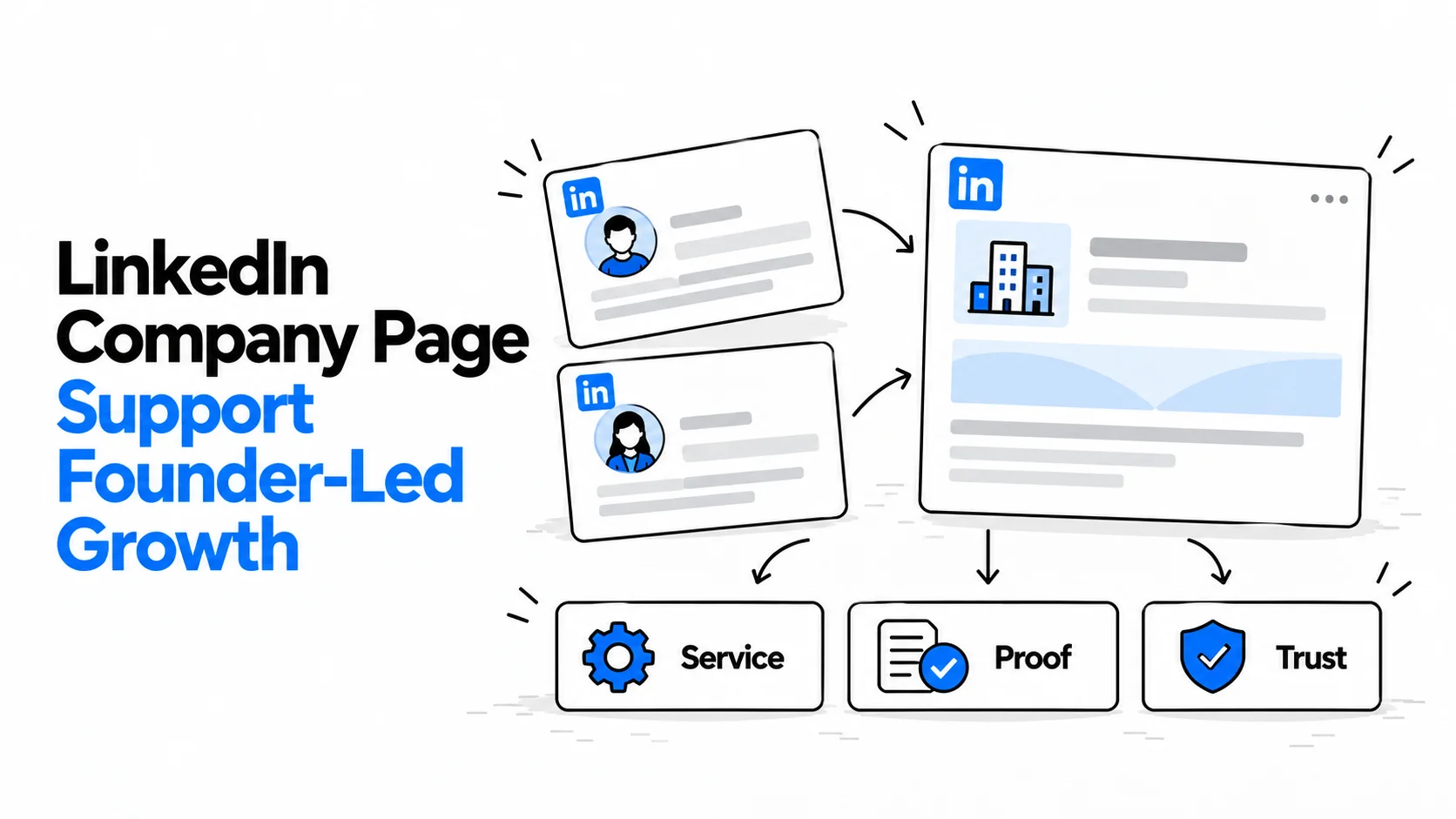
To grow a LinkedIn company page, give relevant people a reason to follow it: a clear description of what you do, useful evidence of your work, and updates that help them evaluate your company. Then make the page easy to find through your website and the people representing the business.
At Rethoric, our practical recommendation is to prioritize founder and team profiles for distribution. In the work we see, personal profiles tend to carry ideas further than company pages. That is an observation from practice, not a universal rule about LinkedIn's algorithm.
The company page still needs to do its job. Someone who discovers your founder should be able to visit it and understand the business without piecing together a month of personal posts.
Our company page versus founder profile guide covers how to divide their roles. Here, the task is practical: make the page useful, help the right people find it, and keep it current without creating another full content program.
Open your page as a prospective customer. Can you tell who the company serves, what it helps them do, and where to learn more?
Start with the tagline and About section. Replace a phrase like “Transforming the future of work” with a description a buyer could repeat to a colleague. For a hypothetical business, that might be: “Scheduling software for multi-location home-care providers.”
Check the website link, company details, logo, and cover image. Use the same business name and positioning visitors will find on your website. LinkedIn's official Pages guidance recommends completing these fields and supports inviting connections and reviewing Page analytics.
Then inspect the destination behind your website link. A visitor interested in the service should land somewhere that explains it clearly. Fix a broken link or an outdated offer before spending time attracting more followers.
A page filled with celebrations tells visitors that the company is active. It may leave them unsure what the company actually does.
Create three useful pieces of company content before expanding the calendar:
The service explained: who it is for, the problem it addresses, what the work includes, and an appropriate next step.
Evidence of the work: an approved customer example, a product demonstration, or an accurate explanation of a process you can show.
A buying question answered: what implementation involves, what the customer needs to provide, or when the product is a poor fit.
These are editorial priorities, not special LinkedIn post types. Keep them accurate and accessible as the business changes. If you have no approved customer results, explain your process or demonstrate the product. Do not fill the gap with an invented success story.
When a real customer example is available, our guide to customer story posts can help you choose the useful detail. Get permission for names, quotes, screenshots, and results before sharing them.
For each proposed example, keep a short source note beside the draft. Record where the information came from, what it demonstrates, what it does not establish, and who can approve its use. This gives the person reviewing the post something concrete to check.
Customer result: retain the original measurement, its period, and the customer's permission. Describe the conditions behind the result rather than implying every buyer will achieve it.
Customer quote: check the wording and approved attribution. A positive comment about onboarding does not support a claim about revenue.
Product demonstration: confirm that the feature shown is available to the audience you are addressing. Label sample data and remove private information.
Process explanation: have the person responsible verify the steps. State what depends on the customer's inputs or circumstances.
If the source is incomplete, narrow the claim or choose another example. You can show how a workflow operates without calling it a customer success story. That is more useful than publishing a confident result nobody can substantiate.
The company page does not need to repeat every founder post. Ask what the organization can add that the original post did not provide.
Hypothetical example: a founder writes about why scheduling breaks down when a home-care provider opens a second location. The company page could share an annotated demonstration of how a coordinator reviews conflicting assignments. The caption explains what the screen shows and what still requires human judgment.
The founder contributes a perspective on the problem. The page gives an evaluator something concrete to inspect. Neither post needs to claim that the product increased revenue or saved a particular number of hours.
Before adding a company post to the calendar, write its contribution in one sentence. If the only answer is “the founder posted this already,” look for a useful supporting detail or skip it.
Continue the hypothetical home-care software example. The source is a demonstration using fictional appointments, checked by the product owner. There is no customer result or performance measurement behind it.
Surface: Founder profile
Useful contribution: Explain the decision or misconception.
Possible opening: “Opening a second location exposes scheduling assumptions that worked when one person knew every appointment.”
Surface: Company page
Useful contribution: Show what a buyer can inspect.
Possible opening: “Here is how a coordinator reviews two conflicting assignments before confirming the schedule. This walkthrough uses fictional appointments.”
Surface: Team member's profile
Useful contribution: Add experience from that person's role, if they want to contribute.
Possible opening: “When I review a scheduling workflow, I first check what happens when two people edit it at once.”
These are hypothetical openings, not quotes from a real founder or employee. In actual production, ask the contributor to supply or approve their own point. Do not turn the team example into a statement that someone had an experience they never had.
Finish the company post with a next step that matches the material. A workflow demonstration could link to the relevant product explanation. A service-process post could invite a question about implementation. An unrelated booking pitch adds little for someone who is still trying to understand the offer.
Start with people who already have a reason to care about the business.
Check existing discovery paths. Make the page easy to find from your website and keep company references in team profiles accurate. Let people choose whether to follow.
Invite selectively. Where available, use LinkedIn's Page invitation tools for connections likely to value the updates. Check the current eligibility and allowance in your account rather than planning around a fixed invitation quota.
Share useful company material in context. A founder or employee can reference a demonstration or company update when it contributes to a conversation. Give people room to explain its relevance in their own words.
Answer questions. Assign someone to review comments and respond with a useful answer or a clear next step. A relevant question deserves more than a generic thank-you.
Avoid purchased followers and coordinated, scripted reactions. They do not establish that the people following the page are potential customers. For a broader approach to team participation, see our employee advocacy guide.
Assign one person to maintain the page. LinkedIn distinguishes content management from analytics access in its Page admin roles; give contributors access appropriate to their work.
Use this as a starting plan, not a posting formula:
Week one: correct the page description and links, record your starting metrics, and publish the service explanation.
Week two: publish one piece of verifiable evidence and invite a small, relevant group of connections where the feature is available.
Week three: answer a question buyers actually ask. Check whether recent comments reveal something the page still leaves unclear.
Week four: review the audience and responses, update anything outdated, and choose what deserves another post.
Keep founder and team publishing as the priority. If maintaining the page crowds out their best work, reduce the page calendar to updates that buyers can actually use.
Before drafting, write down the buyer question, the source material, the company page's contribution, and the intended next step. Name the person who can check the facts and the person who will publish and answer responses. One person can hold both responsibilities in a small team.
For the hypothetical demonstration, the brief might read: “Question: how are conflicting assignments reviewed? Source: product-owner-approved demo with fictional data. Contribution: show the review step. Next step: view the scheduling explanation. Check: feature availability and private information.”
Review those points before polishing the caption. Once published, save the post link with the source note so a future update does not accidentally reuse an outdated claim. This small record is enough to make the next month's planning easier.
Record follower growth, but do not make it the only success measure. Review the audience information available in Page analytics, which posts attracted relevant questions, and whether visitors can reach the right material on your website.
Use tagged website links when you need to distinguish traffic from company posts. Track those visits separately from sales outcomes. A click is evidence of a visit; it does not establish that the page caused a purchase.
At the monthly review, ask: Are we attracting people we want to serve? Are they finding useful information? What question should we answer next? If the evidence is sparse, say so and make a small change you can evaluate the following month.
Keep one row per company post: topic, format, link destination, available reach and interaction metrics, website visits from tagged links, and meaningful questions received. Summarize follower changes and available audience information separately for the month. If a field is unavailable, leave it blank rather than estimating it.
Interpret the signals in context:
New followers, unclear fit: review the audience information you can actually see and the connections being invited. A larger count alone does not show progress with buyers.
Questions about basics: make the service description or next post more specific. Repeated confusion can be an editorial input, even when the post attracted little attention.
Visits without a clear next step: inspect the destination page. The problem may be an unclear offer or a mismatch between the post and what the visitor finds.
If the hypothetical scheduling demonstration attracts a question about whether a coordinator can override a conflict, answer only what the product owner can verify. That question may justify the next explanation. It does not establish purchase intent or prove that the page generated a sales opportunity.
Choose one useful adjustment for the next review period. With a small audience, these are directional observations. Avoid declaring one format a winner from a single post.
Our default recommendation is to prioritize founder and team profiles for distribution, with the company page supporting business validation. Revisit that choice if your own audience and performance data support a different allocation.
Start with a schedule you can maintain using useful, accurate material. The first-month plan above is a starting point, not a claim that a particular frequency earns more reach.
No. Share or adapt material when it helps the page's audience. Add a company contribution, such as a demonstration, a service detail, or approved evidence, rather than duplicating the founder's feed.
Grow the page by making it worth finding and following. Keep the people behind the business visible, and make sure the company they represent is just as clear. If you need help connecting founder content with a consistent company presence, explore Rethoric's approach to founder-led content.
