Cold email gives fast outbound signal, LinkedIn builds trust that compounds. Here’s how B2B founders should split both channels to create pipeline now and authority over time.
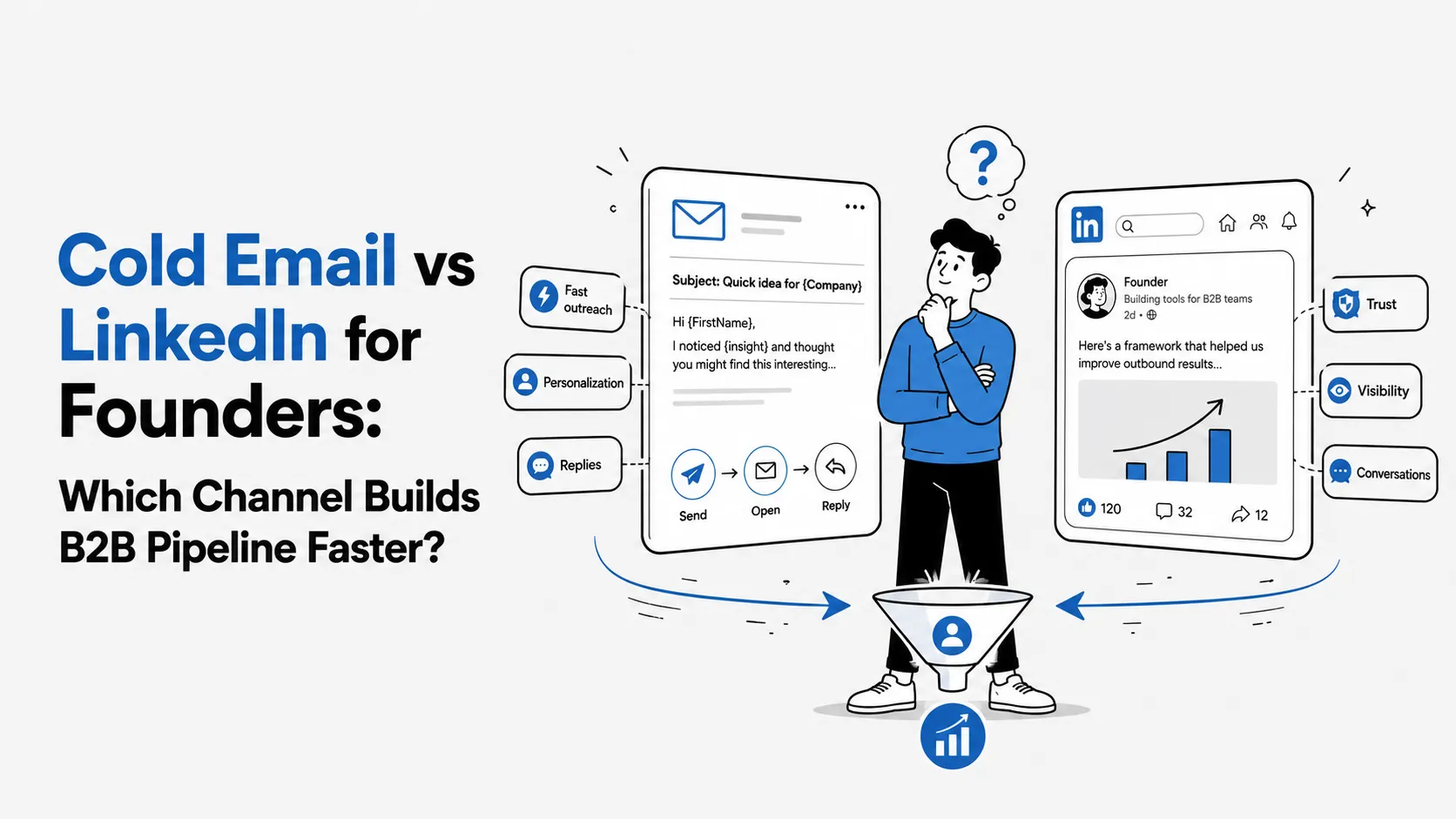
Most B2B founders don’t have a lead generation problem. They have a channel allocation problem. The team runs cold email in one lane, dabbles in LinkedIn in another, and assumes more volume will fix pipeline. It usually doesn’t.
Cold email and LinkedIn both work, but they work in different conditions. One is a direct-response channel. The other is a trust-distribution channel. If you evaluate them with the same success metric on the same timeline, you’ll make bad decisions and burn months.
This guide breaks down when founders should prioritize cold email, when LinkedIn wins, and how to run both together so outbound creates meetings today while founder-led content compounds demand tomorrow.
If you need fast signal on messaging and market segments, cold email is usually the quickest feedback loop. If you need authority, trust, and higher-quality inbound over time, LinkedIn founder-led content is the stronger long-term channel.
The highest-performing teams don’t pick one forever. They sequence both. Cold email creates immediate conversations. LinkedIn improves reply rates, conversion quality, and brand familiarity across the full sales cycle.
Cold email is still the fastest way to pressure-test ICP assumptions at scale. You control targeting, copy, cadence, and call-to-action without waiting for an algorithm or audience build.
It works best when:
Where founders get this wrong is treating cold email as a volume game. Reply quality drops, domain health degrades, and the team confuses activity with actual pipeline progression.
LinkedIn wins when credibility is the bottleneck. In mid-market and enterprise B2B, buyers rarely move from unknown sender to serious conversation without trust. Founder visibility closes that gap.
LinkedIn is stronger when:
If your team is still posting inconsistently, implement a LinkedIn content calendar for founders before expecting predictable pipeline impact.
Cold email typically gives faster first-touch data. LinkedIn usually gives better second-touch conversion because prospects have already seen your expertise in public.
That means you should measure these channels differently:
Both should map to revenue, not vanity metrics. If your KPI stack is weak, align it to this LinkedIn ROI framework for founders.
For most founder-led B2B motions, a 90-day split of 60% outbound execution and 40% LinkedIn authority building works well.
If you’re still unsure how to keep LinkedIn demand-oriented, this playbook on social selling on LinkedIn for founders is the right operating model.
The biggest mistake is running these channels in isolation. Prospects who receive your cold email often check your founder profile before replying. If the profile and recent posts are generic, reply probability drops.
Practical integration pattern:
This is how outbound and inbound reinforce each other instead of competing for internal resources.
Expecting LinkedIn to generate pipeline in two weeks
LinkedIn compounds. Judge it over 90+ days, not one posting sprint.
Treating cold email as fully automated forever
Without ongoing messaging iteration, performance decays fast.
Publishing generic thought leadership
If your content sounds like everyone else, buyers won’t remember you.
Ignoring founder profile positioning
Your profile is the conversion layer for both channels. Fix it with this guide to LinkedIn profile optimization for founders.
Is cold email dead for B2B founders?
No. Cold email still works when targeting and messaging are specific and your deliverability is disciplined.
Can LinkedIn replace outbound completely?
Not for most teams. LinkedIn can reduce outbound dependence over time, but most Series A+ motions still benefit from a coordinated outbound lane.
Which channel drives better pipeline quality?
LinkedIn-sourced conversations are often warmer; cold email can scale faster. Quality improves most when the two channels are integrated.
What should founders do first this week?
Keep cold email testing active, then publish two founder posts that directly address the objections from your last ten outbound conversations.
Cold email and LinkedIn are not substitutes. They are different leverage points in the same demand system. Cold email creates immediate market signal. LinkedIn builds credibility that improves close rates and compounds inbound over time.
Run both with clear roles, shared messaging, and pipeline-level measurement. That is how founder-led marketing becomes a growth asset instead of a random set of channel experiments. If you want this fully executed without adding operational load to the founder, talk to Rethoric.
