LinkedIn content repurposing helps founders turn calls, memos, podcasts, and hard-won opinions into a steady publishing system without flattening the founder's voice.
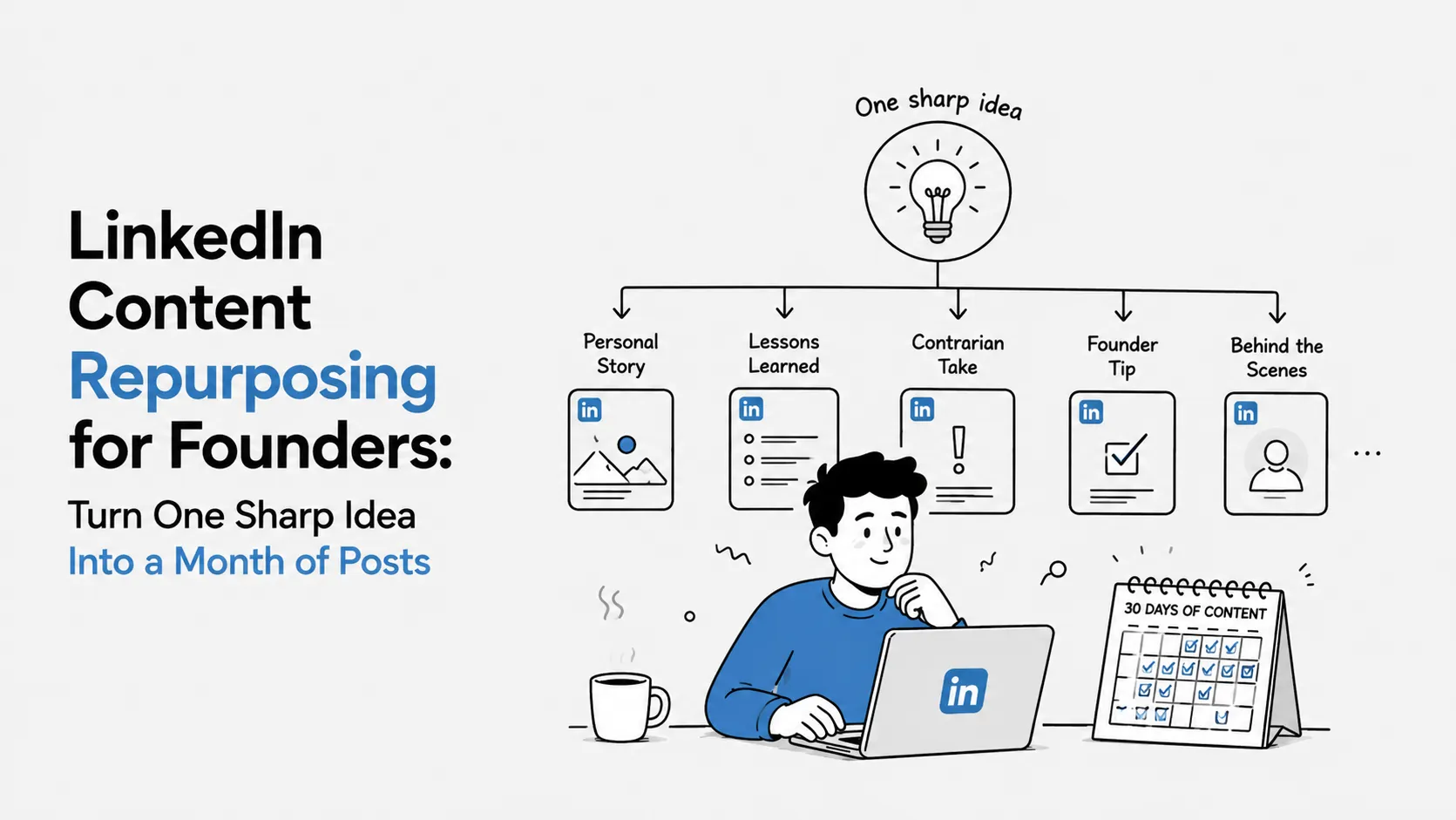
Most founders do not have a content problem.
They have a capture problem.
The best ideas are already showing up in customer calls, investor updates, sales objections, internal memos, podcast interviews, product reviews, hiring conversations, board prep, and the founder's private notes. The founder is explaining the market every week. The company is learning in public-facing conversations every day.
Then almost none of it becomes content.
So the founder sits down to write from scratch. The blank page wins. The team asks for more posts. Someone suggests using AI. The output gets faster, but it starts sounding like every other founder on LinkedIn. The voice gets cleaner and less believable at the same time.
That is where LinkedIn content repurposing matters.
For B2B founders, repurposing is not about squeezing one viral post into ten weaker formats. It is about building a system that turns real founder expertise into consistent LinkedIn content without asking the founder to become a full-time writer. Done well, it creates more posts, sharper ideas, stronger internal alignment, and a founder voice buyers can recognize.
Done badly, it creates a pile of generic fragments that look efficient and say nothing.
This guide breaks down how LinkedIn content repurposing should work for founders: what to repurpose, how to choose the right source material, how to turn one idea into multiple posts, how to protect voice, how to build a workflow around approvals, and how to measure whether repurposed content is creating business signal instead of just filling a calendar.
LinkedIn content repurposing is the process of turning existing founder thinking into new LinkedIn content formats.
The source material can be a customer call, podcast appearance, webinar, sales deck, memo, investor update, long-form article, old post, newsletter, interview transcript, product launch note, hiring lesson, or recorded voice note. The output might be a text post, carousel outline, newsletter intro, comment, founder story, objection-handling post, comparison post, or sales enablement asset.
The key word is thinking.
Repurposing should not start with content artifacts. It should start with judgment. What did the founder notice? What tradeoff did they explain? What market belief did they defend? What customer pattern keeps repeating? What point did sales need help making? What question keeps coming up from investors or buyers?
That is what makes repurposing different from recycling.
Recycling copies the same idea into more places. Repurposing adapts the founder's thinking for a different audience moment, format, or job. A strong customer-call insight can become a short contrarian post, a comment under a buyer's post, a section in a newsletter, a sales follow-up, and a longer article. Each version should feel native to the channel and useful in its own right.
The goal is not more content. The goal is more mileage from the founder's real expertise.
Founders are usually the richest source of market insight and the narrowest bottleneck in the content process.
They know the customer pain. They hear the objections. They understand the product tradeoffs. They see where the category is moving before the market has language for it. They can explain why the company exists in a way the rest of the team cannot fully fake.
But founders are busy. They are selling, hiring, fundraising, building, managing, and making the decisions nobody else can make. Asking them to create every LinkedIn post from scratch is usually unrealistic.
Without a repurposing system, teams make one of two mistakes.
The first mistake is under-publishing. The founder has strong ideas, but they stay trapped in calls and internal documents. LinkedIn becomes sporadic, and the market never gets enough repeated exposure to the founder's point of view.
The second mistake is over-automating. The team uses generic prompts to create generic posts. The calendar fills up, but the content does not sound like the founder. Buyers can feel the gap between the polished post and the real person.
A strong repurposing system solves both problems. It lowers the founder's time requirement while keeping the founder's expertise at the center.
That is the same principle behind founder-led marketing. The founder does not need to operate every part of the machine. But the founder's judgment has to power the machine.
Repurposing bad ideas produces more bad content.
This is where many teams get content operations wrong. They record a call, transcribe it, ask AI for ten posts, and treat the output as a system. The workflow looks modern. The content still fails because nobody decided what the founder should be known for, who the post is for, or what belief the content is meant to reinforce.
Before repurposing anything, the team needs a clear content strategy.
What market problem should the founder own? Which buyers should recognize themselves in the content? What are the founder's strongest points of view? Which company narratives need repetition? Which objections need to be answered before sales calls? Which topics are too far from the business to be worth publishing?
Without those answers, repurposing becomes volume.
With those answers, repurposing becomes leverage. A single founder idea can be shaped into multiple posts because the team understands what the idea is supposed to do. One version can educate buyers. Another can challenge a false belief. Another can support recruiting. Another can help sales follow up with a prospect. Another can become a deeper article.
That is why LinkedIn content strategy for founders has to come before content production. Repurposing is the operating system. Strategy is the map.
The strongest founder content rarely starts in a content brainstorm.
It starts in the places where the founder is already thinking out loud.
Customer calls are one of the best sources. They reveal what buyers misunderstand, what language they use, what they fear, what they want to believe, and where the founder's explanation actually changes the conversation.
Sales calls are useful because they show the objections that matter. If the same objection appears three times in a week, the founder probably has a post to write. Better yet, the team has a post to repurpose from how the founder answered it live.
Investor conversations reveal narrative gaps. If investors keep asking the same market-sizing, timing, category, or defensibility question, that is a signal. The founder can turn the answer into public conviction before the next fundraising process.
Internal memos are often underused. A founder memo explaining a product decision, market bet, hiring principle, pricing lesson, or customer pattern can become a strong LinkedIn post because it already contains real judgment.
Podcasts, webinars, and interviews are useful because the founder has already done the hardest part: explaining an idea in their natural voice. The content team can extract sharp sections and adapt them into posts without inventing a voice from scratch.
Old posts are also worth mining. A post that worked six months ago may deserve a new version with a sharper angle, a better example, or a more specific audience. Repurposing does not mean reposting the same thing. It means asking what the idea can do next.
The best source material has friction in it: a disagreement, tradeoff, hard lesson, repeated customer pain, unpopular belief, specific example, or business consequence. Smooth ideas usually produce smooth content. Sharp ideas create memory.
A founder does not need twenty unrelated ideas to publish for a month.
They need one strong idea with enough depth to support multiple angles.
Take a simple founder belief: enterprise buyers do not need more education before they buy; they need less internal risk. That one idea can become several posts.
One post can be a contrarian take: your buyer already understands the problem, but they do not know how to defend the purchase internally.
Another can be a customer story: the deal moved when the champion got language for the internal business case.
Another can be an objection post: when a buyer says the timing is not right, they may mean the internal risk is still too high.
Another can be a sales enablement post: three questions that reveal whether the champion can sell the idea inside the company.
Another can be a founder lesson: we stopped pitching features first because features do not reduce political risk.
Another can be a category post: the next generation of B2B content will not just explain products; it will help champions sell change internally.
Same core idea. Different audience moment. Different job.
This is the practical heart of LinkedIn content repurposing. The team is not stretching thin content. It is unpacking a real founder belief from multiple useful angles.
A good rule: if an idea cannot support five useful angles, it may not be a core content idea yet. It may be a note, a comment, or a section inside something bigger.
Founders and teams need a practical map for turning source material into posts.
Start with the source. What happened? A customer call, investor question, product debate, podcast clip, sales objection, or internal memo.
Then identify the claim. What did the founder actually say that matters? Strip away the setup and find the argument.
Then name the audience. Is this for buyers, investors, candidates, customers, operators, partners, or the founder's broader category community?
Then choose the job. Should the post educate, challenge, reassure, differentiate, explain, recruit, create urgency, support sales, or clarify positioning?
Then pick the format. A short text post may be enough for a sharp opinion. A list post may work for a workflow. A story post may work for a lesson. A carousel may work for a framework. A newsletter may work when the idea needs more room.
Finally, decide the follow-up. Should sales use the post? Should the team comment on it? Should it become part of the content calendar? Should it feed a longer article? Should it be tagged under a recurring theme?
This map keeps repurposing from becoming random extraction. The team is not just asking, what can we make from this? They are asking, what should this idea do for the business?
That distinction matters.
Repurposing fails when it sands off the founder's voice.
This happens when teams optimize for clean writing instead of believable writing. They remove the founder's rhythm. They replace specific language with professional language. They turn strong opinions into cautious advice. They make every post sound like it came from the same ghostwriting template.
Founder voice is not just tone. It is how the founder thinks.
What do they repeat? What do they hate? What do they explain better than anyone else? Where are they blunt? Where are they nuanced? What examples do they use naturally? What words would they never say? What kind of proof do they trust?
A strong ghostwriting for founders process documents those patterns. It captures the founder's actual language and decision-making style so the team can repurpose ideas without making the founder sound borrowed.
The easiest test is simple: would a customer who knows the founder believe this post came from them?
If the answer is no, the post is not ready.
That does not mean every sentence has to be written by the founder. It means the expertise, point of view, and judgment must come from the founder. The editorial layer should make the idea clearer, not more generic.
A system that captures everything needs a filter.
Not every customer call deserves a post. Not every founder opinion belongs on LinkedIn. Not every internal memo should become public. Not every podcast answer is strong enough to stand alone.
Founders should repurpose selectively.
Good repurposing candidates usually meet at least one of these tests. The idea answers a repeated buyer question. It reveals a market shift. It explains a hard-won lesson. It supports a business priority. It gives sales better language. It makes the founder's positioning clearer. It helps the right audience understand why the company exists.
Weak candidates usually fail those tests. They are too inside-baseball. They are operationally interesting but not market-relevant. They depend on confidential context. They are obvious. They do not connect to the company's strategic narrative. They create attention from the wrong audience.
The best content teams are ruthless here. They do not turn every transcript into content. They extract the ideas that sharpen the founder's authority.
More raw material should create better judgment, not more noise.
Repurposing should not live in a folder of unused transcripts.
It should connect directly to the content calendar.
A practical weekly workflow might look like this. On Monday, the team reviews calls, notes, posts, comments, and internal updates from the previous week. On Tuesday, they select three to five high-signal ideas and map each one to a business priority. On Wednesday, they draft posts and label them by theme, audience, and goal. On Thursday, the founder reviews the drafts in one focused approval pass. On Friday, the team schedules the approved content and flags any comments or DMs that should feed the next cycle.
This does not need to be heavy. It needs to be repeatable.
The calendar should show more than publish dates. It should show source material, topic theme, intended audience, business goal, post format, status, owner, and internal link or sales-use note when relevant.
That connects repurposing to the broader LinkedIn content calendar for founders. A calendar is not just a schedule. It is the operating layer that keeps ideas moving from founder expertise to market visibility.
If the team cannot see where an idea came from, what it is supposed to do, and where it goes next, the calendar is probably just a posting queue.
The mistake is thinking repurposing ends when the post goes live.
A strong idea should also move through distribution surfaces.
The founder can comment with a shorter version under relevant buyer posts. Sales can send the post to prospects who are wrestling with the same problem. Customer success can share it with customers when it clarifies a product or category decision. The team can reference it in outbound. The founder can expand the post into a newsletter or article if the topic earns strong engagement.
This is where repurposing connects to LinkedIn distribution strategy. Publishing is only one surface. The same idea can help the founder earn attention in comments, deepen a DM conversation, support a sales follow-up, or make a company narrative easier for employees to repeat.
One useful post should not disappear after twenty-four hours.
If it reflects a core founder belief, it should become part of the company's public language. That means saving it, tagging it, linking it, reworking it, and giving the team clear ways to use it.
Repurposing is how good ideas stop dying inside the feed.
AI can help with LinkedIn content repurposing. It can also ruin it.
AI is useful for organizing transcripts, pulling out recurring themes, summarizing long conversations, suggesting angle variations, converting a memo into a draft outline, and helping a team see patterns across multiple source materials.
AI is dangerous when the team lets it invent the founder's point of view.
The model can make a post sound complete before the idea is true. It can add generic advice where the founder had a specific belief. It can smooth out disagreement. It can produce content that feels plausible and empty, which is exactly the kind of LinkedIn content busy founders should avoid.
The right workflow is founder first, AI second, editor third.
Capture the founder's real thinking. Use AI to organize and accelerate the transformation. Then have a human editor restore precision, voice, context, and business relevance. The founder should review for judgment, not grammar.
If AI is doing the thinking, the content will eventually sound like everyone else's. If AI is organizing the founder's thinking, the system can move faster without losing credibility.
Repurposed content still needs founder approval.
But approval should not mean scattered comments across docs, Slack threads, texts, and last-minute rewrites. That creates friction, and friction kills cadence.
A good approval workflow gives the founder context before they review. Where did this idea come from? What audience is it for? What business goal does it support? What is the post trying to say? What should not be mentioned? Is this a new idea, a repurposed idea, or a revised version of a previous post?
The founder can then review the parts that matter: is the claim true, is the tone believable, is the example safe, is the angle sharp enough, and would I stand behind this if a buyer asked me about it?
The team should make approval easy on mobile because that is where many founders actually review content. Quick accept, quick comment, quick reject, clear status, no hunting through documents.
This is where Rethoric's platform approach matters. Content calendars, approval workflows, scheduling, alerts, engagement, tagging, mobile review, and analytics all exist to remove operational drag without removing the founder's voice.
Repurposing only works if the system can ship.
Do not measure LinkedIn content repurposing only by output volume.
Yes, repurposing should increase the team's ability to publish consistently. But volume is not the real measure. A content system can publish five posts a week and still fail if the posts do not create authority, trust, or pipeline.
Track whether repurposed ideas produce better market signal.
Are the right people commenting? Are target buyers viewing the founder's profile? Are sales calls referencing the content? Are DMs getting more specific? Are the same themes showing up in customer conversations? Are investors or candidates mentioning the founder's posts? Are old ideas earning new use in outbound, sales follow-up, or onboarding?
Also track which source materials produce the best content. Maybe customer calls are richer than podcasts. Maybe internal memos create sharper posts than brainstorming sessions. Maybe sales objections generate the highest-quality engagement. Maybe founder voice notes outperform heavily edited drafts.
This is the same logic behind LinkedIn analytics for founders. The metric should answer a business question. Is the founder's expertise getting in front of the right people in a way that changes how they think?
If the answer is yes, repurposing is working.
The first mistake is turning one good post into ten weak ones. If the idea is thin, expanding it creates noise.
The second mistake is copying formats without adapting the idea. A podcast clip, carousel, text post, and article have different jobs. The same wording rarely works across all of them.
The third mistake is removing specificity. Generic advice is easier to approve but harder to remember.
The fourth mistake is repurposing only top-performing posts. Some of the best ideas did not perform because the hook was weak, the timing was wrong, or the audience was not ready. Repurpose the belief, not just the metric.
The fifth mistake is ignoring comments. The comment section often reveals the next post. If a repurposed idea creates objections or questions, that is not a problem. That is more raw material.
The sixth mistake is letting the founder disappear. A team can support capture, drafting, editing, scheduling, and analytics. But the founder's judgment has to stay visible.
The seventh mistake is treating repurposing as a one-time content hack instead of an operating rhythm.
The fix is simple but not easy: choose better source material, preserve founder voice, connect each output to a business goal, and keep feeding the system with real market conversations.
Here is a simple workflow a founder-led team can run every week.
Capture raw material continuously. Record voice notes after customer calls. Save strong comments. Pull quotes from podcasts. Tag sales objections. Add internal memos and investor questions to the idea bank.
Review the idea bank once a week. Do not try to process everything. Pick the few ideas with the strongest business relevance.
Map each selected idea to a content pillar. For example: buyer pain, category belief, founder story, product lesson, sales objection, customer pattern, hiring principle, or fundraising visibility.
Draft multiple angles from one idea. Aim for one primary post and two or three secondary uses, not endless variations.
Edit for voice and specificity. Remove generic lines. Add the founder's real language. Keep the claim sharp.
Approve in one focused pass. The founder should review truth, tone, risk, and judgment. The team should handle formatting and scheduling.
Publish and distribute. Use the post in comments, sales follow-up, employee advocacy, newsletters, and future articles when relevant.
Measure signal and feed it back. Comments, DMs, profile views, sales mentions, and objections should become the next week's raw material.
That is the loop. Capture, choose, adapt, approve, publish, distribute, learn.
The workflow is not complicated. The discipline is the hard part.
Rethoric's view is that repurposing should make founders more visible, not more generic.
The founder should not have to write every post from scratch. But the founder's expertise has to remain the source. The best content system captures what the founder is already saying in high-leverage moments, turns it into sharp LinkedIn content, routes it through a clean approval workflow, schedules it consistently, and uses engagement and analytics to improve the next cycle.
That is the difference between an AI content machine and an in-house content team on autopilot.
One produces more words. The other turns founder judgment into a repeatable growth channel.
For Series A+ B2B founders and executive teams, that distinction matters. The market does not need more generic thought leadership. It needs repeated exposure to how the founder sees the problem, where the category is going, and why the company is credible.
Repurposing is how that thinking gets out of calls, memos, and conversations and into the market without forcing the founder to become a content operator.
LinkedIn content repurposing is not about doing more with less. It is about doing more with what is already true.
The founder's best ideas are usually already inside the business. The work is to capture them, choose the ideas that matter, adapt them into useful LinkedIn formats, protect the founder's voice, and connect the content back to business outcomes.
If repurposing only creates more posts, it is a production tactic. If it creates repeated market familiarity with the founder's judgment, it becomes a growth system.
The founders who win on LinkedIn are not the ones who manufacture the most content. They are the ones who turn real expertise into a consistent public point of view before buyers, investors, candidates, and partners are ready to act.
If you want founder-led LinkedIn content with strategy, capture, approvals, scheduling, engagement, tagging, mobile review, and analytics, see how Rethoric works with founders.
