A founder's LinkedIn headline should signal category, buyer relevance, and credibility fast. Here is a practical framework with examples and rewrite patterns.
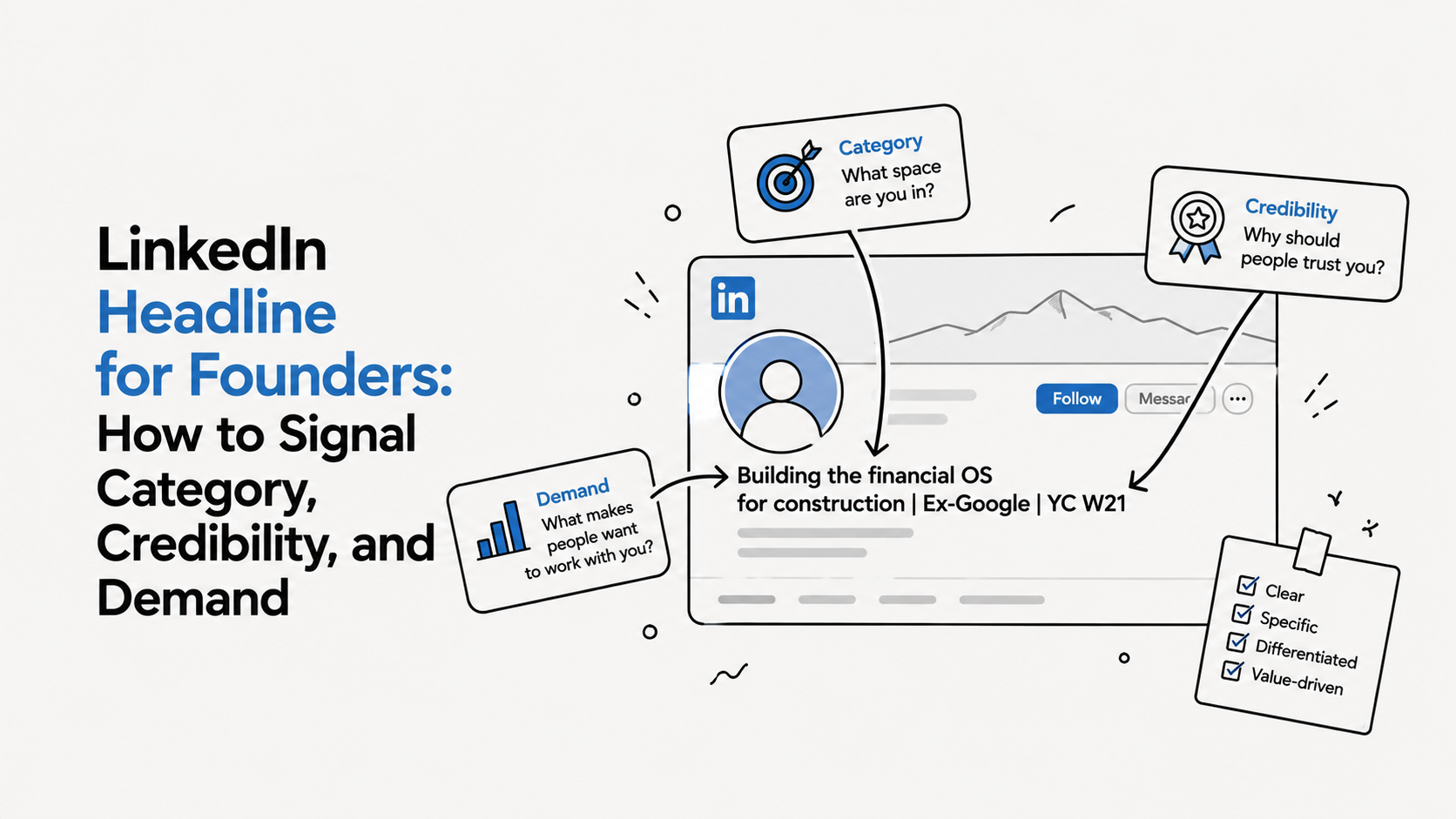
Most founder LinkedIn headlines fail because they try to summarize a career.
That is the wrong job.
A founder's headline is not a resume line. It is a positioning surface. It shows up in search, comments, connection requests, DMs, profile previews, investor checks, podcast pages, event speaker lists, and every post the founder publishes.
When the headline is vague, the market has to do the work. Founder. CEO. Building the future. Helping companies grow. These lines say almost nothing about who the founder helps, what category they are shaping, why they are credible, or why a buyer should keep reading.
A strong LinkedIn headline for founders does the opposite. It gives the right person enough context to understand the founder's lane in a few seconds.
This guide breaks down how to write a founder LinkedIn headline that signals category, credibility, and demand without sounding like a generic personal brand template.
A LinkedIn headline is the short line under your name. For founders, it usually has to serve more than one audience.
Buyers use it to decide whether you understand their world. Investors use it to place you in a category. Candidates use it to judge whether the company has a clear mission. Partners use it to understand where you fit. Reporters, podcast hosts, and event organizers use it to frame your expertise.
That is why "Founder at Company" is usually too thin.
It may be accurate, but it does not create context. It does not tell a VP Sales, CFO, Head of People, CIO, or investor why this founder is relevant to them. It makes the company name carry all the weight, which only works if the company is already widely known.
For most Series A and later B2B founders, the headline should answer four questions fast:
You do not need to answer all four with equal weight. But if the headline answers none of them, it is probably just a title.
The simplest founder headline formula is:
Role + company + category point of view + buyer outcome.
That can look like:
Founder at [Company] | Helping [buyer] solve [specific problem] without [common tradeoff]
This works because it does not force the founder into a fake motivational tagline. It keeps the role clear, anchors the company, names the buyer, and adds a useful point of view.
For example, a weak headline might say:
Founder and CEO at Acme AI
A stronger version would say:
Founder at Acme AI | Helping finance teams automate revenue close without losing audit control
The second version gives the reader a category, a buyer, a problem, and a tradeoff. It also creates better raw material for content. The founder can now publish about revenue close, finance automation, audit control, implementation risk, CFO objections, and the hidden cost of generic AI workflows.
That is the real test. A good headline should make the founder's future content easier to understand.
A resume headline is built around credentials. A founder headline is built around market relevance.
Credentials still matter. A founder may have a strong exit, a YC batch, a category background, a technical specialty, a former operator role, or a customer base that creates trust. But credentials should support the positioning, not replace it.
Weak founder headlines often look like this:
The problem is not that these are always false. The problem is that they are interchangeable.
If the headline could belong to thousands of founders, it is not doing enough positioning work. The right reader should feel some specificity. They should know whether you are relevant to their problem, their industry, their function, or the category they are trying to understand.
That same principle applies across the full profile. Rethoric's guide to LinkedIn profile optimization for founders covers the rest of the profile, but the headline is the line most people see before they ever land on the profile page.
Founders do not need clever copy. They need the right ingredients in the right order.
Start with the role if the founder identity matters to the strategy.
"Founder," "Co-founder," "CEO," or "Founder and CEO" gives the reader immediate context. It also makes founder-led content feel natural because the posts are coming from the person making the decisions.
Do not overcomplicate this part. A long stack of titles makes the headline harder to scan. If you are the founder, lead with that.
The company name still matters, especially if the founder is building company demand.
A headline can include "Founder at Rethoric," "Co-founder of [Company]," or "[Company] CEO." This connects the founder's authority back to the business, which is important for pipeline, hiring, partnerships, and fundraising.
If the company name is not yet known, do not expect it to explain the category by itself. Pair it with a short category or buyer outcome.
The fastest way to make a headline sharper is to name the audience.
"Helping B2B founders," "for revenue teams," "for enterprise finance leaders," "for security teams," or "for Series A operators" gives the right reader a reason to pay attention.
Specificity helps. "Businesses" is too broad. "B2B SaaS founders" is clearer. "Enterprise IT leaders" is clearer. "Seed-stage technical founders selling into banks" is narrow, but if that is the market, it may be exactly right.
A founder headline should connect to a business result, not just a tool or category.
That outcome might be pipeline, faster close, lower churn, better compliance, cleaner customer onboarding, fewer manual workflows, stronger fundraising visibility, or better hiring signal.
The outcome does not have to be grand. It has to be concrete enough for the reader to understand why the founder's work matters.
The best headlines include a small point of view.
That might be a contrast, a constraint, or a tradeoff:
This is where the headline starts to feel like the founder has judgment, not just a job title.
These examples are not meant to be copied exactly. They show the difference between vague positioning and useful specificity.
Weak: Founder and CEO at GrowthPilot
Stronger: Founder at GrowthPilot | Helping B2B revenue teams turn customer signals into pipeline
The stronger version names the buyer and the business outcome. It also opens a content lane around customer signal, revenue operations, sales conversations, and pipeline quality.
Weak: Building the future of AI infrastructure
Stronger: Co-founder at StackLayer | AI infrastructure for teams that need speed without losing reliability
The stronger version keeps the category but adds a tradeoff. That gives the founder room to publish about reliability, implementation risk, infrastructure decisions, and what fast-growing teams misunderstand about AI adoption.
Weak: Cybersecurity Founder | Speaker | Advisor
Stronger: Founder at TrustGrid | Helping security teams prove vendor risk before procurement slows the deal
This version is specific enough for a buyer to recognize the pain. It also connects security to a business process instead of staying at the category level.
Weak: Serial Entrepreneur | Raising Our Series A
Stronger: Founder at ClearDesk | Building the operating layer for distributed finance teams
The stronger version does not ask the market for attention. It gives investors, candidates, and buyers a clean category frame. For more on this surface area, see Rethoric's guide to LinkedIn for founders raising capital.
Weak: Helping founders grow on LinkedIn
Stronger: Founder at Rethoric | LinkedIn content systems for B2B founders who need authority without generic AI slop
The stronger version names the buyer, the category, and the standard the company refuses to compromise. It is clear enough to attract the right founder and repel the wrong one.
LinkedIn is also a search surface, so keywords matter. But founder headlines get weaker when they are stuffed with every possible phrase.
The goal is not to cram in "AI, SaaS, B2B, founder, growth, GTM, revenue, pipeline, automation" and hope the algorithm rewards it. The goal is to use the words your market already uses to describe the category, buyer, and problem.
Use keywords in three places:
If a keyword makes the headline clearer, keep it. If it makes the headline sound like a search query pretending to be a sentence, cut it.
Founders should also match the headline to the language they use in content. If the headline says "category design for enterprise AI," but every post is about general leadership lessons, the profile feels disconnected. The headline sets an expectation that the content has to support.
There is no single perfect structure. The right pattern depends on the founder's company stage, category awareness, and go-to-market motion.
Founder at [Company] | Helping [buyer] achieve [outcome] without [tradeoff]
This is the most useful default for B2B founders. It is direct, commercially clear, and easy to connect to content.
Founder at [Company] | Building [category] for [audience]
Use this when the company is shaping a category and the market needs a clean frame. It works best when the category phrase is specific enough to mean something.
Founder at [Company] | [Credibility marker] for [buyer/problem]
This can work when the founder has a credible achievement, customer base, prior role, or technical background that buyers will recognize. Use proof as support, not as a vanity line.
Founder at [Company] | [Belief about market] for [buyer]
This works when the founder is known for a strong opinion or is trying to become known for one. It needs to be clear, not cryptic.
[Executive role] at [Company] | Helping [market] understand [specific shift]
This is useful for executives who are not the founder but still need a public authority surface. Rethoric's guide to executive LinkedIn strategy goes deeper on that workflow.
A headline is not separate from content strategy. It is the front door.
If the founder's posts are creating attention, people will click into the profile. If the founder is leaving thoughtful comments, people will hover over the profile card. If the founder is connecting with buyers, investors, or candidates, the headline will shape the first impression before the message is read.
That means the headline has to reinforce the content lane.
If the founder publishes about category change, the headline should make the category clear. If the founder publishes tactical advice for CFOs, the headline should name finance leaders. If the founder publishes about implementation risk, the headline should not only say "AI founder." If the founder wants to build authority with Series A B2B founders, the headline should not speak to every business owner on the internet.
This is why Rethoric treats profile positioning and content strategy as one system. A sharp LinkedIn content strategy for founders gives the headline substance, and a sharp headline helps the right people understand the content faster.
The first mistake is being too broad. A broad headline feels safer, but it makes the founder easier to ignore.
The second mistake is overloading the line with credentials. If the headline reads like a conference bio, the reader has to work too hard to understand relevance.
The third mistake is using clever language before clear language. "Reimagining the future of work" may sound polished, but it says less than "helping distributed engineering teams onboard faster."
The fourth mistake is hiding the company. Founder-led content should usually help the company, not build an unrelated personal brand.
The fifth mistake is promising too much. A headline that claims to transform, revolutionize, dominate, or unlock everything creates skepticism. Strong founders can be direct without sounding inflated.
The sixth mistake is never revisiting the headline. Positioning changes. The ICP changes. The company moves upmarket. The founder shifts from fundraising to enterprise sales. The headline should evolve with the business.
Before updating the headline, run it through a simple checklist.
If the headline passes those questions, it is probably strong enough to test. If not, the issue is usually not copywriting. It is unclear positioning.
That is where founder positioning matters. Rethoric's guide to founder positioning strategy explains how to choose the category, buyer, and belief system the founder should become known for.
Founders should review the headline every time the business context changes.
That might mean a new ICP, a new product category, a fundraise, a move upmarket, a hiring push, a new content strategy, or a shift from founder-led sales to a broader revenue team motion.
Do not rewrite it every week. That creates inconsistency. But do not leave a seed-stage headline in place when the company is now selling enterprise deals, recruiting senior operators, and trying to own a more mature category.
A practical cadence is quarterly review, plus event-based updates when the company's positioning changes. The founder's public surface should not lag the business by six months.
Rethoric's view is simple: the headline is small, but it carries more weight than most founders think.
It is one of the few parts of the profile that follows the founder across LinkedIn. It shapes how posts are interpreted. It changes how comments land. It affects whether buyers understand the founder's category before they click. It gives investors and candidates a fast signal about the company's clarity.
But the headline cannot do the whole job alone.
The founder still needs a real point of view, a profile that supports the claim, content that proves the expertise, comments that create distribution, and a workflow that turns raw founder judgment into consistent public signal.
That is the system Rethoric builds for founders: positioning, voice capture, content calendars, approvals, scheduling, engagement, tagging, mobile review, and analytics around the founder's actual expertise.
If your LinkedIn headline says something sharper than your content proves, the market will notice. If your content is sharp but your headline is vague, the right people may never understand why they should care.
A LinkedIn headline for founders should not be a polished job title. It should be a compact positioning statement.
Lead with the founder role, anchor the company, name the buyer or category, connect to a business outcome, and include a point of view when it makes the line stronger. Keep it specific enough to attract the right market and plain enough that the founder would actually say it.
The best headline will not make weak content work. But it will make strong founder-led content easier to recognize, easier to trust, and easier to connect back to the business.
If you want a founder-led LinkedIn system where the profile, content, approvals, distribution, and analytics all reinforce the same point of view, see how Rethoric works with founders.
