78% of investors check a founder's LinkedIn before a first meeting. Here is how founders use LinkedIn for fundraising: the profile, the content, and the six-month pre-raise timeline.
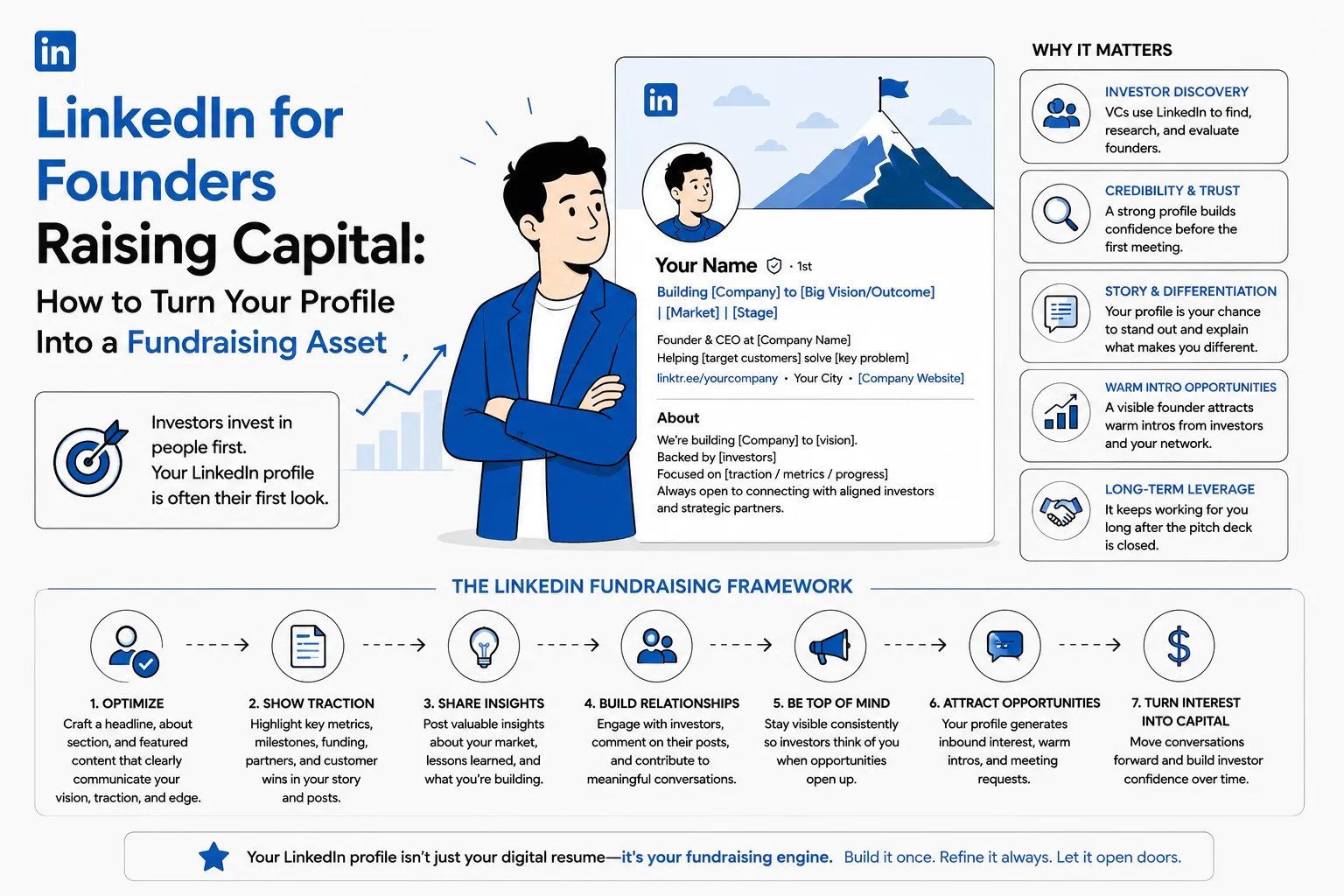
78% of investors research a founder's LinkedIn before agreeing to a first meeting, according to research compiled by West Owls on founder fundraising. The pitch deck is not the first thing most investors evaluate. The founder's online presence is. And for the majority of founders, that presence is doing nothing to support the raise.
Using LinkedIn for fundraising is not about posting that you are raising. It is about building a credible, visible track record over the months before a raise so that when an investor encounters your name, through a referral, a conference, or a portfolio company connection, what they find makes them want to take the meeting. The founders who raise fastest are rarely the ones with the best cold outreach. They are the ones investors have been quietly watching.
This guide covers why LinkedIn matters for raising capital, how investors actually use it, and the specific system for turning your profile and content into a fundraising asset.
LinkedIn helps founders raise capital by functioning as a continuous due diligence asset that builds investor familiarity and trust before any formal fundraising conversation begins. The mechanism is not discovery, though investors do source founders on the platform. It is verification: when an investor encounters a founder through a referral or conference, their next move is almost always to look up that founder's LinkedIn and form an opinion in about 60 seconds. A founder who has published consistently for six months arrives with a track record investors can evaluate, while one who started posting the week they began raising looks reactive. Research shows that 70% of venture capitalists use LinkedIn to source founders, and the median investor follows a founder for several months before reaching out proactively. For founders raising capital, this means the work that determines fundraising velocity happens long before the first pitch: it happens in the consistent, public demonstration of market understanding, execution, and clear thinking that LinkedIn makes visible.
The timeline data makes the case urgent. Carta data shows the median seed round now takes 142 days to close, up from 69 days in 2021. A founder who builds investor familiarity before the raise compresses that timeline, because warm inbound converts at roughly four times the rate of cold outreach to investors. The profile is not a vanity asset during a raise. It is infrastructure that shortens the most expensive part of company building.
For a broader look at how LinkedIn content builds trust before any business conversation, see founder thought leadership: the pipeline asset most founders build too late.
Understanding the investor's evaluation sequence is the foundation of using LinkedIn for fundraising effectively. When an investor looks up a founder, they move through a predictable pattern that takes about four minutes total.
First, a 30-second profile scan: photo, headline, company name, approximate stage. The investor is asking whether this looks like a serious, credible operator or an afterthought. Second, a 60-second read of the About section: what the company does, the founder's background, whether there is a clear and specific value proposition. Third, a two-minute scroll through recent content: what the founder posts, how they think, whether they have a genuine point of view, and whether the people engaging are relevant to the industry. Fourth, a 30-second network check: shared connections and which prominent people engage with the founder's content. Then the decision, which is usually immediate: worth engaging further, or not.
This sequence means that for founders raising capital, every layer of the LinkedIn presence has to hold up under a specific kind of scrutiny. The profile has to signal credibility in 30 seconds. The content has to demonstrate thinking over two minutes. The network has to show that relevant people take the founder seriously. A weak link at any stage ends the evaluation.
For the mechanics of optimizing each profile section for this kind of scrutiny, see LinkedIn profile optimization for founders.
A founder's profile, when raising capital, should be structured around the signals investors evaluate. Each section does specific work.
The headline should communicate three things in one line: what you are building, who it is for, and proof that it is working. A structure that works is "Founder of [X] | Solving [Y] for [Z market] | [traction signal]." This replaces the default "CEO at [Company]" with a line that signals momentum to an investor scanning quickly.
The About section should read as a skimmable micro-pitch, not an origin story or a full career history. Busy investors ignore long text blocks. The most effective structure is a hook that names what you are building and for whom, two sentences of quantified traction, one or two sentences on why you and your team will win, and a clear way to reach you. The goal is to make the investment case feel coherent in 60 seconds.
The featured section is where you place proof: a pitch deck or one-pager, recent press, a product demo, or a post that landed well. This is the section investors click to verify the claims in your headline and About. Treat it as the evidence locker for your raise.
Contact info should make you easy to reach: email, company website, and a calendar link. When an investor decides you are worth a conversation, the path to that conversation should be frictionless.
Founders raising capital should post content that demonstrates the qualities investors evaluate but cannot assess from a deck: market understanding, execution evidence, intellectual honesty, and communication ability. Four content categories build investor perception over time. Building-in-public posts share specific milestones, learnings, and honest updates on what is working and what is not, signaling execution rather than theory. Market-insight posts drawn from the founder's own data demonstrate domain expertise that most people in the space do not have. Founder-journey posts covering challenges overcome and views revised signal intellectual honesty and coachability, two traits investors specifically watch for after being burned by overconfident founders. Industry-analysis posts demonstrate a defensible point of view on where the market is heading. What does not work is company news alone or vague motivational content. Founders who demonstrate genuine expertise through their content are measurably more fundable than those who only announce updates, because the content reveals how the founder thinks, and investors back the quality of thinking as much as the idea.
The consistency of this content matters as much as the quality. Six to twelve months of consistent posting proves discipline and long-term commitment, one of the hardest traits to evaluate in a two-hour pitch meeting. An investor who can scroll a timeline and see a founder thoughtfully engaged with their market for months is evaluating something a deck cannot show.
For a framework on building a sustainable publishing system around these content types, see founder content strategy: how to build a pipeline that compounds.
Using LinkedIn for fundraising works on a timeline, and the founders who treat it as a six-month effort rather than a launch-week tactic see fundamentally different results.
Months one through three are foundation. Optimize the profile, define the two or three topics you will own, and begin publishing consistently. Engage substantively with content from investors and peers in your space. The goal at this stage is not to attract investors directly but to build the track record that will hold up under scrutiny later.
Months four and five are warming. By now, some investors may be engaging with your content. Send personalized connection requests that reference their specific engagement rather than generic outreach. Engage genuinely with the public positions of investors whose thesis aligns with your company. The objective is to move from anonymous to familiar before you ever mention raising.
Month six is activation. Publish an honest post about your fundraising intent, framed not as a pitch but as a statement of where you are and what kind of investor partnership you are looking for. For investors who have engaged most actively, send direct messages that reference the specific content they engaged with. By this point, your outreach is no longer cold: you have a content record investors can evaluate, warm connections, and months of genuine interaction to reference.
For the underlying growth system that makes six months of consistent presence sustainable, see LinkedIn growth strategy for founders.
Founders should start building their LinkedIn presence at minimum six months before they plan to begin formal fundraising conversations. The reason is the mechanics of how investors build conviction: serious investors typically want to have followed a founder for at least two to four months before committing to a first meeting, and several more months before committing capital. A founder who starts posting the week they begin raising has no track record for an investor to evaluate, which signals that the presence is reactive rather than genuine. Starting six months early means that by the time fundraising conversations begin, the founder has a body of content demonstrating market understanding and execution, warm relationships with investors, and months of genuine interaction to reference rather than a cold introduction. The compounding nature of LinkedIn content means the earlier a founder starts, the stronger the asset is when the raise begins. The worst time to start building your fundraising presence is when you need it.
Should founders post that they are actively fundraising? Yes, but with framing. A post about fundraising intent should be an honest statement of where you are and what kind of partnership you are looking for, framed around a competitive process with a clear timeline rather than an open invitation. Social proof and a sense of momentum signal that the round is real and moving. A desperate, open-ended ask signals the opposite. The fundraising post works best at the end of months of consistent content, not as the first thing an investor sees.
How is using LinkedIn for fundraising different from using it for sales pipeline? The audiences and signals differ, but the mechanism is the same: trust built before the conversation. For sales, the content demonstrates that you understand the buyer's problem. For fundraising, it demonstrates that you understand your market, execute reliably, and think clearly. Many founders run both at once, since the same consistent presence that attracts buyers also attracts investors. The difference is emphasis: a fundraising-oriented presence leans more heavily on market insight, traction signals, and evidence of execution. For the broader pipeline application, see LinkedIn ROI for founders.
What do investors specifically look for in a founder's profile and content? Investors evaluate six signals: market conviction, intellectual honesty, execution evidence, coachability, communication quality, and consistency over time. Each is something a pitch deck cannot prove but a LinkedIn presence can demonstrate over months. For a complete breakdown of these signals and how investors read them, see what investors actually look for in a founder's LinkedIn.
Using LinkedIn for founders raising capital is not a fundraising hack. It is the slow, compounding work of becoming visible and credible to the people who will eventually write checks, done in the months before you need them to.
The founders who raise fastest are not the ones with the best cold email. They are the ones whose names investors already recognize, whose thinking investors have already read, and whose track record investors have already evaluated before the first meeting is ever booked.
If you want help building a LinkedIn presence that supports your raise, see how Rethoric works with founders.
