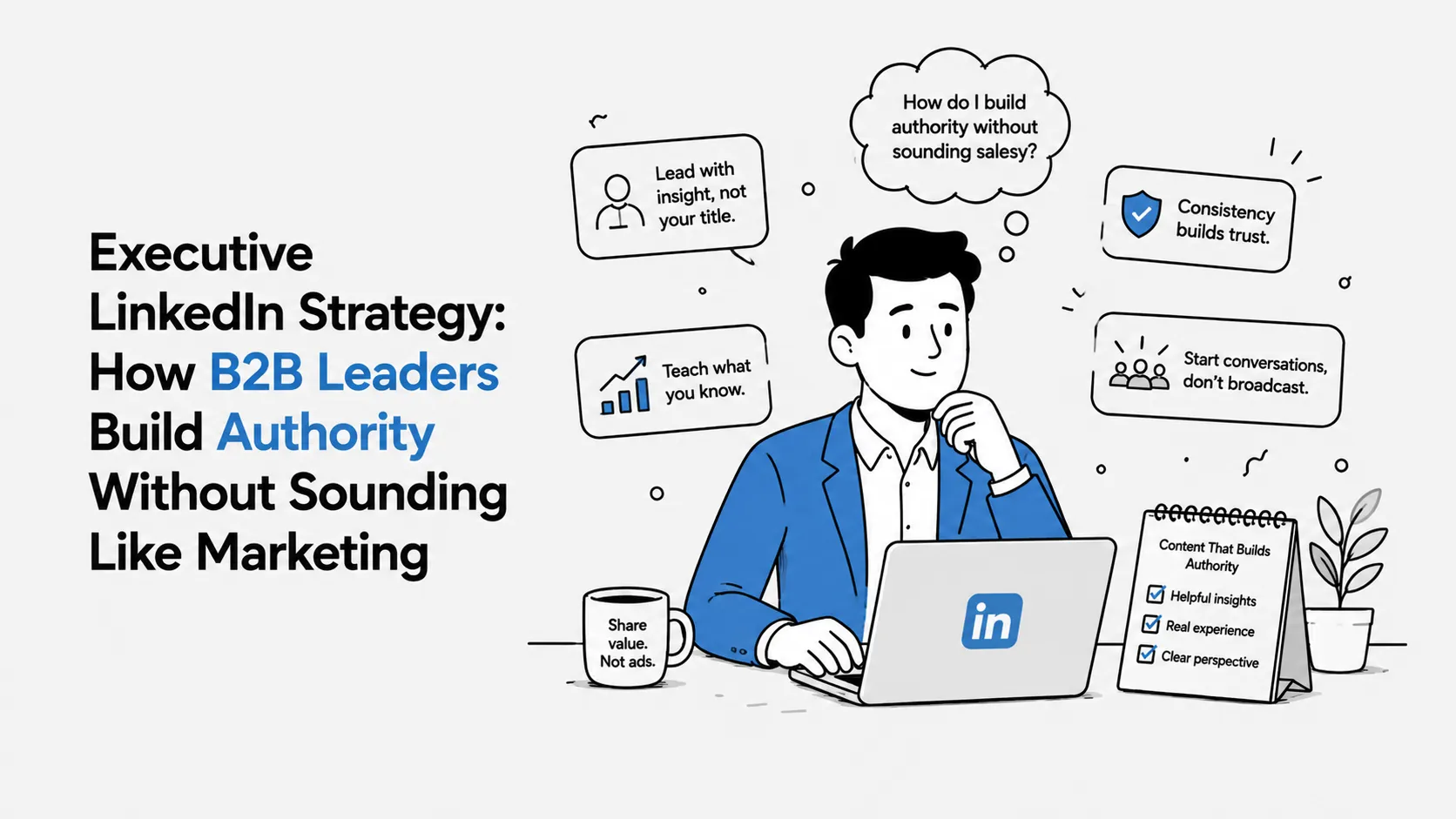
Executive LinkedIn strategy helps B2B leaders turn expertise, market judgment, and company narrative into authority without sounding like a brand campaign.
Most executives do not need more content ideas.
They need a sharper reason to show up.
That is the difference between posting on LinkedIn and having an executive LinkedIn strategy. One creates activity. The other turns executive judgment into market visibility, buyer trust, recruiting signal, investor confidence, and pipeline context.
The problem is that most executive LinkedIn programs are built backwards. A marketing team asks for posts. A ghostwriter asks for stories. The executive approves a few polished updates. Everyone calls it thought leadership because the posts came from a senior person.
But the market can tell when the executive is only lending a name to content.
A real executive LinkedIn strategy starts with what the leader sees that the market does not yet understand. It turns that point of view into a repeatable system: what to say, who needs to hear it, how the team captures the raw material, how approvals work, how posts get distributed, and how engagement becomes signal.
For B2B founders, CEOs, CROs, CMOs, and operators, LinkedIn is not a vanity channel. It is one of the few public places where buyers, investors, candidates, partners, and category peers can watch how a leader thinks before they ever enter a sales process.
Executive LinkedIn strategy is the system that turns a leader's expertise into consistent, credible visibility on LinkedIn.
It includes the executive's positioning, content pillars, publishing cadence, engagement rhythm, team workflow, approval rules, and measurement model. The goal is not to make the executive look busy online. The goal is to make the right market more familiar with the executive's judgment.
That distinction matters.
A random post about leadership might get engagement. A polished company announcement might satisfy the board. A motivational update might feel safe. None of that automatically builds authority with the people who influence revenue, fundraising, hiring, or category trust.
Executive LinkedIn strategy asks better questions.
What should the market believe after reading this executive for six months? Which buyers should feel like the company understands their problem better than anyone else? Which investors should see category conviction before the next raise? Which candidates should understand how the leadership team thinks before they apply? Which sales conversations should become easier because the executive has already made the company's point of view visible?
Those answers shape the content. The posts are the output, not the strategy.
B2B buyers do not only evaluate products. They evaluate people, judgment, category clarity, and risk.
That is especially true when the company is selling a complex product, creating a new category, raising capital, hiring senior talent, or competing against larger incumbents. The executive team becomes part of the product experience before the first call. Buyers want to know whether the company sees the market clearly. Investors want to know whether the founder can narrate the opportunity. Candidates want to know whether leadership has conviction or just a careers page.
LinkedIn gives executives a surface where that judgment can compound.
PR creates spikes. Paid ads create controlled reach. Cold outbound creates direct asks. Company pages create official updates. But executive LinkedIn content creates repeated exposure to the person behind the decisions.
That is why it should connect to the broader founder-led marketing system, not sit off to the side as a personal branding exercise. The executive voice should carry the company's market thesis in a way a brand account cannot.
The best executive LinkedIn strategy makes the company easier to trust because the people leading it are easier to understand.
The strongest executive LinkedIn content does not start with a calendar.
It starts with a point of view.
What does the executive believe about the market that is specific, useful, and a little uncomfortable? What default behavior should buyers stop accepting? What pattern is leadership seeing before the market has named it? What tradeoff does the company understand because it works with the problem every day?
Without that point of view, the content becomes generic. The executive posts tips, leadership lessons, hiring updates, event recaps, and product announcements. Some may perform. None of it teaches the market what the executive is uniquely qualified to see.
A useful point of view has four parts.
First, the market shift. Something is changing and the old playbook is losing power.
Second, the buyer tension. The audience is stuck between two pressures and needs a clearer path.
Third, the executive's earned belief. The leader has seen enough evidence to say something specific.
Fourth, the proof. Customer patterns, operating lessons, product data, sales conversations, investor questions, or implementation stories make the belief credible.
This is what separates executive thought leadership from executive content. Thought leadership gives the market a sharper lens. Content just fills the feed.
Not every executive should sound the same on LinkedIn.
The founder or CEO usually carries the category narrative. They explain why the company exists, what the market is getting wrong, what customers need to understand, and where the company is going.
The CRO should make the buyer problem visible. They can talk about buying committees, pipeline quality, revenue friction, customer objections, and why the old sales motion is breaking.
The CMO should sharpen market education. They can explain demand creation, positioning, content, events, category language, and the difference between attention and trust.
The CTO or product leader should translate technical judgment into business confidence. They can explain tradeoffs, roadmap decisions, architecture choices, security posture, and where the category is heading.
The people leader can show how the company builds teams, makes decisions, and protects execution under pressure.
Executive LinkedIn strategy works best when each leader has a distinct lane. Otherwise the company ends up with five executives posting the same softened brand messages from different profiles.
A strong program gives each executive a clear role in the market conversation. The voices connect, but they do not collapse into one corporate voice.
Content pillars are only useful if they map to business outcomes.
Too many executive programs use broad pillars like leadership, culture, innovation, customer success, and growth. Those are categories, not strategy. They are too wide to create a recognizable point of view.
A better set of pillars ties executive expertise to the business questions the company needs the market to understand.
For pipeline, the pillar might be buyer education. The executive explains why the problem matters now, what mistakes teams make, what tradeoffs buyers need to evaluate, and what strong teams do differently.
For fundraising, the pillar might be category conviction. The founder explains the market shift, the size of the pain, the adoption curve, and why the company has a right to win.
For recruiting, the pillar might be operating philosophy. The executive shows how the company makes decisions, hires, handles ambiguity, and builds under constraints.
For customer expansion, the pillar might be implementation maturity. The leader explains what separates teams that get value from teams that stall.
These pillars are narrow enough to guide content and broad enough to repeat. That is where compounding happens. The market does not remember one post. It remembers the same executive saying the same sharp thing from different angles until the association sticks.
The bottleneck is rarely the executive's knowledge.
The bottleneck is extraction.
Executives are already creating useful raw material every week. They are answering customer objections, reviewing board narratives, making hiring decisions, debating product tradeoffs, giving sales teams sharper language, explaining market shifts to investors, and making calls that reveal how they think.
Most of that signal disappears because nobody captures it.
A good executive LinkedIn strategy creates a capture system. Record a 20-minute founder interview. Pull notes from sales calls. Turn board memo sections into market arguments. Save Slack explanations that contain actual judgment. Capture customer questions. Tag investor objections. Ask the executive for a voice note after a hard meeting.
This is where LinkedIn content repurposing becomes useful. Repurposing is not recycling filler. It is turning high-signal executive thinking into public content the market can learn from.
The best posts often come from moments the executive did not think were content. That is why the system matters. If the team waits for the executive to sit down and write from scratch, the best ideas stay trapped in meetings.
Executive content fails when the voice gets polished until it could belong to anyone.
This usually happens for understandable reasons. The team wants the post to sound professional. Legal wants risk removed. Brand wants consistency. The writer wants clarity. The executive wants to avoid saying something that creates confusion.
But when every sharp edge is removed, the post loses the reason it should come from an executive at all.
Protecting voice does not mean publishing rough thoughts without review. It means preserving the executive's actual judgment, sentence rhythm, directness, and willingness to name tradeoffs. The post should sound like something the executive could defend on a customer call.
That is also how to avoid generic AI slop. AI can help organize notes, draft options, and speed up production. It cannot replace the founder's point of view. If the raw material is thin, the output will be thin. If the executive insight is sharp, the system can help it ship faster without sanding it down.
This is the same standard that separates a useful founder ghostwriting service from a content vendor. The job is not to make the executive sound more like marketing. The job is to make the executive's thinking easier for the market to access.
A strategy that depends on unlimited executive time will fail.
The workflow has to respect the reality of the role. Executives are not full-time creators. They are running teams, selling, hiring, fundraising, handling customers, and making decisions under pressure.
The content system should remove operational drag.
One useful rhythm is simple. On Monday, the team reviews business priorities and decides which pillar matters most. On Tuesday, they capture raw material from the executive through a short interview, call notes, or existing internal writing. On Wednesday, the first draft is created. On Thursday, the executive reviews on mobile and leaves direct comments. On Friday, the post is scheduled and the team prepares engagement prompts.
The exact days do not matter. The operating principle does.
Capture should be fast. Drafting should be supported. Approval should be lightweight. Scheduling should not require the executive to log into another process. Engagement alerts should tell the executive where their judgment is needed, not flood them with every notification.
This connects directly to a strong LinkedIn content calendar. The calendar is not just a schedule. It is the control center for ideas, approvals, timing, distribution, and follow-up.
Executive LinkedIn content often touches sensitive areas.
It may mention customers, revenue lessons, fundraising themes, category claims, product direction, hiring philosophy, or competitive beliefs. Review matters. The mistake is letting review become a place where distinctive ideas go to disappear.
Approval should protect accuracy, confidentiality, and strategic alignment. It should not force every post into the safest possible sentence.
Set rules before the content enters review.
Which claims need proof? Which customer details are off limits? Which product topics require approval? Which financial or fundraising references should be avoided? Which opinions are encouraged because they reinforce the company's position?
Those guardrails make review faster because the team is not renegotiating risk on every post.
The best workflow also separates strategic review from line edits. If leadership agrees with the point, do not let five people rewrite the executive's voice. If the point is wrong, fix the strategy before polishing the paragraph.
Approval should make executive content safe enough to ship and sharp enough to matter.
Publishing is not distribution.
A post can be well written and still miss the right market. Executive LinkedIn strategy has to answer who should see the content and how it will reach them.
Start with the priority audience. Target buyers. Investors. Customer champions. Analysts. Category peers. Strategic partners. Senior candidates. Current customers. The audience changes depending on the business goal for the quarter.
Then plan distribution around that audience.
The executive can comment on relevant posts before publishing. The team can identify customers or partners who may naturally add context. Sales can watch for target-account engagement. Other executives can contribute substantive comments from their own lane. The company page can amplify the post when it serves the broader brand.
Distribution should not become fake engagement. Do not ask employees to paste identical comments. Do not create applause threads. Do not send every post to everyone internally.
Use the same principle behind LinkedIn distribution strategy: get the right idea in front of the right people enough times for trust to build.
The goal is not reach for its own sake. It is relevant repetition.
Executive authority is built in the comments as much as in the post.
A polished post can introduce the point of view. A thoughtful reply proves the executive can think beyond the draft. That is where buyers, investors, candidates, and peers see how the leader handles nuance.
Most executives underuse this surface. They publish and disappear. Or the team replies with generic thanks. Or every interaction is treated like a sales lead too early.
A better system gives the executive a short engagement queue.
Which comments deserve a real reply? Which objections should the executive answer personally? Which reactions came from target accounts? Which DMs should become conversations? Which questions should be saved as future content?
The executive does not need to live on LinkedIn. They need to spend their attention where judgment matters.
This is why LinkedIn engagement strategy belongs inside the content program, not after it. The post opens the door. Engagement turns attention into relationship and market signal.
Executives should not measure LinkedIn like creators.
Follower growth, impressions, reactions, and engagement rate are useful diagnostics. They are not the full scorecard.
A B2B executive needs to know whether the right market is moving closer.
Track audience quality. Are target buyers, investors, partners, candidates, customers, or credible category voices engaging?
Track conversation quality. Are comments becoming more specific? Are people asking better questions? Are DMs referencing posts with real context?
Track business influence. Are sales calls mentioning executive content? Are prospects warmer before outreach? Are investors already familiar with the company's thesis? Are candidates referencing leadership posts in interviews? Are customers sharing posts internally?
Track content intelligence. Which topics create objections, questions, or language the team can use in future posts, sales assets, landing pages, or fundraising narratives?
This is the same logic behind LinkedIn analytics for founders. The useful metric is the one that tells the company whether visibility is becoming trust.
The first mistake is treating the executive profile like a second company page. If the post reads like a press release, it wastes the executive surface.
The second mistake is outsourcing the point of view. A team can capture, draft, edit, schedule, and analyze. It cannot invent the leader's earned judgment from nothing.
The third mistake is writing for peers instead of the business audience. Peer applause feels good, but it may not move buyers, investors, customers, or candidates.
The fourth mistake is being too broad. Leadership, culture, growth, and innovation are not enough. The market needs a specific belief it can associate with the executive.
The fifth mistake is over-approving. Review should protect the company, not flatten the executive.
The sixth mistake is ignoring engagement. If the executive disappears after posting, the content feels broadcast-only.
The seventh mistake is measuring only reach. Reach is the opening. Authority is built when the right people repeatedly see judgment they trust.
Executive LinkedIn strategy becomes easier when the team runs a simple weekly system.
Start with one business priority. Pipeline, fundraising, recruiting, customer trust, category education, or partner visibility. Do not ask one post to serve every goal.
Choose one content pillar connected to that priority. If the quarter is about pipeline, prioritize buyer education. If the quarter is about fundraising, prioritize category conviction. If the company is hiring senior roles, prioritize operating philosophy.
Capture one piece of raw material. A founder interview, customer objection, sales-call pattern, board memo section, product decision, or investor question is enough.
Draft one sharp post from that raw material. Keep the idea specific. Name the tradeoff. Show the executive's judgment.
Review for accuracy and risk, then preserve the voice. Do not let approval turn the post into a committee memo.
Schedule the post and prepare engagement. Decide who should watch, who should add context, and which comments the executive should answer personally.
Capture the signal after publishing. Save questions, objections, target-account engagement, sales references, and future content ideas.
Repeat this every week and the executive stops guessing. The system turns leadership thinking into a channel the business can actually use.
Rethoric's view is simple: executive LinkedIn only works when the leader's real judgment stays in the system.
The job is not to automate the executive out of the content. It is to remove the operational drag around the executive so their limited attention goes to the places where it matters most.
That means strategy before posts. Capture before drafting. Approval without voice loss. Scheduling without friction. Engagement alerts that surface important conversations. Tagging that turns comments and DMs into future content inputs. Analytics that connect visibility to business signal.
For founders and B2B executives, this is the difference between having a writer and having an in-house content team on autopilot. The executive still owns the thinking. The system makes sure the thinking ships consistently and reaches the right market.
That is where authority compounds.
Executive LinkedIn strategy is not about turning leaders into creators.
It is about making executive judgment visible to the market before the market has to make a decision.
When the strategy is weak, executives post generic updates, approve safe copy, and hope consistency turns into authority. When the strategy is strong, every post reinforces a market point of view, every workflow protects the leader's voice, every engagement creates signal, and every month makes the executive easier to trust.
The best B2B leaders do not use LinkedIn to perform expertise. They use it to make their actual expertise easier for buyers, investors, candidates, customers, and partners to see.
If you want founder-led LinkedIn content with strategy, capture, approvals, scheduling, alerts, engagement, tagging, mobile review, and analytics, see how Rethoric works with founders.
