A LinkedIn engagement strategy helps founders turn posts, comments, and DMs into buyer familiarity without spamming the market or chasing vanity activity.
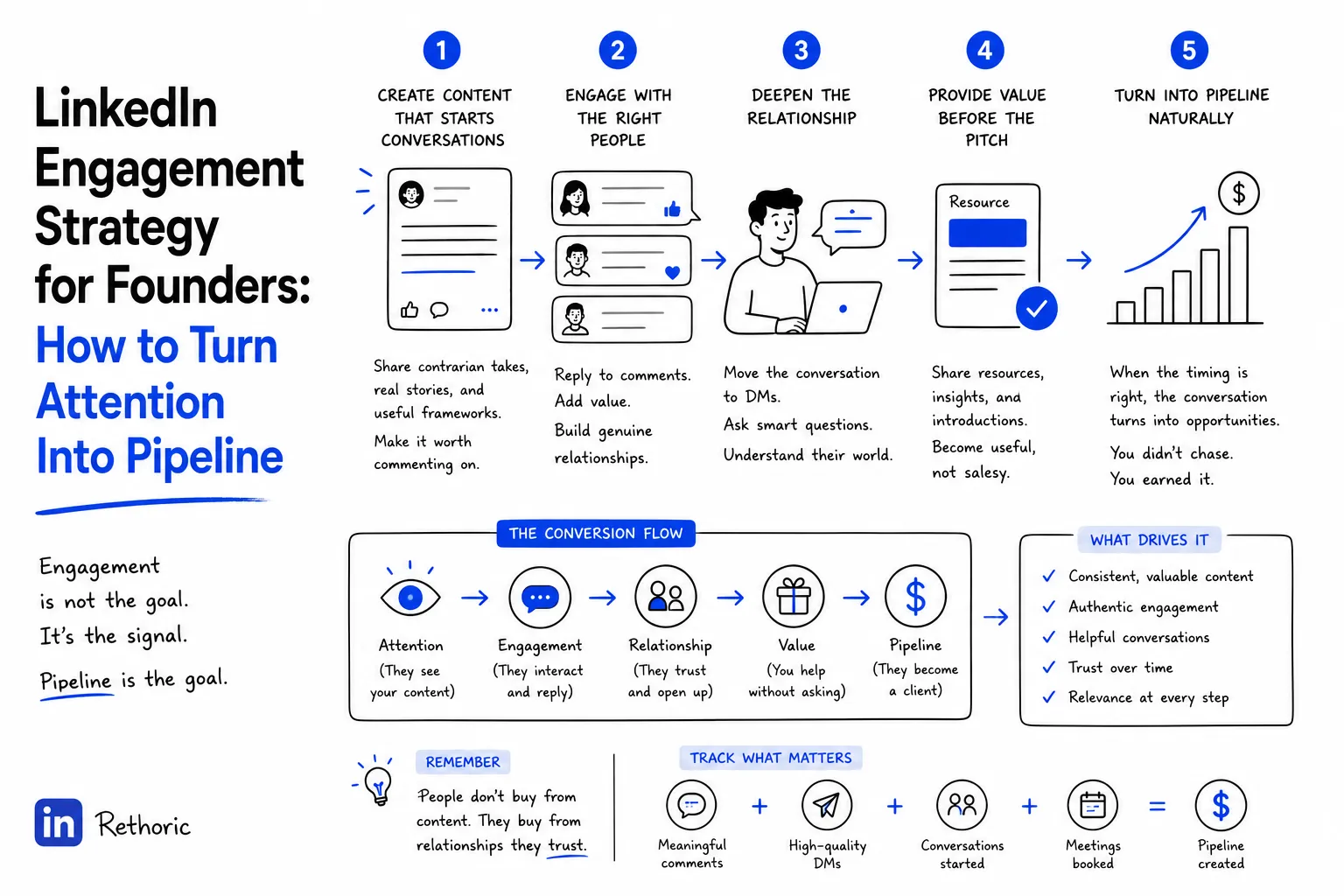
Most founders treat LinkedIn engagement like cleanup.
They publish the post. They check the likes. They reply to a few comments if they have time. Maybe they send a DM when someone obvious shows interest. Then they move on and hope the next post does better.
That is not a LinkedIn engagement strategy. That is reacting to the feed.
For B2B founders, engagement is where attention becomes useful. A post can create visibility, but comments, replies, profile visits, DMs, and target-account interactions are where the market starts to feel familiar with the founder. That familiarity is what makes a sales reply warmer, an investor meeting easier, a candidate conversation stronger, or an inbound lead more qualified.
The problem is that most engagement advice is either too shallow or too spammy. It says to comment more, reply faster, and start conversations, but it does not explain who deserves attention, what to say, when to move to DM, or how to avoid sounding like a growth-hacking account.
This guide breaks down a practical LinkedIn engagement strategy for founders: how to choose the right people to engage, how to use comments without becoming performative, how to turn replies into market signal, when DMs make sense, and how to measure whether engagement is creating pipeline instead of just activity.
A LinkedIn engagement strategy is the system a founder uses to interact with the right people before, during, and after publishing content.
It includes the founder's own comments, replies on their posts, comments on other people's posts, profile visits, connection requests, DMs, team amplification, and follow-up from sales or customer conversations.
The word strategy matters.
Engagement is not just being active. It is deciding whose attention matters, what conversations are worth entering, which ideas deserve follow-up, and how the founder should show up without turning every interaction into a pitch.
For founders, the goal is not to maximize every surface-level metric. The goal is to build repeated familiarity with the people who can buy, invest, refer, hire, partner, or influence the market's opinion of the company.
That means engagement has to connect to the business. A founder with 50 thoughtful interactions from target buyers is usually building more leverage than a founder with 500 shallow reactions from peers who will never become part of the market.
LinkedIn engagement works when it is focused. It becomes noise when it is treated like another vanity scoreboard.
Founders often obsess over reach because reach is visible.
A big post feels good. The number is easy to screenshot. The team can see momentum. The founder can tell whether the post traveled.
But reach alone does not create trust. It creates the opportunity for trust.
Engagement is where the founder proves the post was not just content. When a founder replies with substance, asks a sharper question, adds context in a comment, or follows up with a useful note, the market sees judgment in motion. That is different from reading a polished post.
This matters because B2B buyers rarely move from one post to one purchase. They move through repeated contact. They see the founder explain a problem. They notice the founder in a comment thread. They read a reply that sounds like real expertise. They visit the profile. They see the same point of view again. Later, when the problem becomes urgent, the founder is already familiar.
That is why LinkedIn distribution strategy and engagement have to work together. Distribution gets the idea in front of the right people. Engagement makes the right people feel seen, challenged, and closer to the founder's thinking.
Attention opens the door. Engagement is what keeps the conversation from dying in the hallway.
Engagement and social selling overlap, but they are not the same thing.
Social selling is about using LinkedIn to create and advance sales conversations. It includes relationship building, trust creation, relevant outreach, and moving from public signal to private conversation. A strong social selling system on LinkedIn needs engagement, but engagement is broader.
Engagement also supports category creation, fundraising visibility, recruiting, partnerships, customer learning, and founder authority. A comment from an investor may not be a sales opportunity. A reply from a senior candidate may not belong in the CRM. A disagreement from an operator may not be pipeline, but it may expose a market objection worth turning into content.
The mistake is treating every interaction like a lead.
When founders do that, they become transactional. Every comment becomes a setup. Every DM becomes a pitch. Every connection request feels like the start of a sequence. The market can feel it immediately.
A better approach is to treat engagement as relationship and signal before sales. Some interactions should become pipeline. Some should become content ideas. Some should become research. Some should simply deepen familiarity.
The founder's job is to know the difference.
A LinkedIn engagement strategy starts with people, not posts.
Before deciding what to comment on or who to DM, the founder needs to define the priority audience. That audience might include target buyers, economic decision makers, users, investors, journalists, analysts, advisors, category peers, candidates, customer champions, and current customers.
Not all of those groups deserve the same attention every week.
If pipeline is the priority, target buyers and customer champions should sit at the center. If fundraising visibility is the priority, investors and category voices matter more. If hiring is the priority, candidates and respected operators may be the right audience. If category creation is the priority, analysts, partners, and influential practitioners may deserve more attention.
Most founders fail here because they engage with whoever appears in the feed. The feed is not a strategy. It is an algorithmic mix of what LinkedIn thinks might keep you scrolling.
Build a short priority list instead. Save target accounts. Follow buyer voices. Track investors who care about the category. Identify customers and champions who already interact. Watch the operators whose comments reveal real pain. Keep the list small enough that the founder can actually use it.
Engagement gets sharper when the founder knows whose attention is worth earning before the post goes live.
Founders should manage three engagement surfaces: owned posts, other people's posts, and private conversations.
Owned posts are the founder's home base. This is where the founder replies to comments, expands the point, answers objections, thanks useful contributors, and turns passive readers into visible participants. The comment section is not a formality. It is part of the content.
Other people's posts are where the founder enters existing conversations. This is often the most underused surface. A thoughtful comment on a buyer's post can create more trust than another post to the founder's own audience. It shows the founder is paying attention to the market, not just broadcasting at it.
Private conversations are where public signal can become relationship. DMs, connection notes, and follow-up messages should come after context, not before it. The founder should have a reason to reach out that is tied to something specific the person said, asked, reacted to, or seems to care about.
The sequence matters. If the founder jumps straight to private pitch, the interaction feels cold. If the founder only stays public forever, useful conversations may never move forward. The best engagement strategy knows when to stay in the thread and when to take a real conversation private.
Commenting more is not the goal. Commenting with intent is the goal.
A useful LinkedIn commenting strategy has three rules.
First, comment where the audience matters. A brilliant comment in the wrong room is still the wrong room. Founders should prioritize posts from buyers, customers, investors, partners, credible category voices, and people whose audience overlaps with the market they want to reach.
Second, add something the original post did not already say. Agreement is fine, but agreement alone is weak. A stronger comment adds a customer pattern, a hard-won caveat, a sharper example, a disagreement with respect, or a question that moves the conversation forward.
Third, sound like a person with judgment, not a brand account trying to be visible. The founder should not comment with slogans, generic praise, or thin summaries. The comment should feel like the founder could have said it in a customer call.
Good comments do not need to be long. They need to be specific.
A founder who leaves five sharp comments a day in the right conversations can become more visible to the right market than a founder who publishes three posts a week and ignores everyone else.
Replies are underrated.
Most founders answer comments too quickly. They say thanks, agree, or drop a short response that ends the thread. That is polite, but it wastes a chance to deepen the idea.
A better reply does one of four things.
It expands the argument. If someone agrees, the founder can add the next layer: the exception, the tradeoff, the mistake, or the example that did not fit in the post.
It clarifies the claim. If someone misunderstands, the founder can sharpen the point without becoming defensive.
It surfaces the market pattern. If several people raise the same objection, the founder can name it and turn it into future content.
It invites a real conversation. If someone relevant signals active pain, the founder can ask a specific question or move to DM with context.
This is why replies should not be delegated blindly. A team can help triage, draft, and flag important comments, but the founder's judgment matters. Replies are where the market tests whether the founder actually believes and understands the post.
The post creates the room. Replies decide whether the room gets interesting.
DMs should feel earned.
The worst version of LinkedIn engagement is the founder who comments once, connects, and immediately pitches. That is not engagement. It is cold outbound wearing a social costume.
A useful DM usually follows a clear public signal. Someone asked a detailed question. They shared a relevant problem. They mentioned an initiative. They engaged with several posts on the same theme. They are connected to a target account where the topic is clearly active.
The message should reference that context directly. Not a fake personalization line. Real context.
For example: I saw your comment about the sales team struggling to explain this internally. That is exactly where we see founder-led content help, because it gives sales a clearer point of view before the first call. Happy to send the framework if useful.
That kind of message gives the other person an easy out. It offers relevance before asking for time. It does not pretend every signal is a buying signal.
The best DMs are often not pitches. They are useful follow-ups: a relevant post, a short framework, a customer pattern, an introduction, or a question that helps the founder understand the market better.
If the person wants to talk, the sales motion can begin. If not, the founder still behaved like someone worth knowing.
Founders should not only engage after a post goes live.
Engagement before publishing helps shape better content. Look at what target buyers are already discussing. Read comments under industry posts. Notice objections, repeated complaints, language patterns, and questions that keep coming up. Those are content inputs.
If the founder is about to publish a post on a category problem, they should spend time in the market first. What words are buyers using? What are they tired of hearing? What do they disagree about? What proof do they believe?
Engagement after publishing helps distribute and deepen the idea. Reply to early comments. Send the post to people who contributed to the thinking if it is relevant. Ask the team to add real context, not canned amplification. Watch for high-signal reactions from target accounts.
The best rhythm is simple: listen before you publish, then participate after you publish.
This keeps founder-led content from becoming isolated opinions. The market shapes the post, and the post creates more market signal.
Engagement is not just distribution. It is research.
Every useful comment, objection, DM, and reply can become raw material for future content. Founders should track the patterns that appear repeatedly: buyer confusion, language the market uses, objections sales hears later, investor questions, customer wins, product misconceptions, and competitor narratives.
This does not require a complex system. It requires a place to store signal.
Tag comments by topic. Save strong questions. Screenshot language from buyers. Add notes from DMs to the content backlog. Connect engagement themes to the content calendar. If a post creates three strong objections, the next post might answer one of them. If a comment thread reveals a new buyer phrase, that phrase may belong in the next article, sales deck, or landing page.
This is how engagement feeds founder-led marketing. The founder is not guessing what the market cares about. The market is telling them in public.
Most teams waste that signal because they treat engagement as a notification stream. Treat it as market intelligence instead.
A founder-led engagement strategy should not mean the founder does everything alone.
The team can help in useful ways. Sales can flag target-account engagement. Customer success can identify customer comments worth answering. Marketing can track themes and draft reply options. Executives can add comments from their own expertise. Operators can bring examples that make the founder's point more concrete.
But team engagement can get awkward fast if it becomes scripted.
Do not ask every employee to comment the same thing. Do not turn the founder's post into a corporate cheerleading thread. Do not use the team to manufacture fake momentum. People can see the difference between genuine participation and coordinated filler.
The better workflow is to give the team prompts, not scripts. Who should engage? What angle can they add? What should they avoid mentioning? Which customer or product details are off limits? Where would their expertise make the thread more useful?
This connects to LinkedIn employee advocacy. Team distribution works when employees add real context around a founder-led point of view. It fails when the company asks everyone to act like a comment bot.
Engagement rate is useful, but it is not enough.
A high engagement rate from the wrong audience can make a founder feel visible while creating no business value. A lower engagement rate from the right buyers can be much more important.
Track who is engaging, not only how many people engage. Are comments coming from target buyers, investors, candidates, customers, partners, or relevant operators? Are the same accounts appearing repeatedly? Are people asking deeper questions over time? Are DMs becoming more specific? Are sales calls referencing LinkedIn posts or comment threads?
Also track what kind of engagement happens. Likes are weak signal. Saves, thoughtful comments, profile visits, connection requests, DMs, customer mentions, sales-call references, and target-account interactions are stronger.
This is the same principle behind LinkedIn analytics for founders. The metric should answer a business question. Is the right market moving closer to the founder's point of view?
If the answer is yes, the engagement strategy is working even before clean attribution appears.
Founders do not need to live on LinkedIn to make engagement work.
Use a simple weekly workflow.
On Monday, review the priority audience list. Which target accounts, investors, customer champions, or category voices deserve attention this week?
On Tuesday and Wednesday, spend short blocks commenting on the right posts. Focus on conversations where the founder can add real context.
On publishing days, engage for 20 to 30 minutes after the post goes live. Reply to early comments with substance. Flag high-signal replies. Note any objections or language worth saving.
On Thursday, review DMs and connection requests. Move only the relevant conversations forward. Do not force weak signals into sales motions.
On Friday, capture the week's engagement patterns. Which comments created real conversations? Which people showed repeated interest? Which topic should become a future post? Which account should sales know about?
This is enough to turn engagement from random behavior into an operating rhythm. The founder stays close to the market without becoming a full-time community manager.
The first mistake is engaging with everyone equally. Attention is scarce. The founder should spend it where the business context is strongest.
The second mistake is using comments as mini ads. A comment should add to the conversation, not hijack it.
The third mistake is replying with generic praise. If the founder has nothing specific to add, it is usually better not to comment.
The fourth mistake is pitching too early. Public engagement creates context. It does not automatically create permission to sell.
The fifth mistake is ignoring disagreement. Respectful disagreement can create some of the best engagement because it shows the founder can defend the point of view without turning corporate.
The sixth mistake is failing to capture signal. If a comment thread reveals a common objection and nobody saves it, the team just wasted free research.
The seventh mistake is outsourcing the whole surface. A team can support engagement, but the founder's actual judgment has to show up somewhere. Otherwise the market is engaging with a process, not a person.
Rethoric's view is that engagement is part of the founder-led content engine, not a separate chore.
The content creates the point of view. Distribution gets it in front of the right people. Engagement turns attention into relationship, market signal, and pipeline context.
That requires a system. Founders need a way to capture ideas, publish consistently, approve content quickly, schedule posts, receive alerts, tag themes, review on mobile, support team participation, and measure which interactions create business signal.
Without that system, engagement becomes another thing the founder is supposed to remember. With the system, engagement becomes the feedback loop that makes the whole channel smarter.
The goal is not to automate the founder out of the conversation. The goal is to remove the operational drag so the founder can spend limited attention where judgment matters most.
A LinkedIn engagement strategy is how founders turn visibility into trust.
Posting gets ideas into the market. Engagement proves the founder is actually present in the market. It lets buyers, investors, candidates, and partners see how the founder thinks when the conversation becomes more specific.
The best founders do not chase every like or force every comment into a pitch. They decide whose attention matters, engage where their judgment adds value, reply with substance, move to DMs only when context exists, and capture the signal that should shape future content and sales conversations.
If you want founder-led LinkedIn content with strategy, capture, approvals, scheduling, alerts, engagement, tagging, mobile review, and analytics, see how Rethoric works with founders.
