A practical B2B social media strategy for founders: use LinkedIn as the anchor channel, turn executive expertise into trust, and build pipeline.
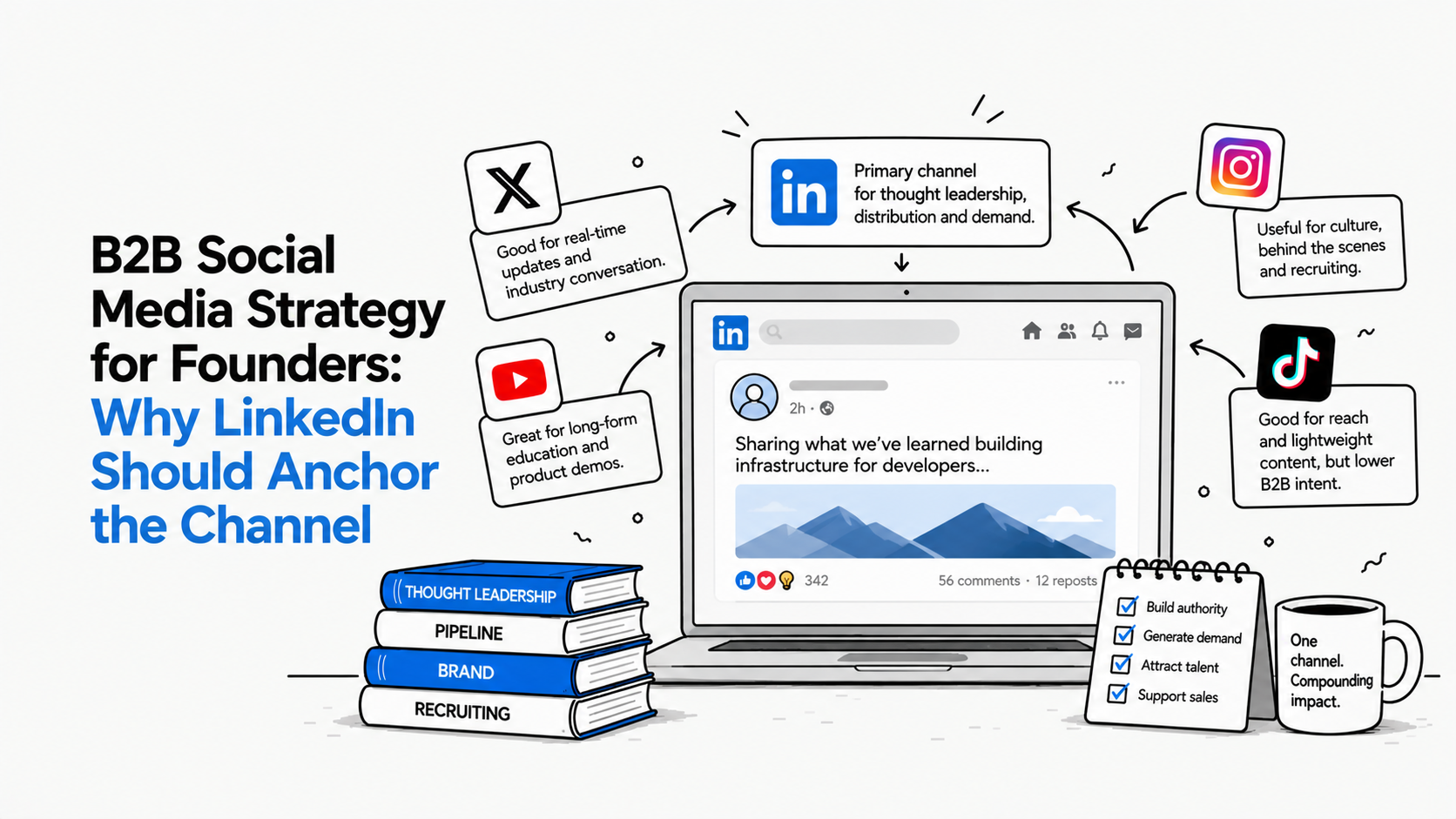
Most B2B social media strategies are built for companies that have time to waste.
They start with channel lists. LinkedIn. X. YouTube. Instagram. Maybe TikTok if someone on the team wants to feel current. Then they fill a calendar with product updates, culture posts, recycled blog snippets, event photos, and the occasional executive quote that sounds like it was sanded down by committee.
That is not a strategy.
It is activity spread across too many surfaces.
For Series A+ B2B founders, the question is sharper: which social system can build buyer trust, founder authority, recruiting credibility, investor visibility, and pipeline without turning the company into a content factory?
For most B2B startups, the answer starts with LinkedIn.
Not because LinkedIn is magic. Not because every founder needs to become a creator. Because LinkedIn is where professional identity, category conversation, buyer research, executive credibility, and warm distribution already overlap.
A strong B2B social media strategy does not ask founders to post everywhere. It uses LinkedIn as the anchor channel, then builds a repeatable system around founder expertise, team distribution, buyer signal, and business outcomes.
A B2B social media strategy is a system for using professional networks to build trust with the people who influence revenue: buyers, investors, candidates, partners, analysts, operators, and category peers.
For founder-led companies, that system should answer five questions:
The mistake is treating social as a place to post updates. B2B social is a place to build memory.
The right market should repeatedly see how the founder thinks, what the company believes, which problems it understands, and why its point of view deserves attention before the sales call, funding conversation, or hiring process starts.
That is why Rethoric’s guide to founder-led marketing starts with founder expertise instead of generic content production. In B2B, trust rarely comes from the brand talking about itself. It comes from a credible person making the market smarter.
LinkedIn gives B2B founders a rare combination: professional context, public distribution, personal credibility, and direct access to the people who can change the business.
On most social platforms, the founder has to fight the native behavior of the feed. Professional insight competes with entertainment, creator drama, lifestyle content, and consumer trends. That can work for some companies, but it usually requires a media motion most B2B startups are not built to sustain.
LinkedIn is different because the audience is already in a professional frame. Buyers are comfortable evaluating expertise. Operators share workflow pain. Investors watch category narratives. Candidates assess leadership. Executives look for peers who understand the same problems.
That makes LinkedIn the best anchor channel for most founder-led B2B social media strategies.
An anchor channel does three things:
Other channels can still matter. A founder’s post can become a newsletter section, a sales note, a short video, a webinar point, or a blog article. But the system needs one place where the company’s point of view compounds.
For B2B founders, that place is usually LinkedIn.
Most startup social strategies overestimate brand accounts and underestimate founder profiles.
A company page is useful. It gives the business a home base, supports recruiting, provides paid media infrastructure, and keeps announcements organized. But it rarely carries the same trust as a founder or executive profile.
People follow people because people have judgment.
A founder can say what the company believes before the market agrees. A founder can explain tradeoffs. A founder can challenge a category myth. A founder can connect product choices to buyer pain. A founder can make the company feel more legible to the market.
That is the real advantage.
The founder does not need to become loud. The founder needs to become clear.
Rethoric’s guide to LinkedIn company pages vs. founder profiles breaks down the practical split. The short version: use the company page for proof, recruiting, product updates, and paid amplification. Use the founder profile for trust, category narrative, market judgment, and relationship creation.
A B2B social media strategy that hides the founder behind the brand account is usually leaving the strongest distribution asset unused.
Before choosing post formats, define the market belief.
After six months of seeing the founder’s content, what should the right audience believe?
That belief might be:
A weak B2B social media strategy starts with “we need to post three times per week.”
A strong one starts with “we need the market to understand this problem differently.”
That belief becomes the spine of the strategy. It guides what the founder talks about, which stories matter, what customer proof to surface, what objections to address, and which topics should be ignored even if they might get engagement.
Without a clear market belief, social becomes a calendar. With one, social becomes demand creation.
Content pillars should not be generic buckets like leadership, product, culture, and growth.
Those are categories. They are not memory structures.
Better pillars come from buyer tension:
Those tensions create better founder-led content because they force specificity.
A founder selling to sales teams should not just post about “growth.” They should talk about pipeline quality, buyer committees, trust before outreach, sales efficiency, cold outbound fatigue, dark social, and how modern buyers actually form preferences.
A founder selling to finance teams should not just post about “automation.” They should talk about control, auditability, close cycles, manual approval risk, and the difference between speed and confidence.
Rethoric’s guide to LinkedIn content pillars for founders goes deeper on this. The key point for B2B social media strategy is simple: pillars should make the founder’s point of view easier to remember.
Once LinkedIn is the anchor, other channels become supporting surfaces.
This keeps the team from making the classic mistake: trying to maintain every channel as if each one deserves an original strategy.
A practical B2B social media channel map might look like this:
The channel map should reduce workload, not increase it.
One strong founder idea can start on LinkedIn, expand into a blog article, become a sales follow-up, feed a newsletter, and give the team language for comments or outbound context.
That is how B2B teams get leverage. They do not ask every channel to invent from scratch.
The strategy fails if it depends on the founder waking up inspired.
Busy founders need a content operating system that captures expertise from work already happening inside the business.
The raw material is already there:
The system’s job is to catch those moments before they disappear.
A simple weekly workflow works:
Rethoric’s guide to LinkedIn content management for founders explains the operating layer behind this: capture, drafting, approvals, scheduling, distribution, tagging, analytics, and review.
The founder remains the source of judgment. The system carries the production load.
Publishing is not distribution.
A B2B social media strategy should define how important ideas reach the right people after they go live.
That does not mean forcing the team to copy-paste generic comments under every founder post. It means matching each idea to the people who would actually care.
For example:
Distribution should feel like relevance, not internal cheerleading.
Rethoric’s guide to LinkedIn distribution strategy for founders goes deeper on this. The important principle: the best B2B content does more work when the team knows where to route it.
B2B social media metrics are easy to misread.
Likes and impressions can help diagnose reach, but they do not prove business impact. A post can get modest engagement and still warm the exact investor, buyer, or candidate who matters. Another post can get broad applause from people who will never buy, hire, fund, partner, or refer.
Measure signals closer to the business:
Rethoric’s guide to LinkedIn analytics for founders explains how to separate vanity metrics from pipeline indicators.
The goal is not to make every post measurable in a dashboard. The goal is to know whether the right market is becoming more familiar with the founder’s thinking.
The first mistake is channel sprawl. Startups spread thin because every channel feels like an opportunity. In practice, each extra channel adds operating drag. Concentrate before you expand.
The second mistake is brand-first content. Company updates have a place, but they rarely build trust alone. Founder and executive judgment should carry the sharpest ideas.
The third mistake is outsourcing the thinking. Agencies, writers, and AI can help with production, but they cannot invent real founder judgment from nothing. If the content has no point of view, the market will feel it.
The fourth mistake is posting without a sales feedback loop. Sales hears the objections. Product sees the workflow tension. Customer success knows where promises break or hold. If those signals do not feed content, the strategy gets generic fast.
The fifth mistake is confusing consistency with volume. Three sharp posts around a clear market belief beat ten filler posts built to satisfy a calendar.
The sixth mistake is letting AI flatten the voice. AI can help summarize calls, organize ideas, and draft options. It should not replace the founder’s taste, specificity, or conviction.
Rethoric helps B2B founders turn LinkedIn into a repeatable growth channel without turning the founder into a full-time content operator.
That means the strategy is not just “write posts.” It includes founder voice capture, content pillars, calendars, approval workflows, scheduling, alerts, engagement, tagging, mobile review, analytics, and done-for-you agency support.
The point is not to automate the founder out of the process.
The point is to build an operating system around the founder’s expertise so the company can publish consistently without losing the voice, judgment, and specificity that make the content worth reading.
That is what most B2B social media strategies are missing: not another channel, but a sharper system.
A B2B social media strategy should not be a channel checklist.
For founder-led companies, it should be a trust-building system anchored on LinkedIn, powered by founder expertise, supported by team distribution, and measured by business signal.
Start with the market belief. Build pillars around buyer tension. Use LinkedIn as the anchor. Turn founder judgment into a weekly operating system. Distribute intentionally. Measure whether the right people are becoming more familiar with the company’s point of view.
That is how B2B social media starts to compound.
Not because the company posts everywhere.
Because the right people keep seeing the founder think clearly about the problems they already care about.
If your team wants a founder-led LinkedIn system that turns executive expertise into trust, authority, and pipeline, see how Rethoric works with founders.
